



"Home... I want to go home." —Kasumi in Dead or Alive 2
Kasumi (Japanese: 霞[9]) is a nukenin (missing shinobi) and former member of the Mugen Tenshin clan. She debuted in the arcade version of Dead or Alive in 1996 as one of the original eight characters and became the franchise's central figure. Kasumi won the first Dead or Alive Tournament, establishing herself as a formidable fighter despite her young age.
Originally positioned as the clan's second-in-line heir, Kasumi abandoned her position and home to pursue vengeance for her brother Hayate after he was severely injured. Her departure made her a nukenin (missing shinobi), marking her officially as a traitor to her clan. She is the half-sister of Ayane, cousin to Honoka, and carries the complex family dynamics of the Mugen Tenshin's layered bloodlines and secrets.
Contents
History
Childhood

Kasumi as a child
Kasumi is the daughter of Shiden and Ayame, who was born into the Mugen Tenshin's head family, making her second-in-line to the title of clan leader, after her older brother Hayate.
Before entering Dead or Alive tournaments, Kasumi and Ayane - unaware that they were related - were best friends, although the clan saw Ayane as "cursed" and didn't want Kasumi or any other children to be around her. Since childhood, Kasumi has been pampered and spoiled as she lived a privileged life full of expensive clothes, servants and the respect of the rest of the Mugen Tenshin clan. According to their mother, Ayame, Kasumi and Ayane used to have fun catching fish for the family. Her relationship with Hayate was also ideal, with the two playing games and training together happily.
However, once Ayane learned of her true heritage – a product of the assault of Ayame, making her Kasumi's half-sibling – Kasumi's friendship with Ayane ended due to Ayane's bitterness and envy over her mistreatment by the clan, centering her animosity on the "princess" Kasumi.
Running away and the First Tournament
When Kasumi was seventeen, her uncle, the rogue ninja Raidou, returned to the village to obtain the Torn Sky Blast technique; a ninpo spell used by the clan's leaders. Defeating even the prodigious Ayane, Raidou eventually managed to mimic the technique from Hayate, and rendered the boy both comatose and paraplegic before escaping. As Kasumi was not present during the attack and nobody told her what had happened, she was left clueless as to what happened until much later. [10]
Due to Hayate's dire state and the unlikelihood of his recovery, Shiden chose Kasumi to become the clan’s eighteenth master. Her worry over her brother seemed to affect her training, but she managed to learn the Torn Sky Blast at least. Wanting to know the truth, Kasumi turned to Ayane, and believing that Kasumi would never become a great leader anyway, she told her that Raidou was the one who harmed Hayate.
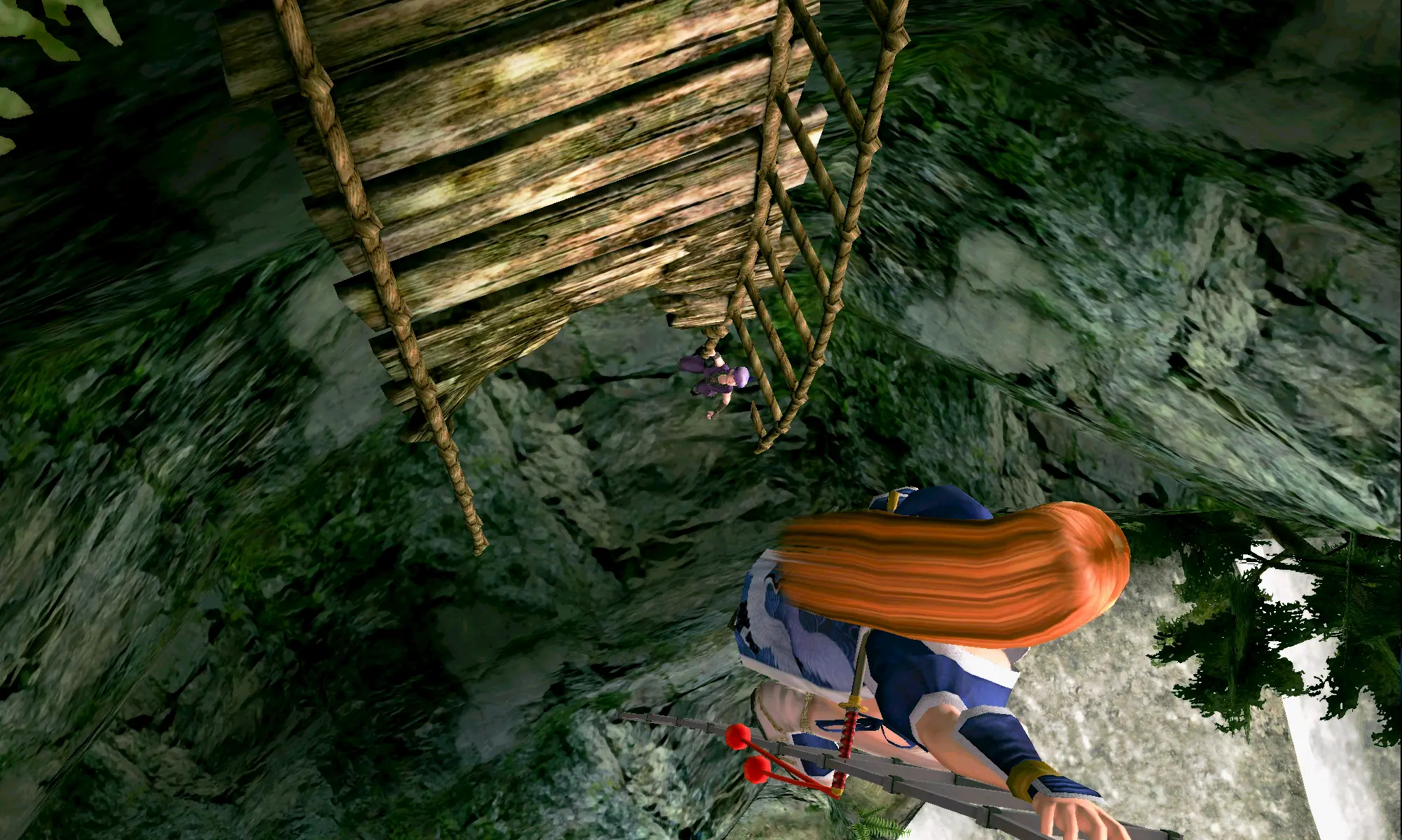
Kasumi only managed to escape from the village alive thanks to Christie and good timing.
With the truth finally out, Kasumi decided to take possibly suicidal action and left the village without permission in order to find Raidou and take revenge on him for Hayate, although this meant she would become a nukenin and marked for death. The clan quickly found out about Kasumi's leave, and Ayane was ordered by Genra to find and kill her. Ayane tried to stop her on the bridge just out of the village, but Kasumi was saved when Christie appeared on a helicopter and separated the two shinobi with gunfire. Although Kasumi didn't know Christie, she jumped on the helicopter and they flew away from Ayane. [11]
Now in the company of Christie and Bayman, Kasumi learned that Raidou was taking part in the Dead or Alive World Combat Championship, which was being sponsored by the Dead or Alive Tournament Executive Committee, the company they work for. They took her to the cruise liner Freedom Survivor, where the tournament would officially begin and Kasumi signed herself up. [12]
While the start of the tournament is being officially announced, Kasumi finds Ayane in the crowd. Ayane tells her that she is there to avenge Hayate too, as well as kill her, under the orders of her foster father Genra. The girls quickly discover that Raidou is working with the head of DOATEC [13] , Fame Douglas, but when Ayane tries to get him, even though Kasumi tries to stop her, the girl is beaten back. Fame then tells Kasumi that if she wants to face Raidou in battle, she has to come out as winner in the tournament. [14]
Kasumi fights her way through the tournament, and does come out as the winner of the tournament, meaning that she will have to face Raidou in the Danger Zone. She manages to defeat Raidou, and was happy because she thinks she had avenged Hayate [15] , but Raidou awakens stronger than before, with inhuman strength caused by DOATEC experiments. [16] Their battle ends in a Torn Sky Blast duel, and with the help of Ryu Hayabusa from the sidelines, Kasumi overpowers Raidou in the end and he is finally killed. [17]
Her victory, however, leads directly to her violation. She is abducted by DOATEC and taken to their labs in Germany. There, her body is treated as a resource; her DNA is forcibly extracted for experiments designed to create the "ultimate fighter," reducing her from a tournament champion to a non-consenting subject in their perverse quest for power. [18]
Escaping DOATEC and the Second Tournament
After a period of harrowing captivity, a rescue is mounted by Hayabusa, who sets the DOATEC facility ablaze. In the ensuing chaos, Kasumi is confronted by the first product of her violation: Kasumi α, a clone created from her stolen DNA. The clone, a twisted mirror of herself, taunts her with the "sisterhood" of their shared genetics and claims ownership of Hayate. The encounter forces Kasumi to fight her own image, a battle that is interrupted by DOATEC scientist Lisa Hamilton. When Kasumi demands to know Hayate's whereabouts, Lisa threatens her with violence, but Hayabusa intervenes, extracting Kasumi from the burning facility. [19]
While with Hayabusa and Irene Lew, they learn from stolen DOATEC data that Hayate was actually at DOATEC Germany at the same time as Kasumi. Worried about her brother's safety, Kasumi goes against Hayabusa's orders and runs off to find Hayate. Although Hayabusa sends Ayane after her, Kasumi manages to escape her. [20]
Kasumi and Hayate after their battle
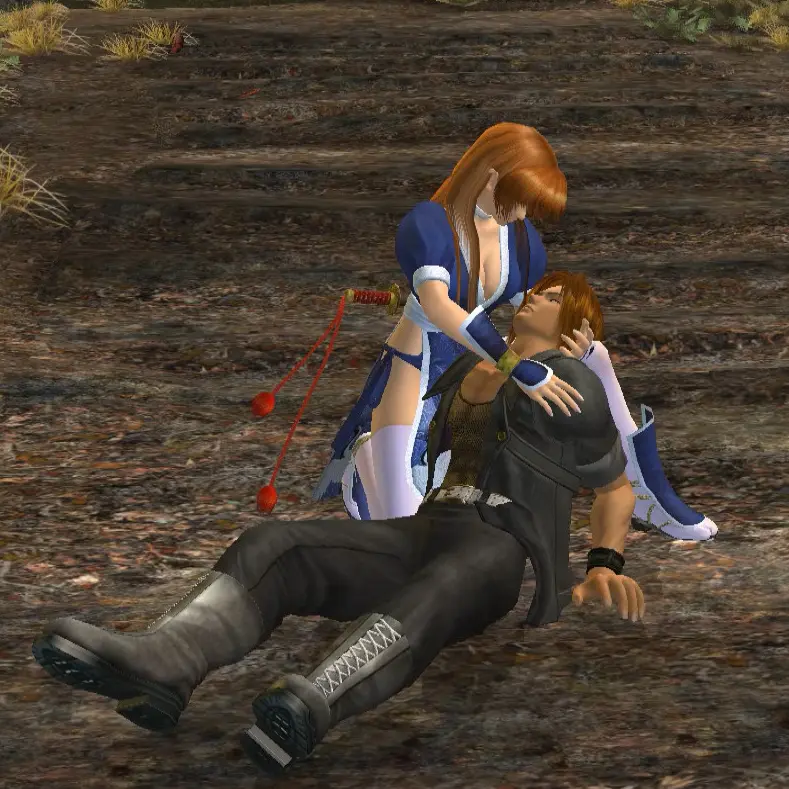
After discovering Hayate alive but amnesiac, Kasumi faces her brother in combat at Hayabusa's insistence - though his theatrical pronouncements about "shinobi souls" mask what essentially amounts to emotional manipulation. Despite the traumatic circumstances, Kasumi demonstrates her combat prowess by defeating Hayate, successfully restoring his memories through their confrontation.
Her capabilities are further proven when she confronts and defeats Gohyakumine Bankotsubo - the legendary Tengu. This victory against a supernatural entity of immense power solidifies her status as one of the world's most formidable fighters.
However, the emotional toll proves overwhelming. While Hayate and Hayabusa pursue Genra's schemes involving Alpha-152 and a brainwashed Ayane, Kasumi makes the difficult choice to withdraw once more. Later scenes show her beside a lonely pair of gentian flowers, longing for home despite knowing she cannot return - not from weakness, but from the painful understanding that some paths, once taken, cannot be walked back. [23]
The Third Tournament
Homesick and constantly hunted, Kasumi still wishes to see Hayate, but has to go into hiding from the Mugen Tenshin clan again. She spends some time in the geisha district of Kyoto during her running, and to cover up her shinobi identity, she dresses as a normal high school girl and acts like a normal civilian in public to get by. She appears to have become ill from running and living rough, because she develops a fever. When she is half-passed out on the road, she is found by a local maiko Kokoro, but refuses her help. When she sees Ayane, she panics and runs away again. [24]
During the third tournament, Kasumi tries to find Hayate, who is, at this time, with Ayane and Hayabusa trying to track down Genra, who has turned against the clan. Kasumi crosses paths with Ayane, but apparently her sister is focused on taking down Genra, so she isn't going to kill her; [25] although Ayame has previously asked Ayane to help Kasumi rather than be against her. [26] Ayane lets Kasumi try to get to Hayate, but not before she fights her for her troubles. [25]
When Kasumi finally meets up with Hayate, he is torn between the code of the clan to kill nukenin and his desire to see his sister again. He tries to save her, saying that they can pretend they didn't meet with each other, but Kasumi is prepared to fight her brother. [27] After the fight, Kasumi escapes again and goes into hiding once more.
Zack Island
Investigating a supposed Dead or Alive tournament invitation, Kasumi discovered the Zack Island event was a hoax. Rather than departing immediately, she strategically assessed the situation and chose to remain, utilizing the temporary sanctuary to regroup away from constant pursuit.
The Fourth Tournament and the Fall of DOATEC
During the time of the fourth tournament, Kasumi catches word of the Mugen Tenshin's plan to attack DOATEC and take their revenge against the company. Worried about everyone's safety, Kasumi risks her life visiting the outside of the village, and finds Hayate. As she tries to convince him to stop the war against DOATEC, Hayate remains quiet and Ayane arrives to interrupt them, providing enough of a distraction for Hayate to leave and continue on with his mission. [28]
Although the attack is on the go, Kasumi pursues everyone to DOATEC's TriTower headquarters so she can still stop the chaos. There, she confronts Helena Douglas, the current head of DOATEC, and begs her to leave the shinobi alone. However, Helena tells her that DOATEC's latest creation - a modified Kasumi α, renamed Alpha-152 - is about to become active. Helena is about to shoot Kasumi, to stop her from being involved, but she is saved by Hayabusa, who is there helping Hayate, and Kasumi fights her way past Helena. [29]
She then heads down to the lab to destroy Alpha-152. She fights her clone to her best efforts but in the end it appears Alpha-152 escapes in the chaos of the destruction wrought by the Mugen Tenshin invasion. After the match, having herself escaped the burning building, Kasumi is last seen watching Helena entering the blazing helipad. As Kasumi tries to stop her, Ayane prevents her from going after Helena, who by doing so saves Kasumi's life as the building starts exploding mere seconds later. [30]
New Zack Island
Kasumi arrived at New Zack Island after Zack falsely claimed Hayate was sighted there - a deliberate manipulation to lure her into his resort fantasy. When she discovered the deception, she remained not for tactical reasons, but because the island offered rare moments of peace away from constant pursuit. Her mermaid dream, trapped in a net while chasing freedom - mirrored her reality: lured by false promises of family, only to find herself captive in someone else's commercialized paradise.
The Fifth Tournament
At some point between the events of the fourth and fifth tournaments, it appeared that Kasumi went into hiding with the assistance of Hayabusa and his ally Muramasa, who made sure that no one knew where she was. [31]
However, Victor Donovan had continued Project Alpha with his new origination MIST, and one of the clones produced managed to leave the facility - it's unclear if it was allowed to leave or it escaped. This clone believed that it was the real Kasumi and held the same desire to locate and destroy Alpha-152 as the original did. It turned to Helena for help, but turned away from her when the woman tried to get Hayate involved, believing that Alpha-152 would be too much for Kasumi to handle alone. The clone felt that it needed to face Alpha-152 by itself and left. [32] Its behavior seemed to make Hayate suspicious so he ordered Ayane to follow. [33]
While trying to keep away from her pursuers, the clone traveled to New York and asks Lisa where Alpha-152 was, but received no answer. [34] After much travelling, the clone got fed up and returned to Helena demanding for Alpha-152's location. Helena reveals that Alpha-152 was hidden at an DOATEC-owned DIG oil rig, but she would be sending Hayate, Ayane, and Hayabusa there as well, much to the clone's dismay. [35] After fighting her way past Rig and Lisa, Kasumi finds and defeats Alpha-152, [36] [37] [38] but is soon found and attacked by the other shinobi, who had by then worked out that this Kasumi was a fake. [39] The clone is slain, and the shinobi are attacked by MIST which led to Hayate's capture. [40]
Hayabusa sent a message to the real Kasumi telling her of their problem and she finally comes out of hiding to aid them. She rushes to the oil platform and fights her way past Christie and Rig to get to Hayate, who had been forced into reactivating Project Epsilon. With Lisa's help, the shinobi succeeded in releasing him, however they are too late to stop Donovan from beginning Phase 4 of Project Alpha: mass production of the best clones. Following a long battle against Alpha-152, the clone and the lab is destroyed, with the shinobi managing to escape.
The next day, Kasumi thanked Hayate and Ayane for their help before taking her leave, swearing to defeat Donovan at all costs.
Back on New Zack Island
Fortune telling repeatedly guiding Kasumi back to the island prompted deliberate investigation. She consciously chose to explore why fate directed her there, discovering the location triggered reflections on her pre-exile life. Her departure was strategic rather than reluctant - understanding when to move on remains essential to survival.
The Sixth Tournament and Raidou's Resurrection
During her time on the run, she maintained contact with her mother via letters. However, while composing another letter, she stopped due to sensing a foreboding element. At some point, Mai Shiranui tracked down Kasumi, and announced her arrival by throwing a paper fan at her, forcing Kasumi to dodge by teleporting from her bench. Mai then asked if she was the strongest kunoichi, with Kasumi acknowledging Mai's presence. Mai, noticing her Mugen Tenshin symbol, deduced that Kasumi must be intelligent before requesting a spar to see who was the strongest in Japan. After the spar, Kasumi and Mai chatted, with Mai admitting that exercise always leaves her hungry. She also had a near run-in with Marie Rose and Honoka at her favorite shop, and overheard them talking about a ninja who frequented the location, with Kasumi deducing from Marie Rose's description that her half-sister Ayane had earlier encountered them.
Kasumi was eventually ambushed by Phase 4 clones of the Alpha project, although she was saved by Ryu. She then accompanied him so they could deal with MIST. Eventually, their travels took them to a ruined highway. After Ryu dealt with a robot made in her evil uncle Raidou's likeness, she received a butterfly familiar from Ayane requesting assistance, with Kasumi expressing shock that Ayane would actually sent her an SOS.
They then headed by chopper to MIST's lab with the help of Ryu's old CIA contact, Irene Lew, and upon rendezvousing with Hayate, they stormed the facility to rescue Ayane. Kasumi then encountered NiCO, the head researcher, who intended to dispose of Ayane and Honoka due to having successfully revived Raidou. While Hayate pursued a Phase 4 clone to retrieve Honoka, Kasumi was forced into a fight with her half-sister due to NiCO brainwashing the latter. After Ayane was subdued, Hayate returned with Honoka and reassured Kasumi that she was merely unconscious. Kasumi, alongside Ayane and Hayate, then engaged Raidou in a final showdown, eventually destroying him into nothingness via a joint effort. Kasumi then left, although not before briefly recalling her childhood.
Arrival on the Venus Islands
Following fortune telling guidance, Kasumi arrived at Venus Islands seeking clarity. When recruited for the Venus Festival, she weighed the request against intelligence-gathering opportunities before consenting to participate - maintaining her agency while navigating the island's social dynamics.
Dead or Alive 7
Kasumi is set to feature in the upcoming Dead or Alive 7. The announcement coincided with the reveal of Dead or Alive 6 Last Round, which generated significant discussion within the community. A prominent point of criticism has been the continued absence of foundational modern fighting game features, such as rollback netcode. Furthermore, community documentation has recorded instances of official platform moderators issuing permanent bans to users requesting the inclusion of "fan service" and "enhanced physics"—elements that were historically heavily emphasized in the franchise's marketing.[91] Her presence in the next mainline tournament is confirmed, though it remains to be seen how the developers will balance her legacy and emotional core with the studio's contemporary focus on modern monetization strategies and shifting series tone.
Character
Appearance
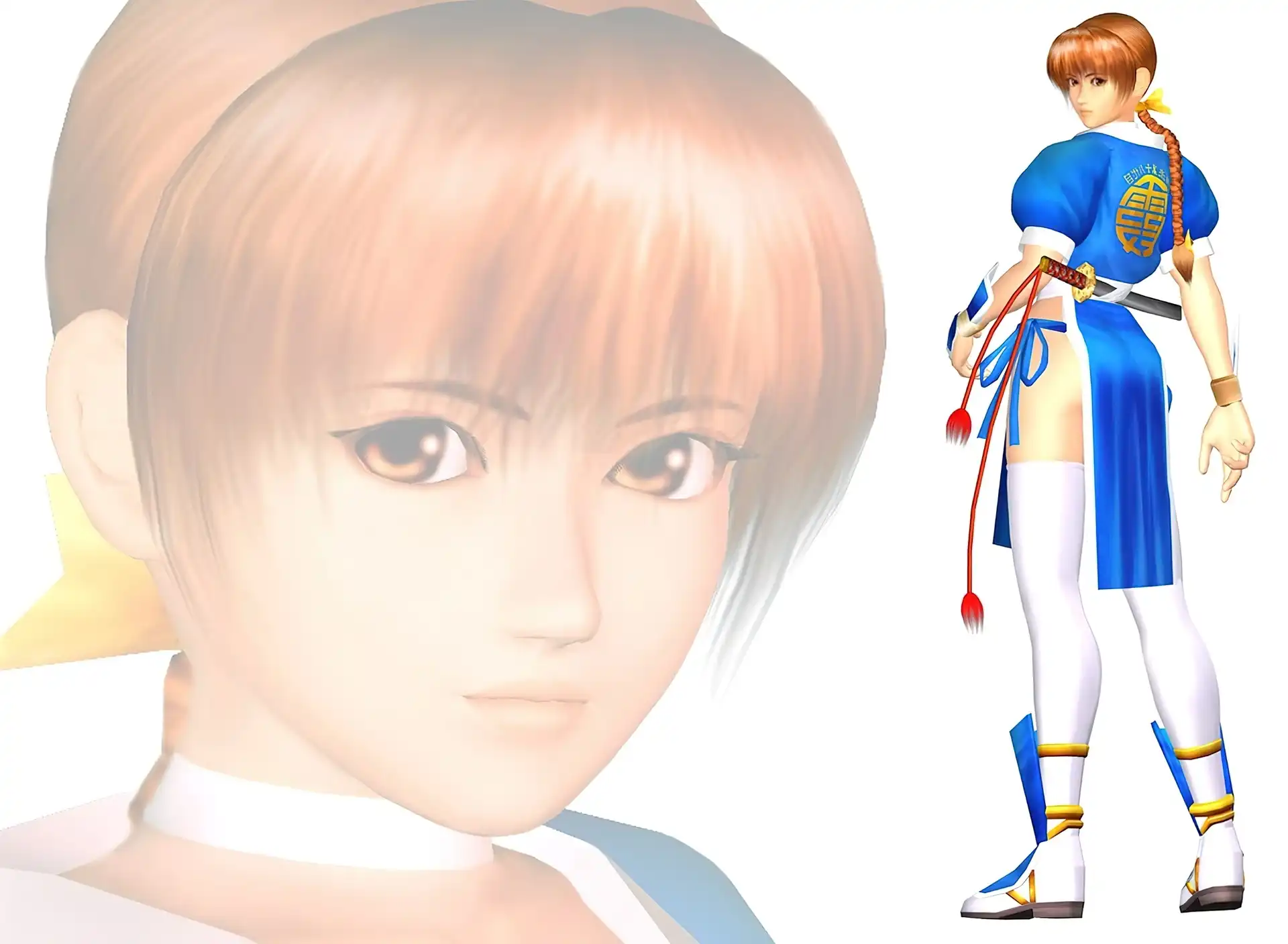
Kasumi in her trademark dress, as seen in Dead or Alive 2
Kasumi has a petite, athletic build developed through years of intensive kunoichi training. Her most distinctive features are her wide amber eyes and her hair, which ranges from chestnut brown to ginger and copper tones throughout the series. She styles her hair in various ways including high or low ponytails, side ponytails, French braids, or worn loose, typically adorned with a colored ribbon.
In earlier games, Kasumi was designed with softer, more youthful features including a round face and large eyes. Beginning with Dead or Alive 5, her appearance matured significantly with an oval-shaped face, narrower eyes, and hair shortened from hip-length to shoulder-length. This redesign aimed to present a more realistic and grown-up version of the character after sixteen years.
Costumes
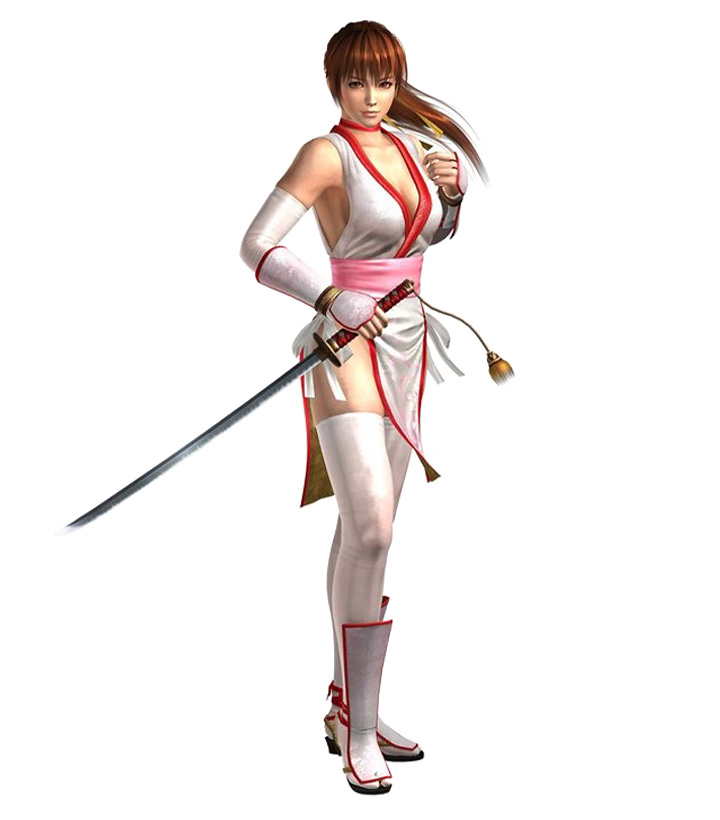
Kasumi's signature outfit—known as "Brilliant Lapis" in blue and "Immaculate White" in red and white—consists of a short side-tie dress with puffy sleeves, white trim, her name embroidered in gold kanji (霞) on the back, and a phoenix pattern on the skirt. She wears this with thigh-high tabi, low-heeled sandals with shin guards, forearm guards with metal wristbands, and a choker. This outfit has become iconic in gaming culture and is frequently recreated by cosplayers.
Throughout the series, Kasumi's wardrobe has expanded to include:
- Ninja attire: Various color schemes of her traditional outfit, tactical bodysuits, and stealth gear
- Casual clothing: Modern streetwear, dresses, and everyday fashion
- School uniforms: Japanese schoolgirl outfits in multiple styles
- Traditional wear: Kimonos and formal Japanese garments
- Swimwear: Featured extensively in the Xtreme spin-off series
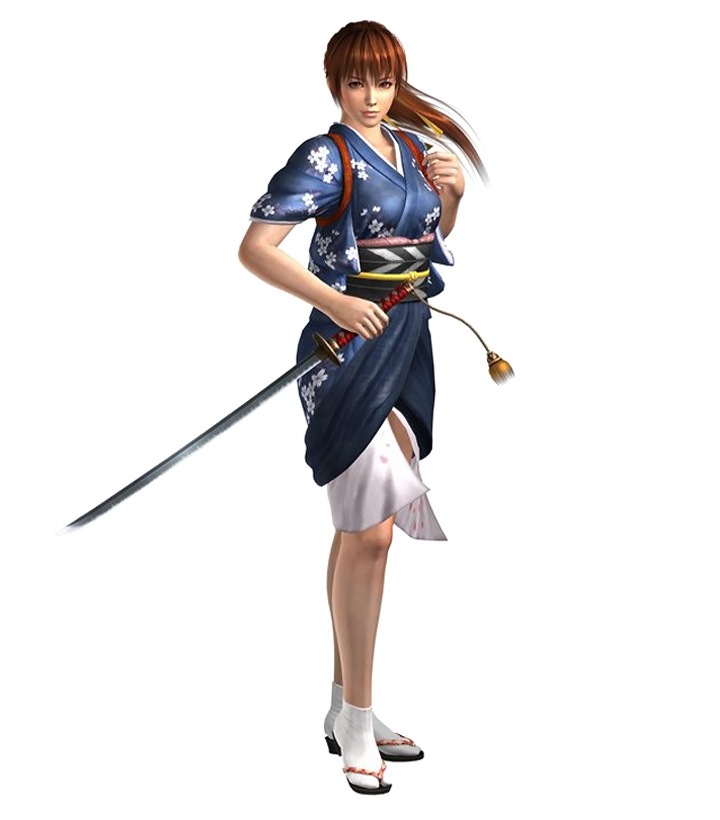
In Dead or Alive 5, while recovering under Muramasa's care, Kasumi wears a blue short-sleeved kimono with white flower designs, a black obi with leaf patterns, and white tabi. During her infiltration of MIST to rescue Hayate and confront Alpha-152, she adopts a black sleeveless tactical bodysuit with blue accents, a choker, matching gloves and leg guards, and heeled boots. In this outfit, her wakizashi is secured with blue rope instead of her usual red, and she wears a blue ribbon rather than yellow.
Dead or Alive 6 introduced an entirely new default costume: a predominantly black armored bodysuit with white gloves, tabi-style heeled footwear, and blue accents. The suit features her name in gold kanji on the back, armored padding on her arms and shins, a small sakura emblem on the chest, and her sword mounted on her lower back. She also received a casual outfit consisting of a long-sleeved sweater dress with flower decals, thigh-high stockings, and low-heeled leather boots. In this game, taking a Break Blow causes her ponytail to come undone, revealing thicker and longer loose hair than seen in previous entries.
Personality
Kasumi is compassionate, honorable, and inherently peaceful despite her lethal training as a kunoichi. She actively dislikes combat and frequently attempts to avoid confrontation when possible. Her participation in the Dead or Alive tournaments after the first was never motivated by victory or glory, but by her desperate search for her brother Hayate.
Family defines Kasumi's core motivations. She is deeply devoted to her brother and mother, and her greatest desire is to return home peacefully to the Mugen Tenshin village. However, she is not naively pacifistic—when Raidou crippled Hayate, she willingly defied her clan to hunt him down and kill him. She fights without hesitation against her clones and anyone who threatens her loved ones. While gentle and emotionally honest, she speaks her mind clearly when the situation demands it.
Character Growth
In Dead or Alive 5, Kasumi demonstrates significant personal growth. She remains caring and compassionate, but has become mentally stronger and more willing to engage in necessary combat rather than avoiding all conflict. Her mission to destroy DOATEC's Phase 4 project and confront Victor Donovan reveals a stronger resolve and greater maturity. She has also achieved peace in her relationships with both Hayate and Ayane, though she still longs to return home and maintains contact with her mother through letters.
The Xtreme spin-off series places Kasumi in a non-combat, vacation setting, yet continues to subject her to objectification. Her character is portrayed as "vulnerable" and "modest," often showing embarrassment when placed in revealing outfits or made to perform actions like pole dancing. This framing can be interpreted as a gamified representation of exploitation, where her discomfort is presented as a form of entertainment. While the series attempts to show a more "carefree" side of her personality, it does so within a context that continually reinforces her status as a sexual object, divorced from her identity as a warrior and a fugitive.
By Dead or Alive 6, Kasumi has fully embraced her strength as a fighter. She no longer shows reluctance in combat, particularly when facing Raidou—her confrontational stance toward him reveals the depth of her hatred for the man who destroyed her family. While she still questions why she must fight Ayane and Hayate, she otherwise operates at peak mental and physical capability, showing no fear when it comes to protecting those she loves.
Name Symbolism
Kasumi's name (霞) means "mist" in Japanese—a light fog that carries layered symbolic meaning:
- Isolation: Mist represents loneliness and solitude, reflecting her forced separation from the Mugen Tenshin clan and her life as a fugitive
- Emotion over logic: Fog symbolizes unclear thinking, mirroring how Kasumi made her life-altering decision to leave the village based on her feelings rather than rational consideration
- Elusiveness: Mist cannot be easily contained or captured, just as Kasumi has repeatedly evaded the clan's assassins for years
- Uncertainty: Mist represents an undefined, transitional state—as a runaway shinobi marked for death, Kasumi exists in constant uncertainty, never knowing if tomorrow brings freedom or her execution
Weapons and Equipment
Throughout the Dead or Alive and Ninja Gaiden series, Kasumi is depicted wielding various traditional Japanese bladed weapons, primarily wakizashi (short swords). Despite her prominence as a weapon-wielding ninja character, the developers have only officially named one of her four documented weapons.
Shrouded Moon
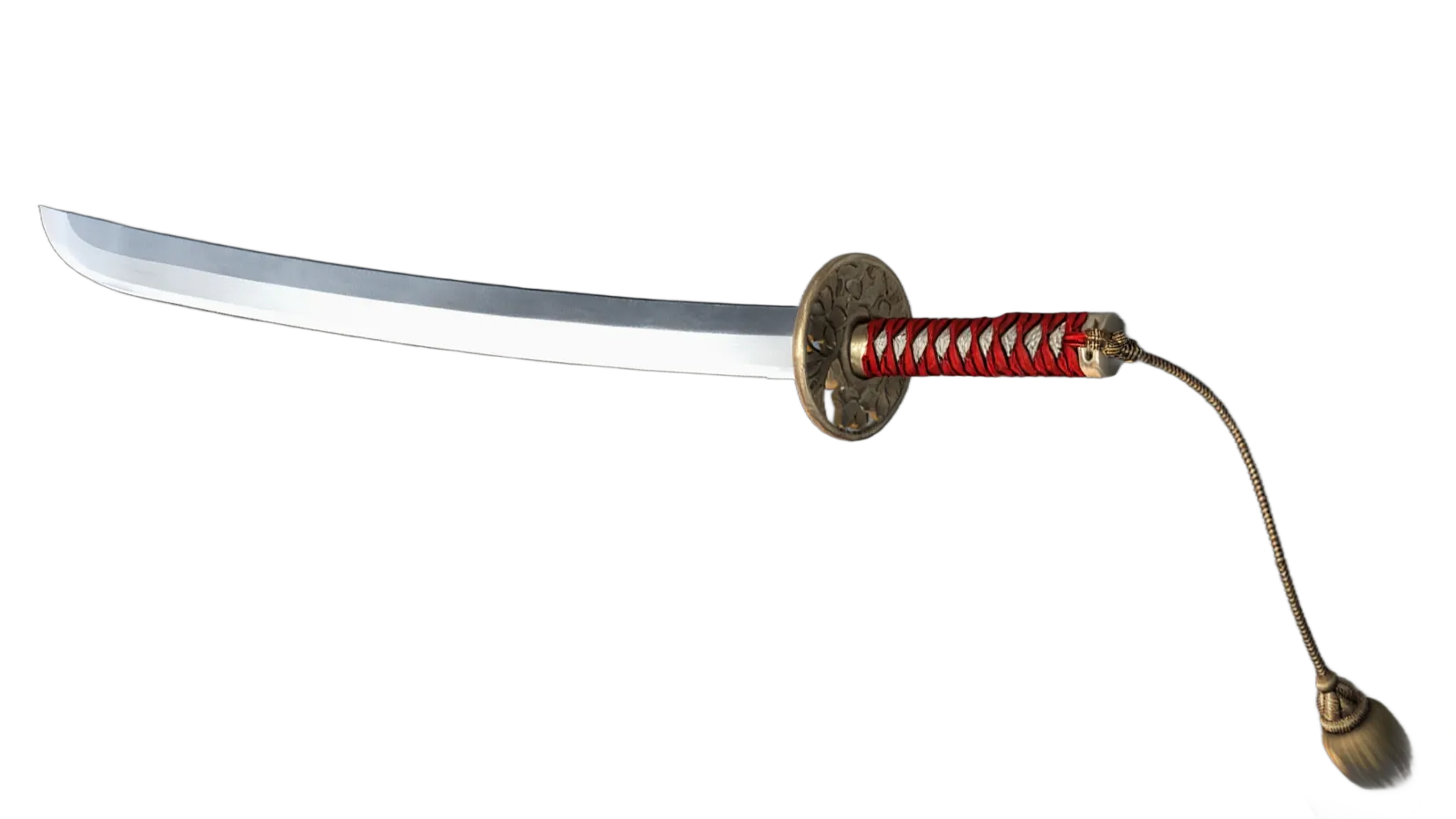
The Shrouded Moon, Kasumi's named weapon from Ninja Gaiden
The Shrouded Moon is Kasumi's signature wakizashi featured in the Ninja Gaiden series. It is the only weapon officially named by the developers. The blade features a curved single-edge design typical of wakizashi construction, with a distinctive red-wrapped tsuka (handle) and a single tassel attached to the pommel. The weapon's name reflects traditional ninja philosophy of operating under cover of darkness.
Extended Shrouded Moon Variant
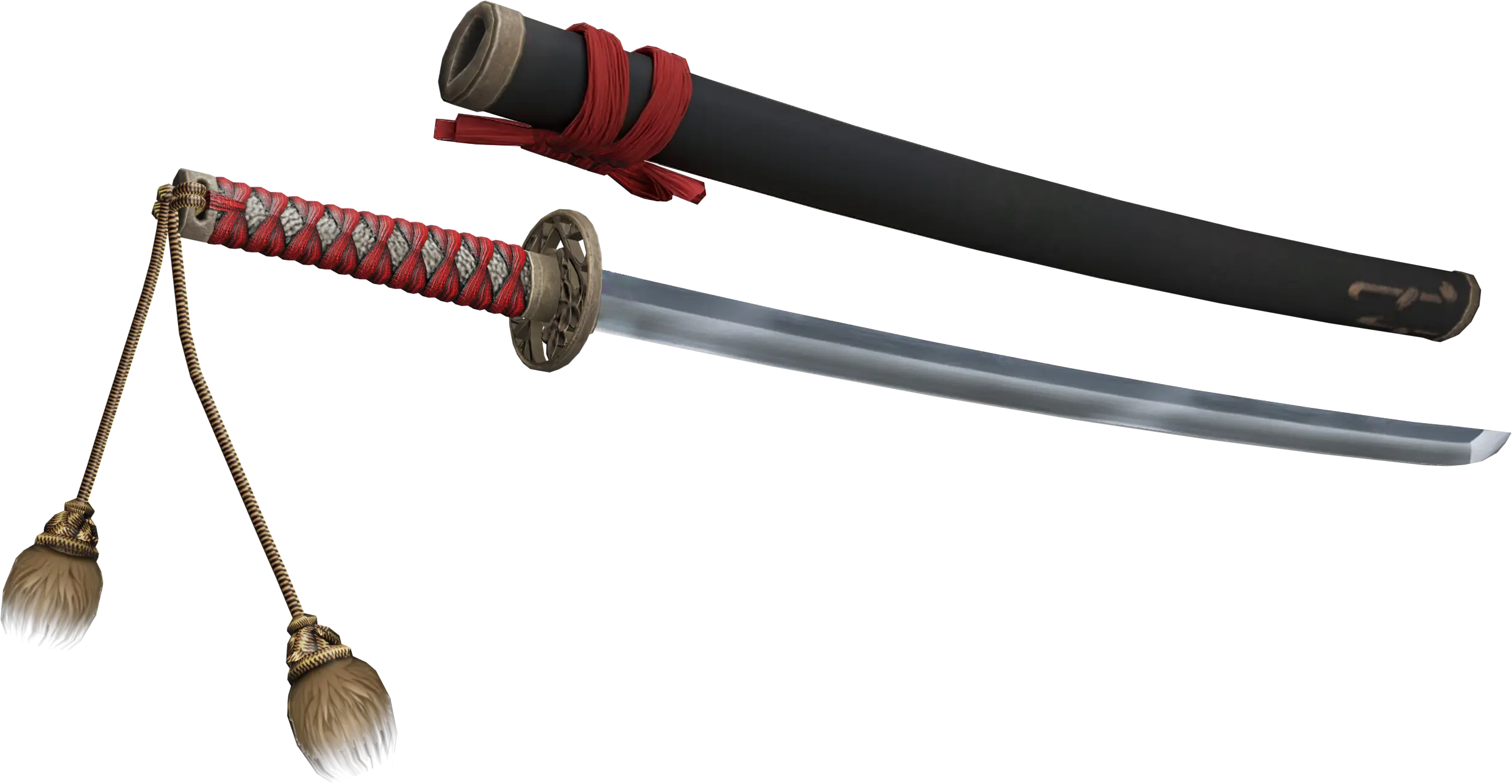
Extended variant of the Shrouded Moon featuring dual tassels
A longer variant of the Shrouded Moon appears with an extended blade length approaching that of a full katana. This version features two tassels rather than one, attached to the pommel with decorative brass fixtures. The dual-tassel design may serve both aesthetic and practical purposes, as weighted tassels can be used for distraction techniques in traditional ninjutsu.
Primary DOA Wakizashi
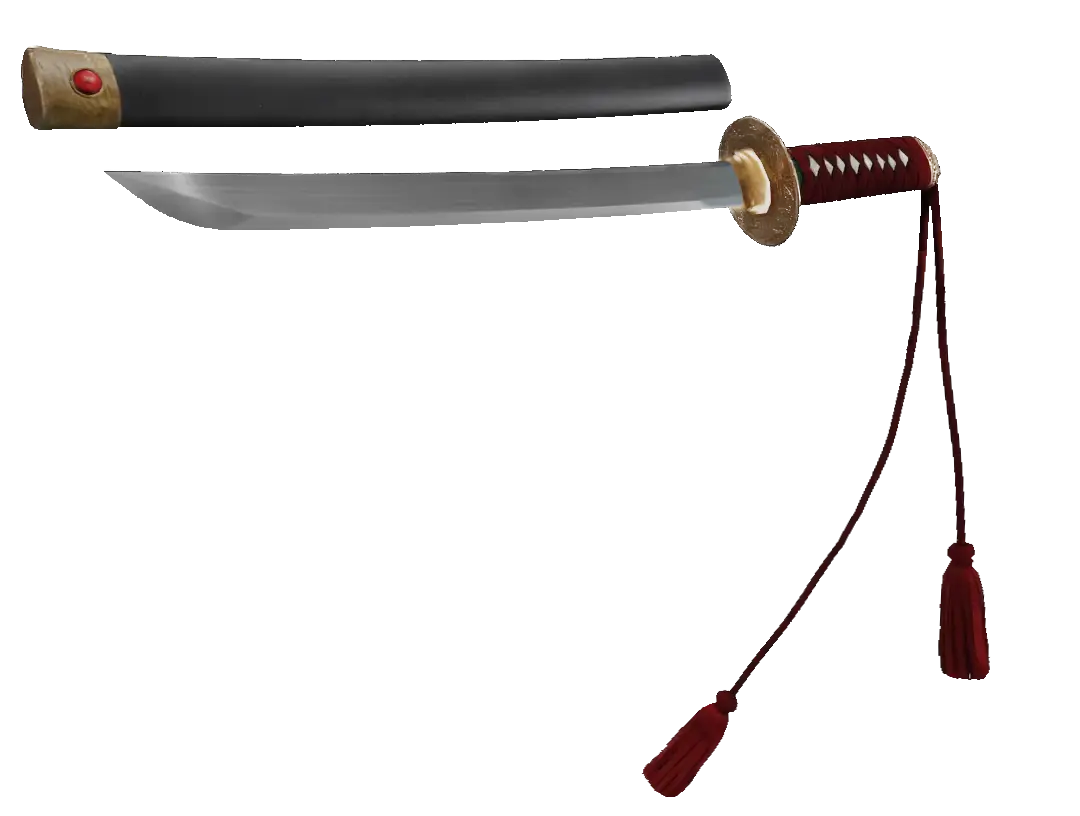
Kasumi's unnamed wakizashi featured throughout the Dead or Alive series
Throughout the Dead or Alive series narrative, Kasumi wields an unnamed wakizashi with distinctive red cord wrapping and two red tassels. This weapon appears in cinematics and promotional materials but has never been officially named by developers. The weapon features traditional construction with what appears to be a circular brass tsuba (hand guard) and pommel fixture.
Ninja Gaiden 2 Black Wakizashi
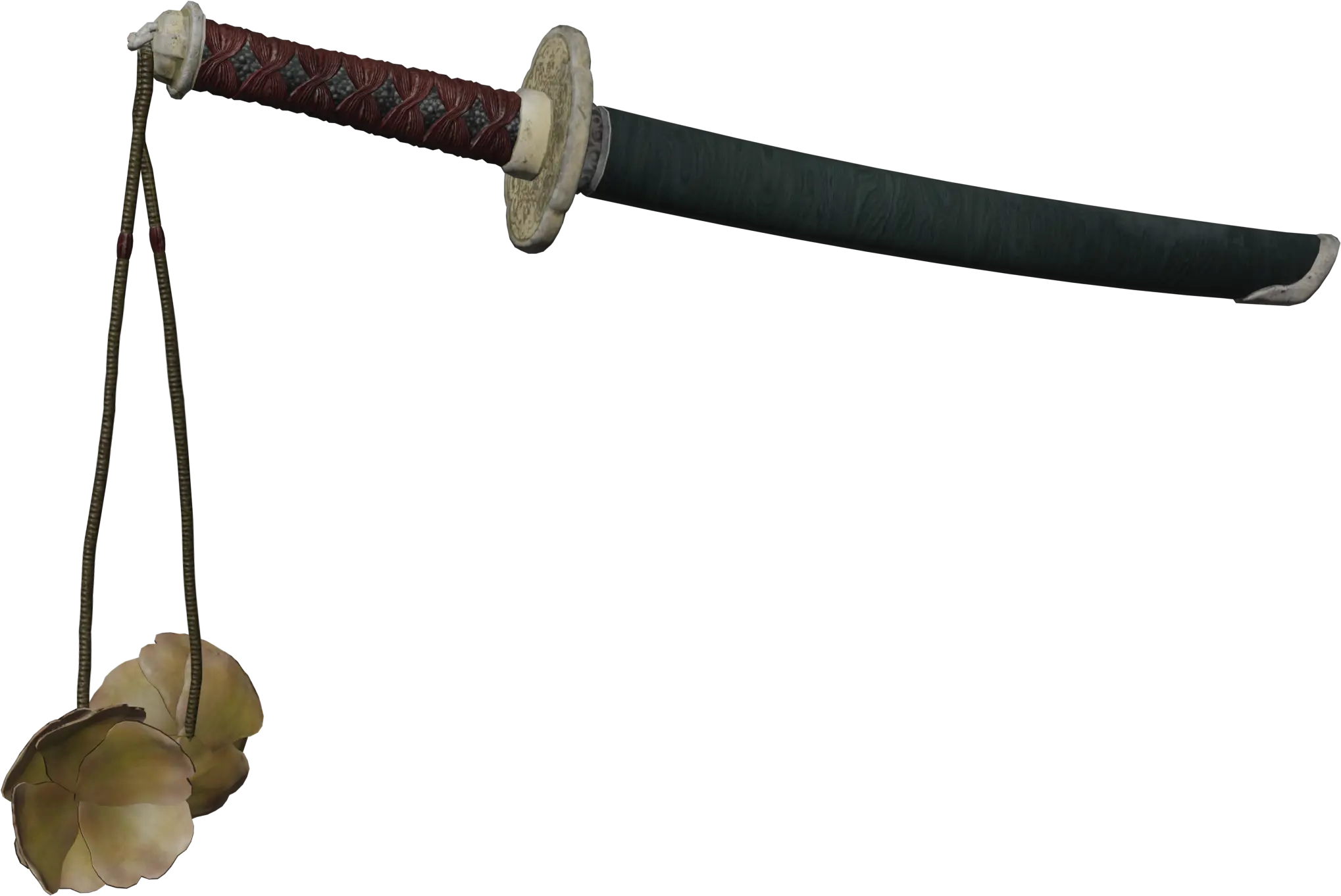
Unnamed wakizashi from Ninja Gaiden 2 Black (2025 remaster)
In Ninja Gaiden 2 Black, Kasumi appears wielding another unnamed wakizashi with a darker aesthetic. The weapon features wrapped gray-green tsuka, a simpler circular tsuba, and dual brass-colored tassels. This design represents a more subdued, practical approach compared to her brighter DOA-era weapons.
Combat Applications
In gameplay, Kasumi's wakizashi serves primarily as a visual element rather than a functional weapon, as her fighting style in the Dead or Alive tournament series focuses on unarmed Mugen Tenshin Ninjutsu techniques. However, in the Ninja Gaiden series where she appears as a support character, the Shrouded Moon functions as a fully realized combat weapon with its own moveset and techniques.
Relationships
Shiden
Kasumi's relationship with her father, the 17th Leader of the Mugen Tenshin, is defined by painful dramatic irony. Growing up, Kasumi revered Shiden as a pillar of strength and righteousness. In reality, Shiden is a man utterly paralyzed by shame and duty. His cowardice in failing to protect Ayame from Raidou's assault—and his subsequent refusal to seek justice in order to preserve clan politics—set the stage for the total destruction of his family. When Hayate was crippled and Shiden hastily anointed an unprepared Kasumi as his successor, it was an act of desperate compensation for his own impotence. Once Kasumi abandoned the village to do what he never could—avenge their family by hunting Raidou—Shiden's rigid adherence to tradition ultimately forced him to order her execution. He chose the archaic laws of a broken system over the life of his daughter.
Ayame
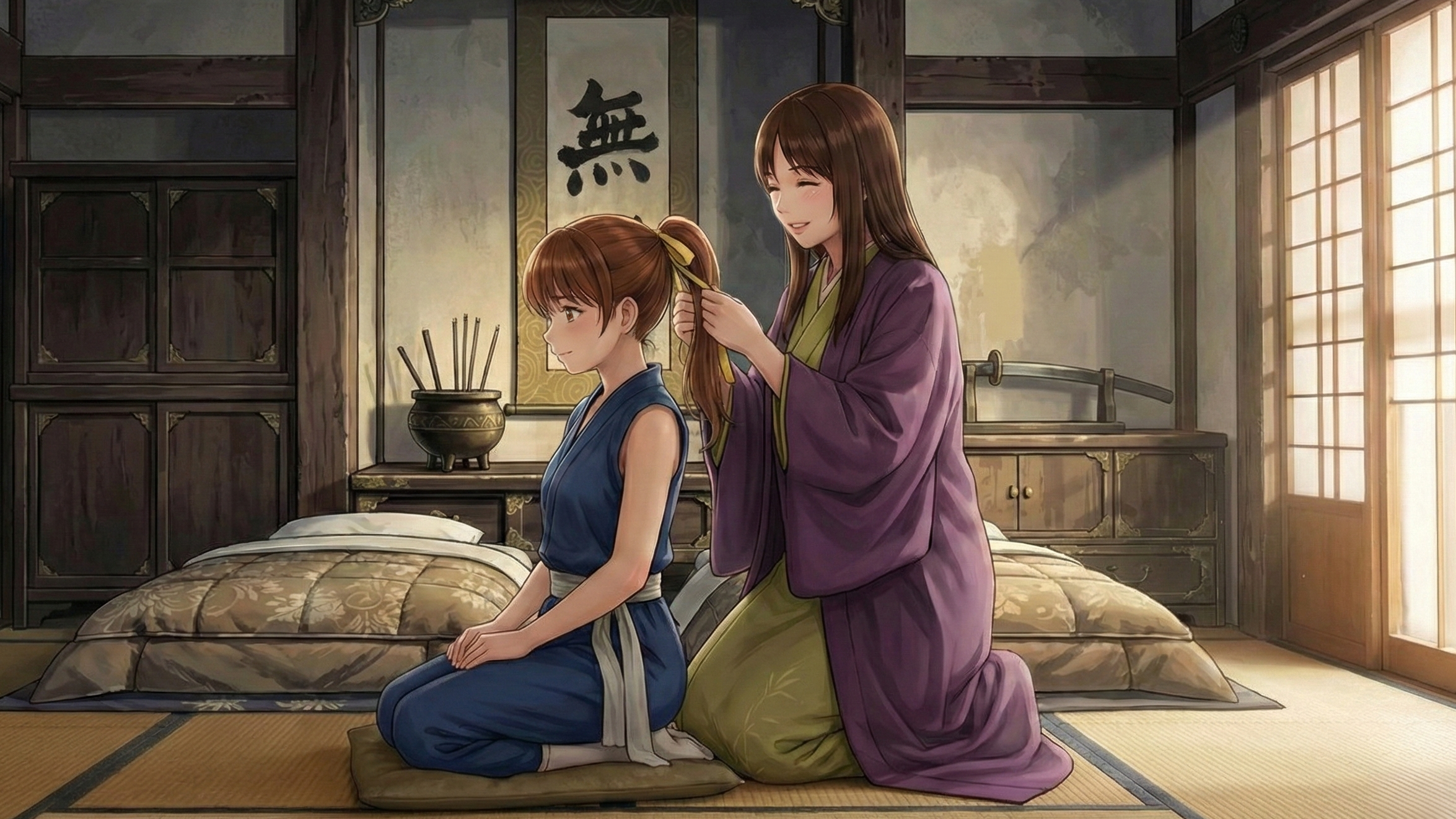
Ayame giving Kasumi her iconic yellow ribbon in Kunoichi of Destiny
The stoic matriarch and the quiet, iron core of the Mugen Tenshin. While history often reduces her to the victim of Raidou's assault, Ayame's choice to carry that trauma in absolute silence for seventeen years was an act of ferocious will—a deliberate sacrifice to protect Kasumi's innocence and prevent the clan from tearing itself apart. Kasumi's love for her mother is absolute, yet now laced with profound survivor's guilt, realizing her "perfect" sheltered childhood was bought entirely with Ayame's hidden suffering. Ayame's love for both her daughters transcends the clan's rigid politics; Though Kasumi still writes letters to her from exile, the correspondence serves as a poignant tether to a woman whose immense, quiet strength Kasumi is only just beginning to truly understand.
Hayate
Hayate is the golden child turned tragic martyr of the Mugen Tenshin. Before Raidou's attack, he and Kasumi shared an idealized shinobi childhood, completely insulated from the clan's dark underbelly. When Raidou crippled Hayate, it shattered Kasumi's worldview and served as the direct catalyst for her exile. As the true 18th Leader, Hayate's relationship with Kasumi is now utterly broken by duty. While the sanitized game canon insists they "work together on better terms," the reality is far more agonizing. Hayate is bound by the ancient laws of the Tenjinmon; he cannot openly embrace or protect his nukenin sister. Every time they cross paths, it is a painful reminder that the brother Kasumi sacrificed everything to save is now the authority figure obligated to see her executed. Their bond is defined by an agonizing, unspoken grief—they love each other deeply, but the institution of their clan demands they be enemies.
Ayane
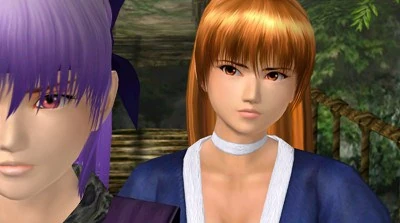
Ayane's hatred toward Kasumi is built on lifelong trauma and systemic isolation.
Ayane is the dark mirror to Kasumi's existence. Born from Raidou's brutal assault on their mother, Ayame, Ayane was ostracized by the clan as "cursed" and shoved into the shadows of the Hajinmon sect, where she was weaponized by Genra. Her relationship with Kasumi is a pressure cooker of profound jealousy, trauma, and systemic inequality. While Kasumi was raised as the pampered "princess" of the Tenjinmon, Ayane was subjected to brutal training and emotional isolation. Ayane's intense, often violent animosity toward Kasumi isn't merely sibling rivalry; it is the furious resentment of a child who was punished for the circumstances of her own violent conception. Genra deliberately stoked this hatred to manipulate Ayane into hunting her sister.
Even as the immediate threat of Raidou or DOATEC forces them onto the same battlefield, the chasm of privilege and trauma between the two halves of a fractured family remains one of the most volatile and tragic dynamics in the entire franchise. Kasumi, for her part, refuses to harbor hatred for her sister, viewing her instead through a lens of profound empathy and heartbreaking guilt over the life Ayane was forced to endure.
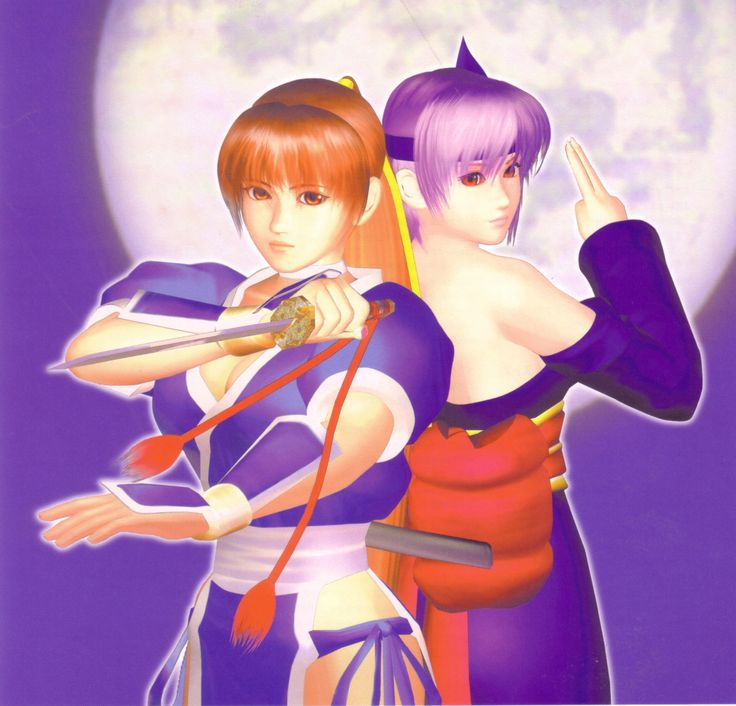
Kasumi & Ayane
However, over time, Ayane's envy and hatred of Kasumi slowly abated since their circumstances changed. Due to the events of Dead or Alive 3 and Genra's passing, Ayane became the new Hajinmon master of the Mugen Tenshin clan, respected and feared alike, and Kasumi was the nukenin — the outcast of the village. Ayame, her mother, had also come to terms with her by then in an attempt to heal her emotionally scarred daughter. During the Dead or Alive 4 tournament, Ayane merely delayed Kasumi enough for Hayate to get a head start on their plan to take down DOATEC, rather than killing her. This fading animosity may have also been why she stopped Kasumi from entering the burning DOATEC building to try and save Helena. In Dead or Alive Xtreme 2, Kasumi and Ayane seem to have started to develop a more friendly relationship with each other.
In Dead or Alive 5, when Ayane and Hayate are about to fight Alpha-152, Ayane stops Kasumi from joining the battle by throwing a kunai at her feet. Kasumi quietly grants Ayane's silent request to fight alongside Hayate and the improvement of their relationship is greatly evident. At the end of the ordeal, Kasumi and Ayane seem finally at peace, as both sisters smile at each other instead of killing one another. Kasumi returns Ayane's kunai with a word of thanks before setting off to track down Donovan. In tag team matches, they also have a more cooperative relationship, and there no longer seems to be any tension between them, as seen in their entrance, and victory pose together.
Additionally, when in trouble in Dead or Alive 6, Ayane sends a request for help to Kasumi, surprising Kasumi herself. Despite this, however, thanks to NiCO brainwashing Ayane into thinking Kasumi had betrayed the clan, the two half-sisters were also forced to fight each other again. When Ayane returned to her senses, she and Kasumi fought alongside Hayate against Raidou to defeat him once and for all, but Ayane was left weary and worn out after the battle and had to be lead along by Hayate as Kasumi walked behind them, before teleporting away leaving the current state of their relationship unclear. When the two battle, Kasumi still questions their reason for fighting, while Ayane claims that their battle is "for real" and that she's "nothing".
In Dead or Alive Xtreme 3, when the player gives Ayane a gift that Kasumi likes (such as strawberries), she'll reject it and gets seemingly annoyed by it. Kasumi also dislikes some of the gifts that Ayane likes (such as Marron Glaces, Cream Soda, Opera Glasses, and etc.) It is implied that Ayane didn't want to be too soft and nice to Kasumi; she wants to be friendly with her but still considers Kasumi her rival. In addition, they also worked together for a ghost festival. Ayane also chose Kasumi to act as her partner in setting up the Sisters Quarrel rivals festival.
Ryu Hayabusa
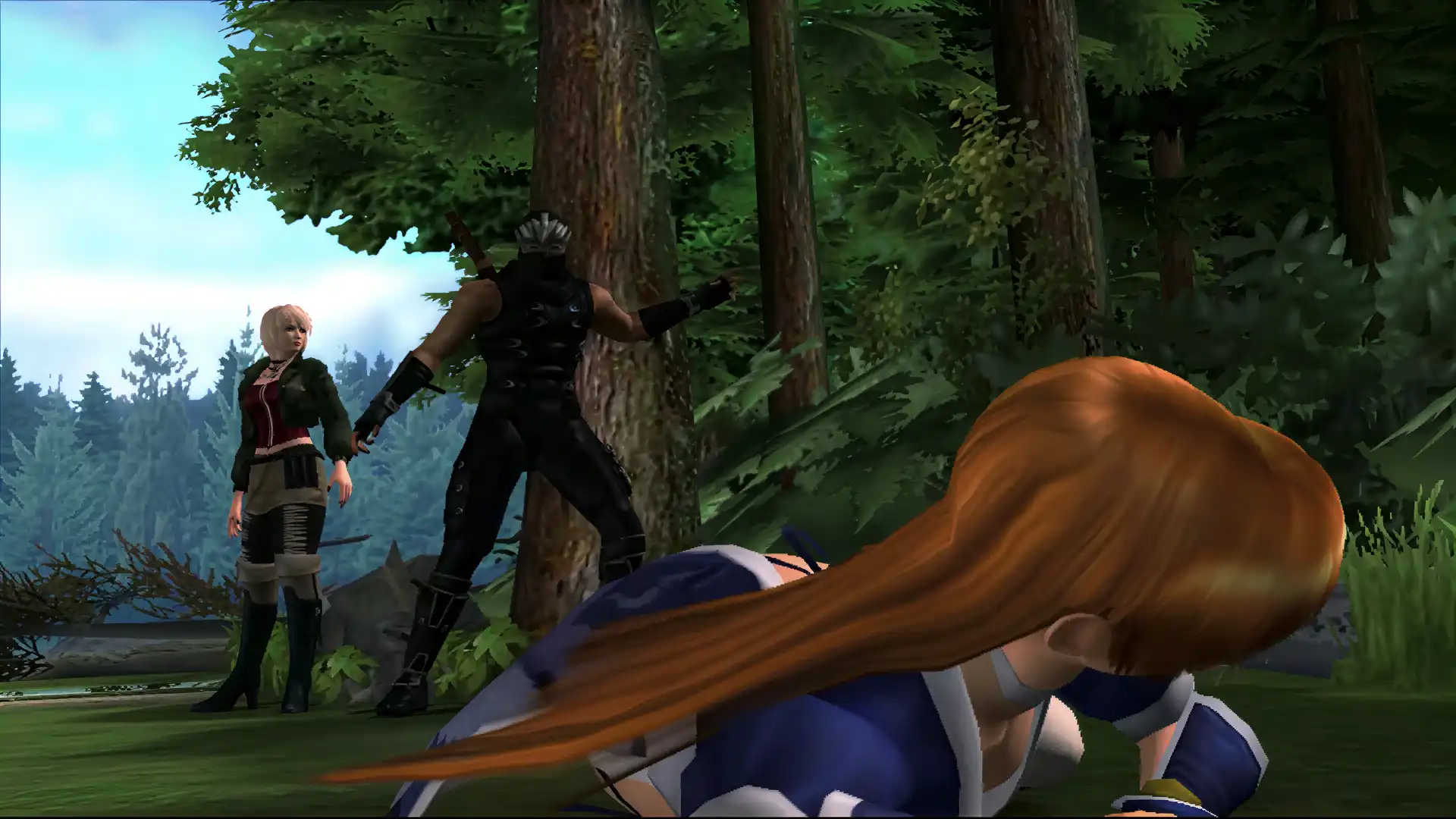
Kasumi after being struck by Hayabusa.
Ryu Hayabusa maintains a complex and often contentious relationship with Kasumi. While nominally acting as her protector under a promise to Hayate, his methods frequently involve patriarchal control rather than genuine support. He has repeatedly attacked Kasumi, restricted her autonomy, and watched over her without consent - all under the guise of clan honor.
His protection proves highly conditional, abandoning her against threats like Alpha-152 for abstract principles while delivering vague philosophical advice that provides little practical help. Most disturbingly, he has physically assaulted her on multiple occasions - slapping her "for her own good" - revealing a pattern of control masquerading as guardianship.
During the sixth tournament, Hayabusa saves Kasumi from Phase 4 clones and warns her about MIST, yet their subsequent alliance remains strained. She eventually accompanies him to destroy Raidou resurrected, but is sent away when Ayane's SOS arrives - another instance of Hayabusa directing her movements rather than respecting her agency.
While Kasumi appreciates having an ally unbound by Mugen Tenshin laws, their relationship remains fundamentally unbalanced.
Marie Rose
In Dead or Alive Xtreme Venus Vacation, Kasumi and Marie Rose seemed to get along fairly well (it's implied that the reason they knew each other was through Helena), and worked with Marie Rose for a photoshoot relating to New Years cards. During another photoshoot, this time to act as Cover Girls, Kasumi also admitted that it was "reassuring" that Marie Rose was present when the Owner called them to act as Cover Girls. The shinobi also largely agreed to a commemorative photo in front of the god statue despite her personal misgivings to the Cover Girl photoshoot (especially her having to wear a particularly skimpy outfit for it) because Marie Rose thought it was okay to do so.
Honoka
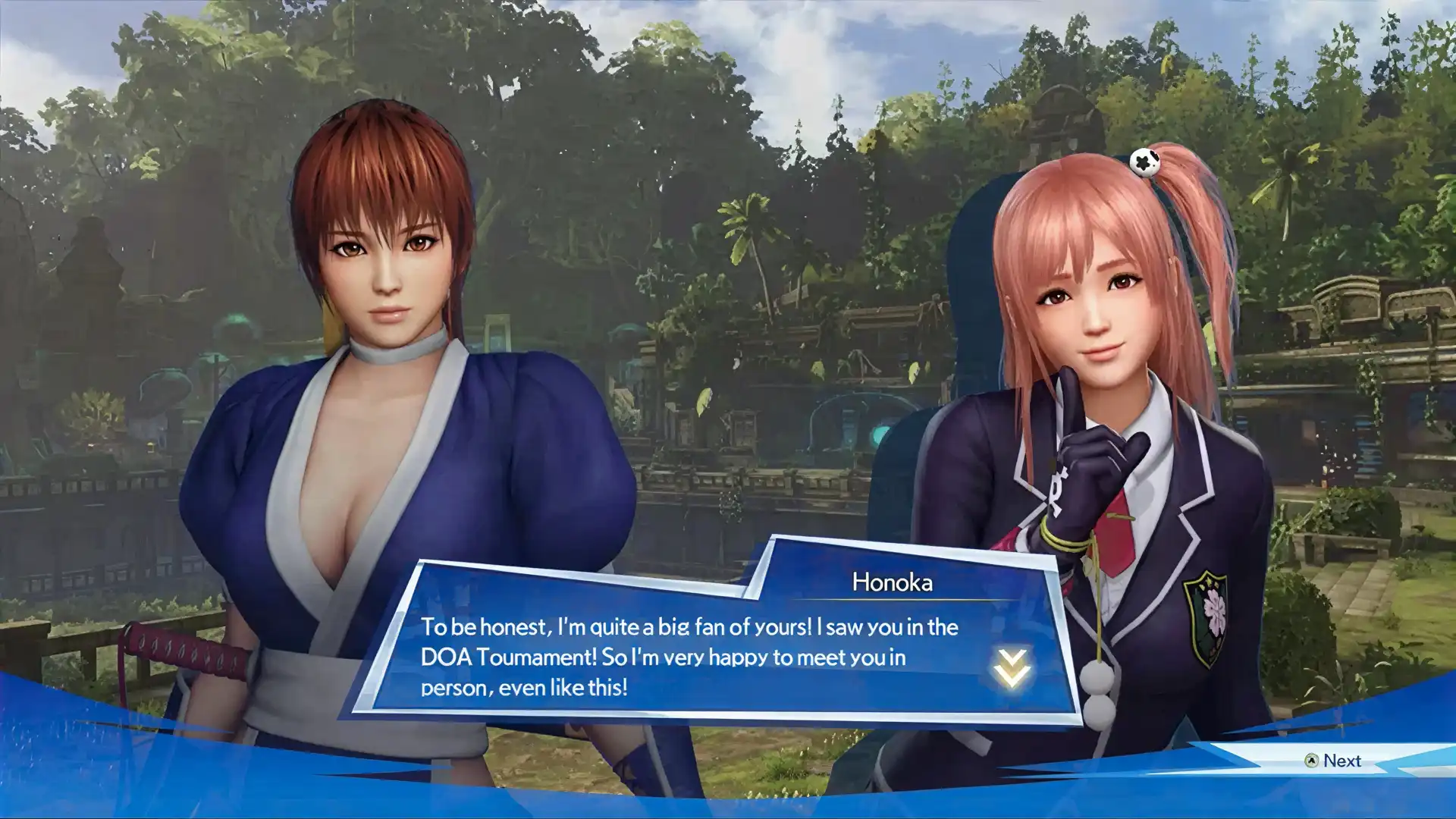
Kasumi & Honoka
While Kasumi and Honoka don‘t have many noteworthy interactions in the main series, they do interact in the crossover Warriors All Stars. According to Honoka, she’s been a big fan of Kasumi ever since she won the first DOA tournament. Honoka describes Kasumi as “cool and collected”. Kasumi is flattered by her praise and thanks her. Overall Honoka and Kasumi exhibit a friendly relationship. Sometimes, Kasumi gets worried about Honoka due to her powers reminding her of Raidou, and even asks her about her father. Honoka replied that she doesn't remember her father. It’s not clear if this interaction is considered canon due to Warriors All Stars being a crossover spin-off.
In Dead Or Alive 6, Kasumi has a near run-in with Honoka and Marie Rose when they coincidentally frequent the same confectionary shop she frequents. Later, after defeating a brainwashed Ayane, Hayate carries over Honoka, who is unresponsive. Kasumi expresses worry over both Honoka and Ayane until Hayate notes that they are simply unconscious. Due to the revelation of Honoka being the daughter of Raidou, this would make her Kasumi’s paternal cousin. However, neither are likely to be aware of this as NiCO only tells Ayane about their familial relationship and Kasumi leaves after the defeat of the resurrected Raidou.
In Dead or Alive Xtreme 3, the two are very close to each other at the very beginning of the vacation as both are bearing 3 musical notes to each other. In Xtreme Venus Vacation, Kasumi and Honoka worked together alongside Ayane while cosplaying uniforms for the Hanzo National Academy, also winning the tournament. The two also worked alongside each other to help welcome Monica to the island.
Kokoro
Their first acquaintance was when Kokoro was walking home and saw Kasumi disguised as a high schooler to keep her shinobi identity secret. Kokoro showed concern for Kasumi as she was suffering from a high fever and asked her if she needed any help, but Kasumi refused and fled as she saw Ayane approaching. Kokoro seemed to know that Kasumi was potentially in danger as she quickly pretended to not know what Ayane was talking about when questioned on which way Kasumi fled, much to Ayane's irritation. Kasumi and Kokoro met again in Dead or Alive Xtreme 2 and got along well as they are the same age and have similarly compassionate dispositions. In Venus Vacation they were part of a strawberry festival, where Kokoro said she saw a happier side of Kasumi she didn't know.
Momiji
Kasumi and Momiji's familiarity is not specified, despite both girls being ninjas and having full respect for Ryu Hayabusa. However, Momiji does call out Kasumi's name during a tag battle. In Dead Or Alive Xtreme 3, it is seen they are close at the very start of the vacation, both bearing 3 musical notes (maximum closeness). In addition, in Venus Vacation, she also had Kasumi aid in a New Year's Card photo session, the latter as one of the models alongside Marie Rose and Kokoro, and even took a fortune with her for the event and commented on the shinto shrine.
Helena Douglas
Despite what DOATEC has done to Kasumi's life, she still shows friendly and caring feelings towards Helena and seems to understand the pain that Helena must be going through. However, these feelings are coldly dismissed by Helena when she tries to shoot Kasumi claiming that she has no use for her, only to quickly be stopped by Hayabusa. Even after threatening to kill her, Kasumi attempts to stop Helena from committing suicide, which would have resulted in her death had Ayane not stopped her, showing that she still cares for Helena.
After the fourth tournament, she and Helena have been more friendly and have an understanding relationship with each other. It's also implied that Kasumi knew of Marie Rose through Helena.
Lisa Hamilton
Kasumi seems to know Lisa from around the second tournament. When Kasumi was fighting Kasumi α, Lisa came into the lab during the fight, and demanded to know what was going on. To her horror, she found out Kasumi α told Kasumi that Hayate was in the DOATEC facility. She attempted to silence an enraged Kasumi by putting her at gun-point, but Hayabusa came to her rescue abruptly. Lisa didn't like her odds, forcing her to flee with Kasumi α in hand.
Two years later, during the fifth tournament, Kasumi infiltrated the MIST facility alongside Ayane and Hayabusa to rescue Hayate, after she learned that Donovan was trying to reactivate project Epsilon. Kasumi went in the room with Hayate already in the start up phase, and as she attempted to free him, a shocked Lisa came in, and wondered who was responsible for this. Kasumi, already fueled with negative feelings for Lisa, accused her, and demanded to know what was going on. Lisa denied knowledge, but she went into the control room in an attempt to stop it.
Luna
Kasumi was shown to be somewhat amused by Luna's quirky nature, as evidenced by the time she, Ayane, and Luna worked together to help set up the First Anniversary of the Venus Festival, as well as the clear card souvenir which depicted her chuckling as she watched Ayane scolding Luna while the latter did v-finger poses. However, while more tolerant of Luna's quirks, she is weirded out to a certain degree by them, as evidenced by her reaction to making a pose and declaring "Misty Blossom" subsequent to Luna making a similar declaration. While partnered up for testing out a new form of body soap, Kasumi also got along extremely well with Luna, even being amused at Luna's antics, including her desiring more soap lathering after being told she looked a bit like a rabbit, and also worked together to do a form of fortune telling.
Tamaki
Unlike Momiji, Kasumi didn't mind Tamaki too much, and was even slightly amused by Tamaki's personality. She also had some fondness for Tamaki, likening her to a sister. However, she still had some wariness to Tamaki's more lewd aspects, admitting she was embarrassed by Tamaki's groping of her.
Leifang
Not much known about their relationship to each other in the main series, although they are quite acquainted to each other in Dead or Alive Xtreme 1 and 2 and can easily become friends and partners in the game. In addition, in Xtreme Venus Vacation, their interactions indicated that they were very familiar with each other and act as long-standing friends, with Kasumi freely explaining the circumstances behind her arrival on the island.
Monica
Monica met Kasumi and Honoka to deal a card game with them after making a bet with the Owner that if she loses to any of the girls in anything, she does what they have to say. They agreed to rounds of the card game Old Maid, though she ultimately had exceptional difficulty winning against them, with Kasumi in particular due to doing fortune telling. She ultimately won by placing cards, though she conceded defeat due to her technically cheating in order to do so. Kasumi and Honoka then suggested she continue playing Old Maid with them.
Sayuri
Sayuri met Kasumi while Ayane was resting, and also filled her in on the events that transpired thus far. Kasumi didn't mind Sayuri's quirk of referring to herself as an older sister, even finding it nice.
Raidou
Raidou was Kasumi's uncle; he was the older brother of Shiden, Kasumi's father. Kasumi defeated and killed Raidou in the first DOA tournament as revenge for causing Hayate’s then comatose and paraplegic state. This was the only time that Kasumi showed pure hatred and cruelty toward another person.
Two years later, she confronted a revived Raidou alongside Hayate and Ayane, and they destroyed him together, with no trace of him left behind.
Mai Shiranui

Kasumi and Mai
Being a fellow kunoichi like Kasumi the two seemed to have formed a friendly rivalry and Kasumi enjoys the amiable connection they have, as shown when they had a cheerful conversation after they sparred. It's also implied that Mai is a particularly famous combatant in the DOA world as Kasumi seems surprised and rather taken aback that Mai is her opponent in her intro against her.
Owner
The player-character in the Xtreme spinoffs holds a transactional relationship with Kasumi under the title "Owner" - a dynamic she tolerates rather than embraces. While accepting gifts and temporary sanctuary on the islands, she maintains clear emotional boundaries, never reciprocating the romantic or sexual interest shown by other contestants.
Her limited tolerance stems from practical necessity: the islands provide rare opportunities to reconnect with Ayane away from clan politics. The infamous shiromuku-style dress incident provoked visible discomfort, highlighting her awareness of the inappropriate implications behind such "gifts."
Ultimately, Kasumi treats these resorts as temporary shelters while pursuing her own goals - a strategic decision that reflects her survival instincts rather than genuine connection to the proprietor.
Kasumi Gameplay
Kasumi is a high-speed ninja character in the Dead or Alive series, specializing in fast strikes, deceptive movement, and a versatile mix-up game centered around her signature Hoshinpo teleport stance. Her fighting style combines graceful martial arts with tactical deception, making her a formidable opponent in the hands of skilled players.
Strike String Combos
Kasumi's core offensive tools are her chain strings (Ren- prefix), which allow for sustained pressure and mix-ups:
- Ren-Kaio-Shujin - 5-punch chain ending in mid-level strikes, ideal for pushing opponents back
- Renkai-Shusui-Jin - Mixed high/mid strikes transitioning to kicks for interruption opportunities
- Renkai-Shiranami - Double kick finish for extended pressure and momentum
- Tenjin Style Strings - Core Mugen Tenshin combos that can chain into special moves
These strings emphasize her speed and ability to maintain offensive pressure through delayed inputs and timing variations.
Directional Strikes
Kasumi's directional attacks provide positioning and angle control:
- Senko Series - Forward-dashing flash attacks for approach and pressure
- Moshu Series - Backward-stepping defensive attacks for retreat while maintaining offense
- Kaio Series - Ocean-themed flowing attacks from crouching or unexpected angles
These directional options allow Kasumi to control spacing and create unpredictable attack patterns.
Kick-Based Combos
Her leg-focused attacks emphasize swift footwork and timing:
- Shinden-Ga Series - Divine formation kick chains for when opponents are off-balance
- Rengetsu Series - Moon-themed flowing kicks that can transition to stance
- Advanced Kick Strings - Situational kicks with various martial art themes
These kick combos provide range and timing-dependent damage options.
Throws
Kasumi's throw game combines animal imagery with water/weather themes:
- Core Throws - Basic grabs including Ryuto-Enbu (dragon wheel) and Kasumi-Gaeshi (reversal)
- Directional Throws - Varied throws based on input direction for adaptation to positioning
- Wall Throws - Environment-specific throws near walls
- Hoshinpo Stance Throws - Special throws available during her teleport stance
Her throw variety allows for punishment of guarding opponents and close-range damage.
Holds/Counters/Parry System
Kasumi's defensive system rewards prediction and timing:
- Punch Counter Holds - High, mid, and low counters for punch attacks
- Kick Counter Holds - Specialized holds for kick attacks
- Sakura-Madoi - Iconic high parry where Kasumi vanishes in cherry petals and reappears behind opponent
- Sakura-Mayoi - Mid parry with directional repositioning for defensive mix-ups
The Sakura parry system represents her graceful evasion and signature defensive identity, using floral imagery for her defensive techniques.
Special Moves
Kasumi's special moves form the core of her offensive strategy:
- Hoshinpo (Star Step) - Core teleport stance with evasive properties and multiple follow-up options
- Tenbu (Heavenly Dance) - Aerial launching attack for juggle setups
- Jingei (Actual Martial Art) - Stance entry with directional holding for style application
Hoshinpo dominates her offense, giving her mix-up game and gap-closing abilities through teleportation.
Contextual Moves
Additional situational techniques:
- Back-Turned Strikes - Offense while turned away for escape and unexpected attacks
- Wall Moves - Stage geometry utilization for environmental advantage
- Rise Attacks - Invulnerable frames while getting up from knockdown
- Side-Step Moves - Defensive footwork with unexpected angle attacks
Strategic Playstyle
Kasumi excels at speed and deception, using her chain moves with complex timing options to confuse opponents. Her Hoshinpo stance provides teleport mix-ups and gap-closing abilities, while her Sakura parries reward reading opponent's attacks. Players can delay inputs to create uncertainty and maintain offensive pressure through combo scaling and sustained chains.
Thematic naming throughout her moveset emphasizes her identity: Sakura for defensive grace, Tenjin for her core martial art style, Tenbu for heavenly execution, and water/ocean themes for adaptability and flow.
Competitive Legacy
Despite the series receiving less competitive spotlight than peers like Tekken or Street Fighter, Kasumi has maintained a consistently strong presence in the Dead or Alive competitive meta across nearly every entry. Her gameplay philosophy — speed over power, evasion over aggression — mechanically mirrors her narrative identity as a character who does not want to fight.
| Game | Tier | Notes |
|---|---|---|
| Dead or Alive (1996) | S | Top tier in the original arcade release. Canonically wins the first tournament. |
| Dead or Alive 2 / 2 Ultimate | A | Balanced and solid. Limited archived competitive data due to the era. |
| Dead or Alive 3 | B+ | Great speed but lower raw damage than top tiers (Hayate, Jann Lee, Hayabusa). Accessible for newcomers. |
| Dead or Alive 4 | S | Free Step Dodge community placed her S Tier. DOA4 was featured at MLG and briefly at EVO. Notable: competitive player "Kasumi Chan" (Marjorie Bartell) earned $55,000 in DOA4 tournament winnings. |
| Dead or Alive 5 Last Round | A+ | Both US and Japanese FSD community lists placed her A+. Team Ninja's own internal tier list ranked her S Tier. |
| Dead or Alive 6 | A | Community consensus: A Tier. Considered "best ninja in the game" by FSD community. One top player listed her #2 overall and flagged her as needing nerfs. |
Her competitive identity across the series is defined by strong mix-up potential, exceptional mobility, and a playstyle that rewards patience and reads over brute force — a fitting mechanical reflection of the kunoichi who fights not because she wants to, but because she has no other choice.
Quotes
Kasumi's dialogue throughout the Dead or Alive series reflects her compassionate nature, internal conflicts, and growth as a character. Her quotes range from battle declarations to emotional moments with family and friends.
- DOA1
- DOA2
- DOA3
- DOA4
- DOA5LR
- DOA6
- DOAX
Victory Quotes
「貴方に私は倒せない。」
Anata ni watashi wa taosenai.
"You cannot defeat me."
After winning a match
「これは夢幻天神流よ。」
Kore wa Mugen Tenshin-ryū yo.
"This is the Mugen Tenshin style!"
When declaring her clan
「ごめんなさい・・・大丈夫?」
Gomen'nasai... daijōbu?
"I'm sorry, are you okay?"
After a great victory
「立ち止まってる時間はないの・・・さよなら。」
Tachi-domatteru jikan wa nai no... sayonara.
"I have no time to spare... goodbye."
Exit line
Story Quotes
「こんな形で戦いたくなかったわね・・・」
Kon'na katachi de tatakai takunakatta wa ne...
"I didn't want to fight like this."
After defeating Hayabusa
「兄さん・・・わたし勝ったよ!」
Nii-san... watashi katta yo!
"Big brother... I did it!"
After defeating Raidou
Pre-Fight Quotes
「誰にも邪魔させない!」
Darenimo jama sa senai!
"You can't stand in my way."
Battle intro
「何で?」
Nande?
"Why?"
After winning once in Versus Mode
Victory Quotes
「この戦いに勝つ!」
Kono tatakai ni katsu!
"I will win this battle!"
After match victory
「これが夢幻天神流よ!」
Kore ga Mugen Tenshin-ryū yo!
"This is Mugen-Tenshin style!"
Martial arts declaration
「ごめんなさい、大丈夫ですか?」
Gomen'nasai, daijōbu desu ka?
"Sorry, are you okay?"
After getting a "Great" rating
Pre-Fight Quotes
「勝負だけが全てを決める!」
Shōbu dake ga subete o kimeru!
"Only fighting will settle this!"
Battle declaration
「誰にも邪魔させない。」
Darenimo jama sa senai.
"No one gets in my way."
Determined intro
Victory Quotes
「貴方に私は倒せない。」
Anata ni watashi wa taosenai.
"You cannot defeat me."
After winning
「今、私は何が欲しいのか分かった。」
Ima, watashi wa nani ga hoshii no ka wakatta.
"Now, I know what it is that I want."
Character development line
「今、私は行かなくちゃ。」
Ima, watashi wa ikanakucha.
"Now, I must go."
Exit quote
Pre-Fight Quotes
「戦いたくないけど・・・選択肢がない!」
Tatakai takunai kedo... sentaku shi ga nai!
"I don't want to fight... but I have no choice!"
Reluctant fighter
「勝つ!」
Katsu!
"I will triumph!"
Battle determination
「覚悟を決めた。」
Kakugo o kimeta.
"I have made peace with myself."
Inner resolve
Victory Quotes
「静かに休んでください・・・」
Shizuka ni yasunde kudasai...
"Please, rest quietly..."
Compassionate victory
「まだ諦められない!」
Mada akiramerarenai!
"I can't give up yet!"
Perseverance
「これが夢幻天神流。」
Kore ga Mugen Tenshin.
"This is Mugen-Tenshin."
After great victory
Pre-Fight Quotes
「覚悟を決めたわ。」
Kakugo o kimeta wa.
"I am ready."
Battle readiness
「戦いは避けられない。」
Tatakai wa sakerarenai.
"I can't avoid this fight."
Reluctant acceptance
「勝負よ。」
Shōbu yo.
"We settle this!"
Classic declaration
Victory Quotes
「もう迷わない。」
Mō mayowanai.
"I know what I must do."
Resolution
「ごめんなさい・・・進まなくちゃ。」
Gomen'nasai... susumana kucha.
"I'm sorry... I must go on."
Apologetic determination
「これが夢幻天神流よ!」
Kore ga Mugen Tenshin-ryū yo!
"This is Mugen Tenshin!"
Martial arts declaration
「貴方に私は倒せない。」
Anata ni watashi wa taosenai.
"You will never defeat me."
Confidence
Taunts
「ごめんなさい。」
Gomen'nasai.
"Sorry!"
In-battle taunt
「あり得ない。」
Arienai.
"No way."
Dismissive response
「諦めて!」
Akiramete!
"Give up!"
Aggressive taunt
Pre-Fight Quotes
「勝負よ。」
Shōbu yo.
"We settle this!"
Standard intro
「夢幻天神流の名に於いて。」
Mugen Tenshin-ryū no na ni oite.
"In the name of Mugen Tenshin."
Clan declaration
「私は・・・貴方を滅する!」
Watashi wa... anata o metsu suru!
"I shall... destroy you!"
Against Raidou
Victory Quotes
「貴方に私は倒せない。」
Anata ni watashi wa taosenai.
"You will never defeat me."
Confident victory
「戦い続ける。」
Tatakai tsuzukeru.
"I will fight on."
Continuing resolve
「これが夢幻天神流よ!」
Kore ga Mugen Tenshin-ryū yo!
"This is Mugen Tenshin!"
Martial prowess
Combat Calls
「そこっ!」
Soko!
"There!"
Fatal Rush activation
「これで終わりよ!」
Kore de owari yo!
"This is it!"
Final hit of Fatal Rush
「終わらせる!」
Owaraseru!
"I shall end it!"
Break Blow finishing move
「見えた!」
Mieta!
"I see that!"
Break Hold success
Boundary Setting
「あ!見ないで!よくもまあ…」
A! Minaide! Yoku mo mā...
"Ah! No peeking! How dare you..."
When player prematurely opens eyes while she's changing
「よくもまあ…」
Yoku mo mā...
"How dare you..."
General boundary enforcement
「やめて!」
Yamete!
"Hey, stop it!"
Resisting unwanted attention
Personal Reflections
「兄様はどうしているかな…」
Ani-sama wa dō shite iru kana...
"I wonder how Hayate's doing..."
Missing her brother and home
「占いの通り、あなたとよく会うのは偶然じゃないのかも」
Uranai no tōri, anata to yoku au no wa gūzen ja nai no kamo
"Maybe I keep running into you because of that fortune I received."
Acknowledging fate, not affection
「ここに来て本当によかった」
Koko ni kite hontō ni yokatta
"I'm really glad I came here."
Appreciating the sanctuary
Competitive Spirit
「よかった!」
Yokatta!
"Thank goodness!"
After winning Butt Battle
「ありがとう!また遊ぼうね!」
Arigatō! Mata asobou ne!
"Thanks! Let's play again!"
Sportsmanship after victory
These quotes showcase Kasumi's evolution from a reluctant fighter to a determined warrior, while maintaining her compassionate core personality throughout the series.
Appearances
Kunoichi of Destiny

Kasumi in Kunoichi of Destiny
Kasumi appears as the primary protagonist of Kunoichi of Destiny, a narrative-driven visual novel that reimagines her as a deeply human, psychologically complex character. Blurring the lines between past and present, the story follows her harrowing journey from childhood innocence through the trauma of exile, and her desperate search for healing in a world that only sees her as a weapon.
Daily Fortune & Live Journal

Kasumi appears in an interactive Omikuji and Major Arcana fortune telling hub that doubles as her live journal. Updated by her every day, this space finally explores her canonical hobby of fortune telling... a genuine, spiritual character trait that those other guys neglected and failed to implement in any meaningful way outside of cheap spin-offs.
Main Series Games
Kasumi is a playable character throughout the Dead or Alive franchise:
- Dead or Alive (1996-98)
- Dead or Alive 2 (1999-2000)
- DOA2: Hardcore (2000)
- Dead or Alive 3 (2001-02)
- Dead or Alive Xtreme Beach Volleyball (2003)
- Dead or Alive Ultimate (2004-05)
- Dead or Alive 4 (2005-06)
- Dead or Alive Xtreme 2 (2006)
- Girls of DOA BlackJack (2009)
- Dead or Alive Paradise (2010)
- Dead or Alive Dimensions (2011)
- Dead or Alive 5 (2012-13)
- Dead or Alive 5 Ultimate (2013)
- Dead or Alive 5 Ultimate Arcade (2013)
- Dead or Alive 5 Last Round (2015)
- Dead or Alive Xtreme 3 (2016)
- Dead or Alive Xtreme: Venus Vacation (2017)
- Dead or Alive 6 (2019)
- Dead or Alive 6 Last Round (2026)
- Dead or Alive 7 (TBA)
Dead or Alive Related Media
DOA: Dead or Alive (2006 Film)
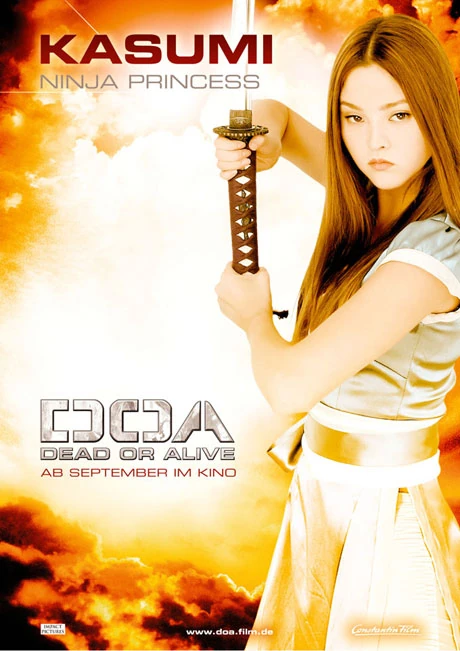
Devon Aoki as Kasumi in DOA: Dead or Alive
In the 2006 feature film, Kasumi is portrayed by Japanese-American actress Devon Aoki. As with most characters in the film, Kasumi's personality was changed to be cold and stern, contrasting her more open and compassionate nature in the games.
Girls of DOA BlackJack
Kasumi appears in the iPhone version of Girls of DOA BlackJack, acting as the blackjack dealer. She is not voiced in the game, though players can unlock different costumes for her with winnings and use pictures of her as iPhone backgrounds.
Ninja Gaiden
Kasumi has made two appearances in Ninja Gaiden
Ninja Gaiden Σ2 / Ninja Gaiden 2 Black (2009 / 2025 Remaster)
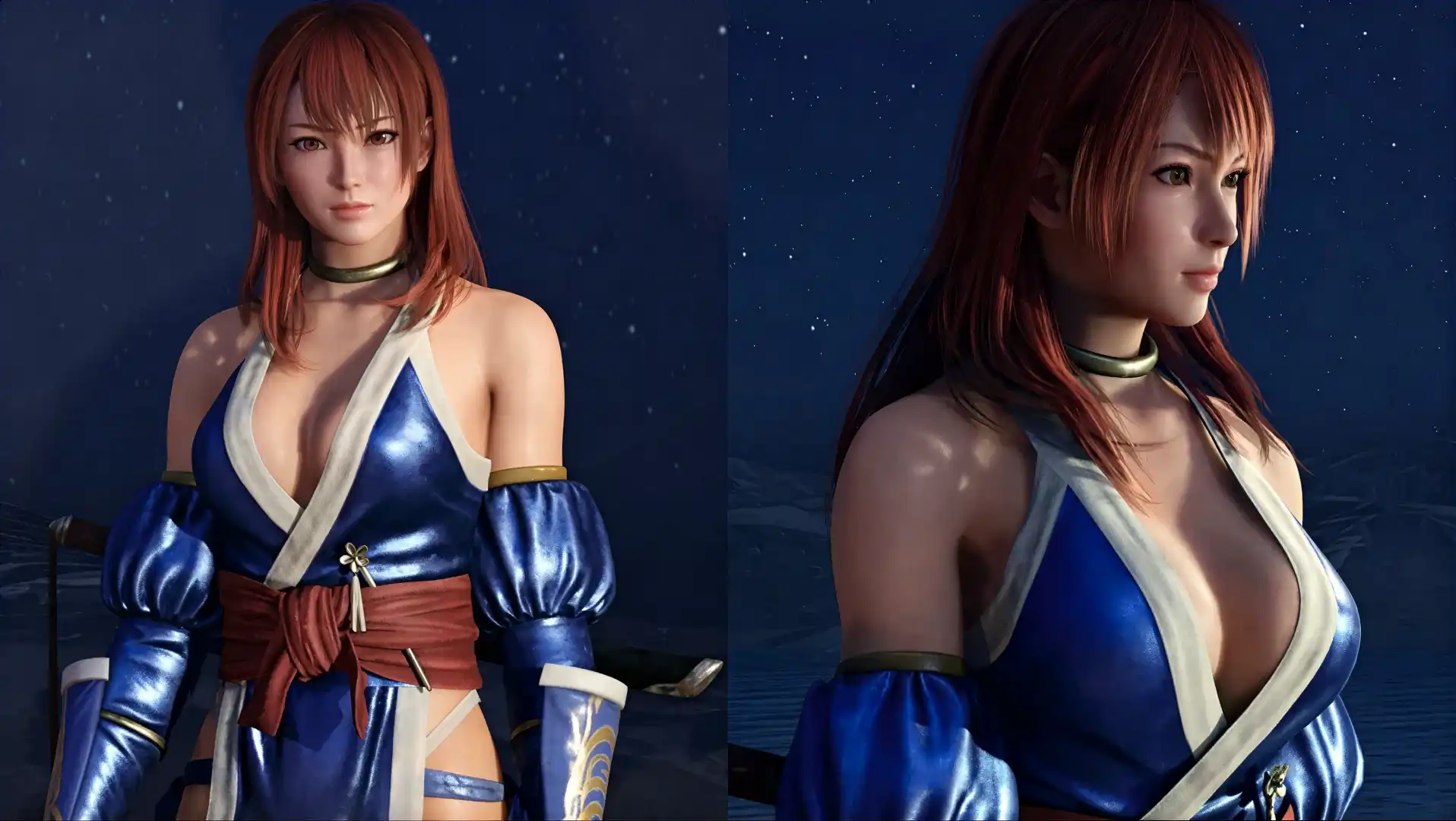
Kasumi in Ninja Gaiden Σ2
Kasumi makes a brief non-playable appearance in Ninja Gaiden Σ2, observing Ryu Hayabusa's battles from a distance. Her face is never shown - she appears only from behind or at angles obscuring her features.
This appearance was included in the 2025 remaster Ninja Gaiden 2 Black, though the character model has notable inaccuracies compared to her established DOA design.
Ninja Gaiden 3: Razor's Edge (2012)
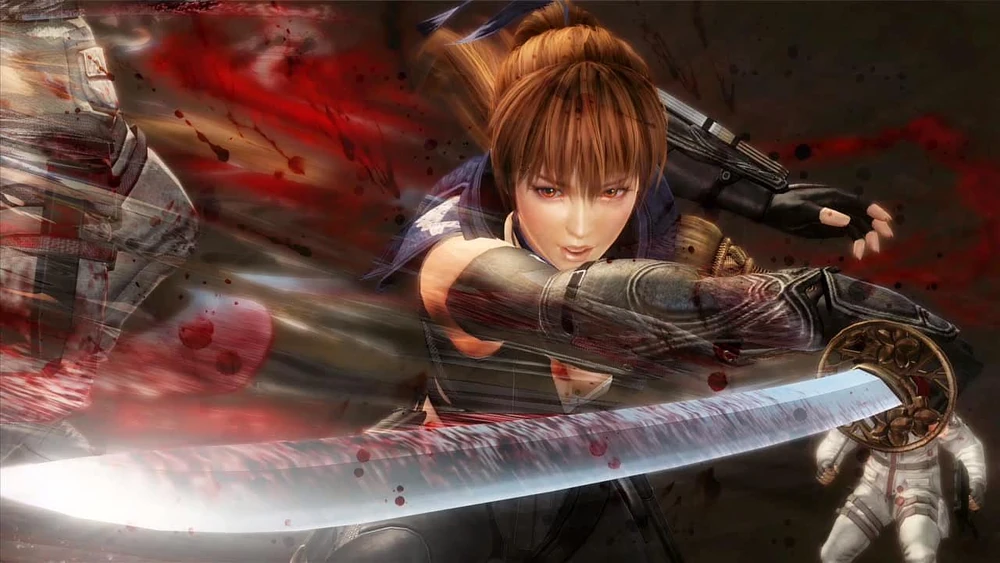
Kasumi in Ninja Gaiden 3: Razor's Edge
Kasumi appears as a playable character in Ninja Gaiden 3: Razor's Edge, available via free DLC (Wii U) or by completing story mode (other platforms).
Bijin Tokei

Kasumi in Bijin Tokei.
To celebrate the release of Dead or Alive Paradise, Kasumi was featured as a place card girl on the Bijin Tokei iPhone digital clock application from April 1-30, 2010. She appeared at random times at least 10 times throughout the day, holding a placard showing the current time.
Non-Dead or Alive Appearances
Queen's Blade / Queen's Gate
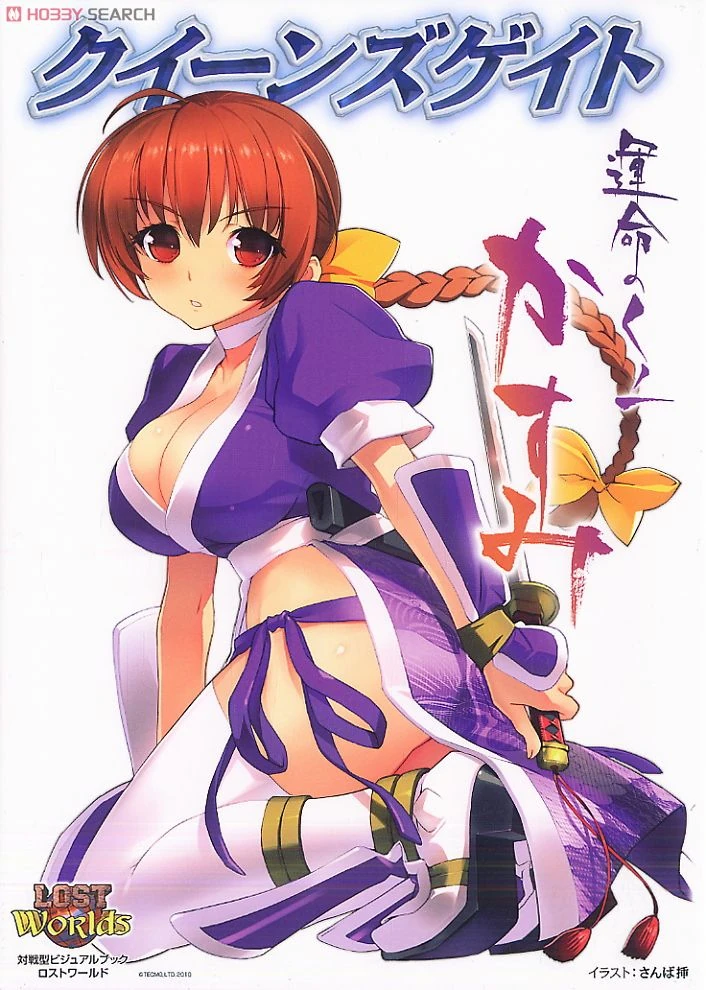
Kasumi in the Queen's Gate series
Kasumi is a playable character in the visual combat book series Queen's Blade, published by Hobby Japan. Her player book is part of the Queen's Gate sub-series, which features licensed characters from video games and anime including Lili from Tekken and Mai Shiranui from King of Fighters. The overall plot involves an interdimensional gate and fighters joining forces to destroy evil and return home. She also received a figure based on her Queen's Gate appearance.
Monster Rancher
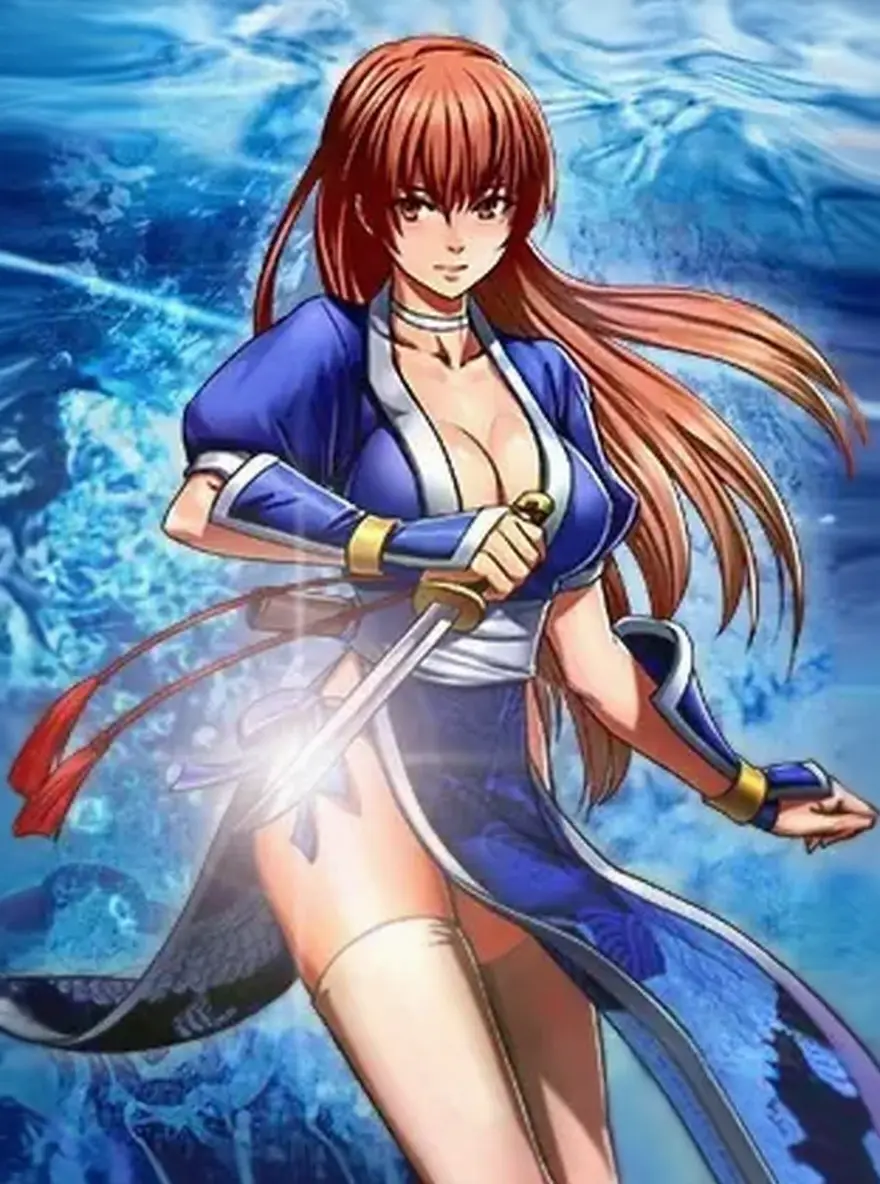
Kasumi sprite in My Monster Rancher
Kasumi appears as a playable "Sprite monster" in Monster Rancher 2, Monster Rancher 4, My Monster Rancher, and the Nintendo DS entries. She must be unlocked by inserting the corresponding Dead or Alive disc at the Shrine. The sprite features shorter, spiky-ponytailed hair and a shorter skirt than her canonical appearance, along with feathery white wings.
Warriors Series
Warriors Orochi 3 Ultimate
Kasumi joins the cast as a playable character on PS3, PS4, Vita, and Xbox One. Her fighting style is based on her appearances in Ninja Gaiden games. Her in-game theme is "Hitohira -DW SW MIX-," a remix of her Dead or Alive 2 theme.
Warriors All-Stars
Kasumi is a playable character representing Dead or Alive alongside Ayane, Honoka, and Marie Rose. Additionally, her outfit is used as a DLC costume for Dynasty Warriors character Wang Yuanji. In the game, Kasumi and other DOA characters are scattered across an alternate world and must be recruited to save it.
Nobunyaga no Yabou: Cat or Alive (April Fool's Joke)
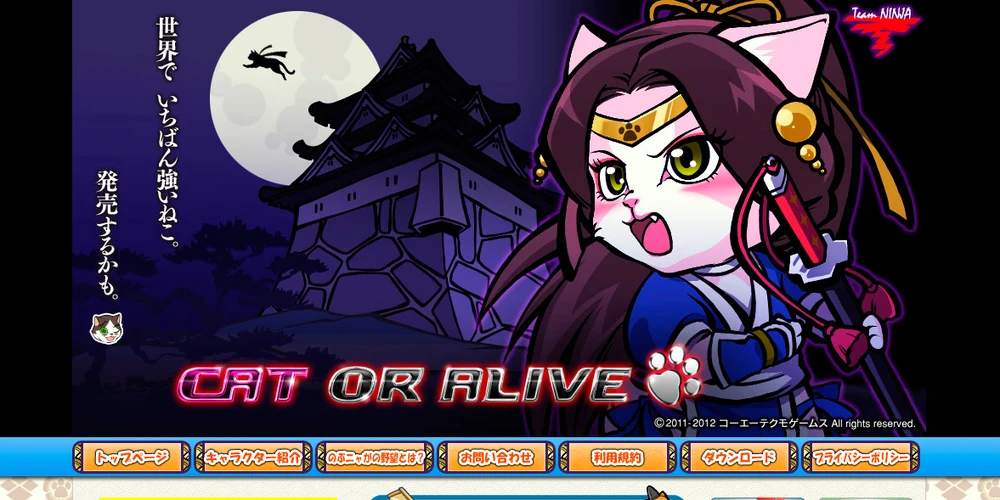
The fake Cat or Alive announcement for April Fool's Day 2012
As an April Fool's joke in 2012, a fake announcement for Cat or Alive was posted on the Nobunyaga no Yabou website, featuring a character dressed as Kasumi. The banner was taken down the next day.
Hyakuman-nin no Ninja Gaiden
Kasumi is one of three rare character cards included in the first Dead or Alive update for this Japan-only social game. Her card is titled "Kunoichi of Destiny Kasumi."
The King of Fighters Series
The King of Fighters XIV
Kasumi appears alongside Mai Shiranui in a cross-series promotional wallpaper, though she is not a playable character in the game itself.
The King of Fighters All Stars
Kasumi appears as a guest fighter alongside Honoka, Nyotengu, and Marie Rose. She wears her default Dead or Alive 6 costume and a blue bikini variant.
Destiny Child
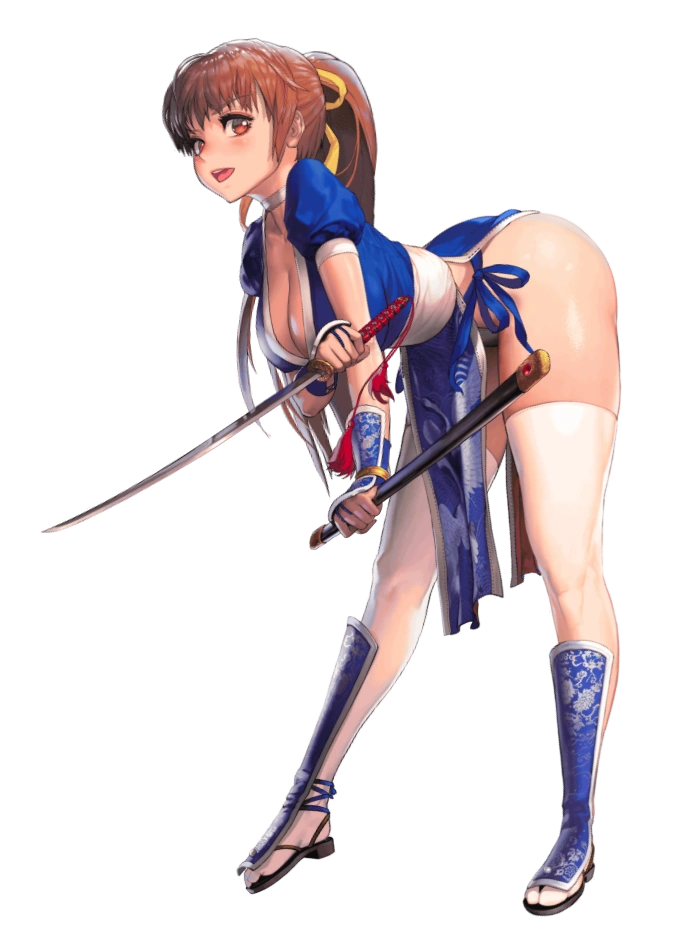
Kasumi in Destiny Child
Kasumi, alongside Marie Rose, Honoka, Leifang, and Ayane, appeared in Destiny Child as part of a collaboration with Xtreme Venus Vacation. She received a costume based on the character Eve.
Alice Gear Aegis
Kasumi was added alongside Marie Rose as part of a collaboration between this game and Xtreme Venus Vacation. She reappeared during the game's second collaboration.
Senran Kagura: New Link
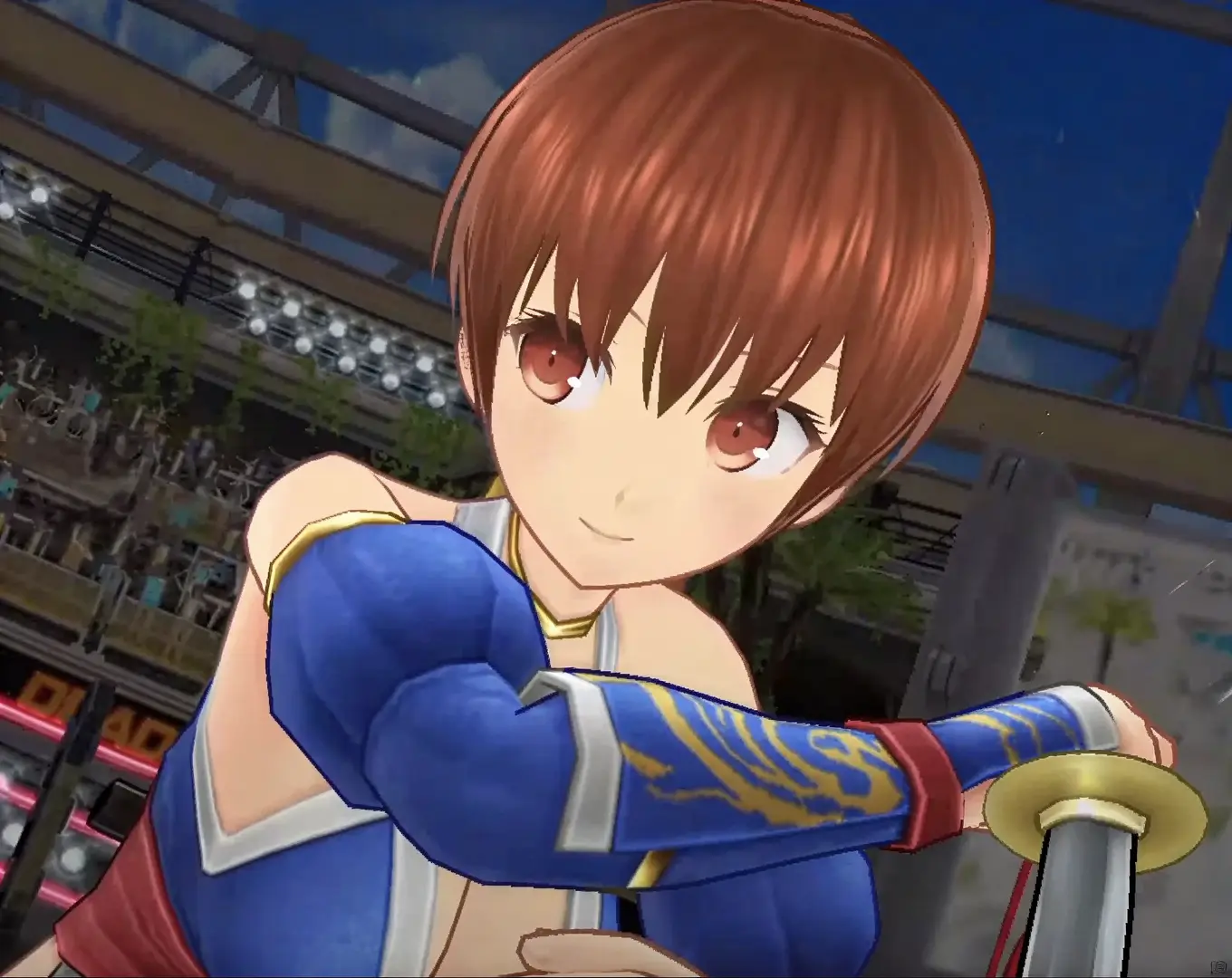
Kasumi in Senran Kagura: New Link
Kasumi appears in Shinobi Master Senran Kagura: New Link alongside Ayane, Marie Rose, and Honoka as part of a collaboration. Her costume was also used for character Asuka during an Xtreme Venus Vacation event in an earlier game.
Azur Lane
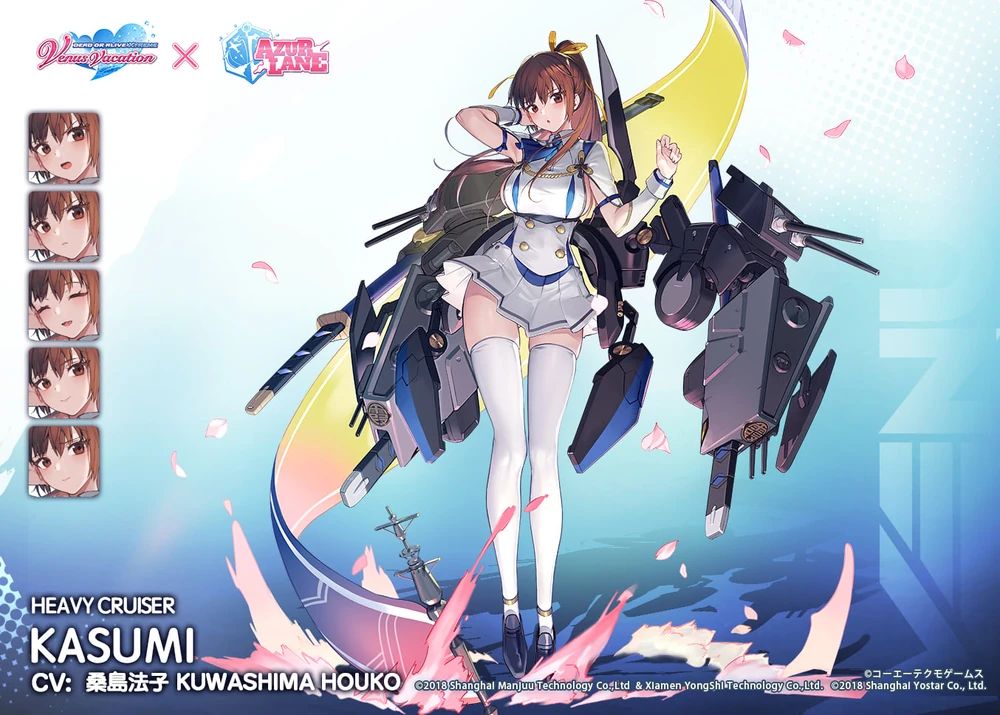
Kasumi in Azur Lane
Kasumi appears as a Heavy Cruiser-class Ship Girl alongside Nyotengu, Marie Rose, Monica, Honoka, Nagisa, and Misaki in a crossover event. On the title screen, she cosplays as shipgirl Atago.
Romance of the Three Kingdoms XIV
Kasumi was added to this game alongside Marie Rose, Ayane, and Misaki as part of a collaboration with Dead or Alive Xtreme Venus Vacation.
Idle Huntress
Kasumi was added alongside Marie Rose as part of a collaboration with Dead or Alive Xtreme Venus Vacation. Her age was initially listed incorrectly as 18 in the Japanese version, which was later corrected by the developers with an apology.
Langrisser
Kasumi was added alongside Marie Rose and Nyotengu as part of a collaboration with Dead or Alive 6.
Outfit usages
Kasumi's signature blue outfit is an unlockable costume in Super Swing Golf, Super Swing Golf 2, and DOAXVV. In the 2004 survival horror Fatal Frame II: Crimson Butterfly Director's Cut for the Xbox, the outfit appears as an alternative outfit for Mio Amakura. Her costume is also available in Koei's social browser game My GAMECITY for both female and male character avatars. The outfit, hairstyles, and accessories were also used in Phantasy Star Online 2 as part of a collaboration with Dead or Alive 5 Last Round.
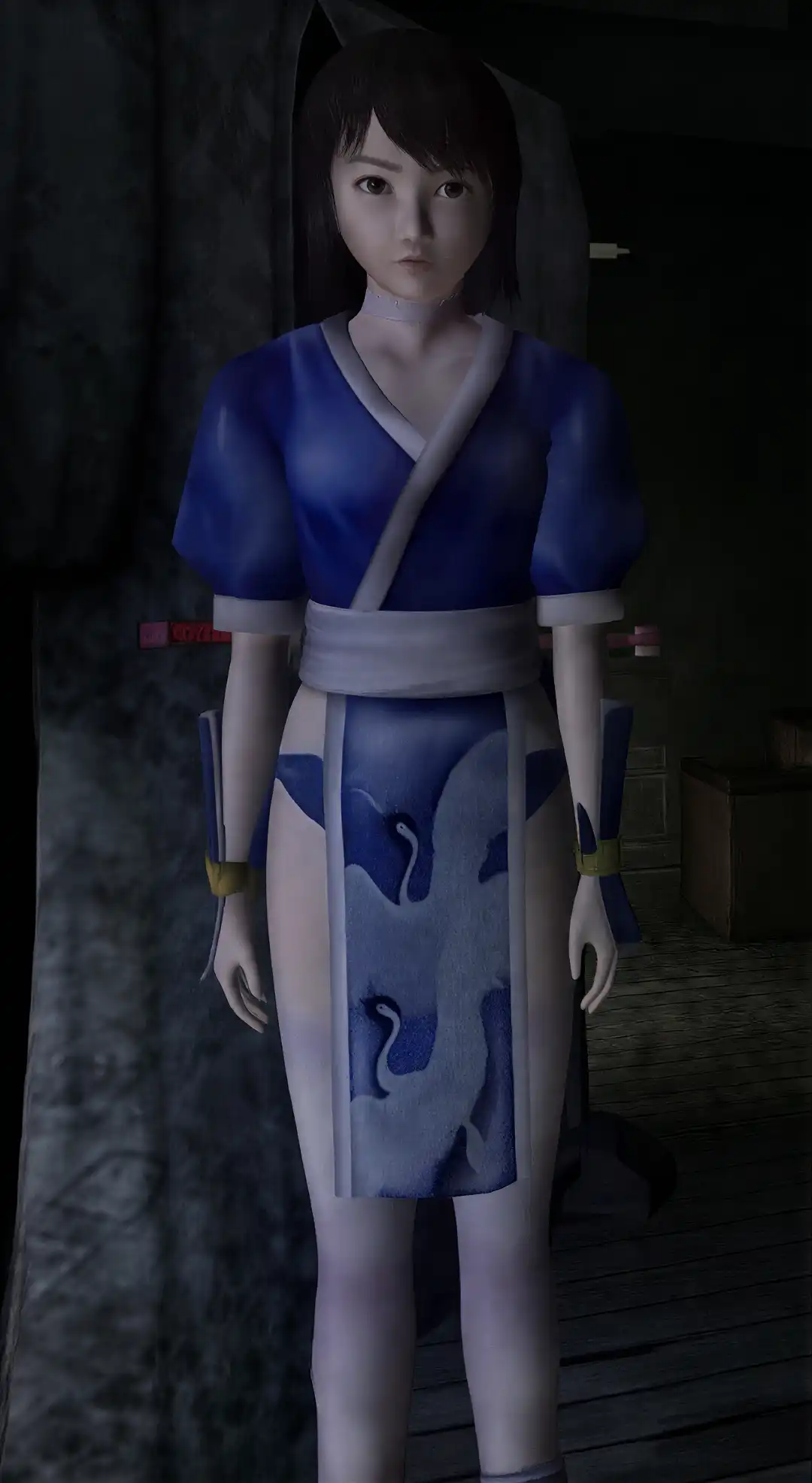
Mio's "Kasumi Outfit" in Fatal Frame: Crimson Butterfly
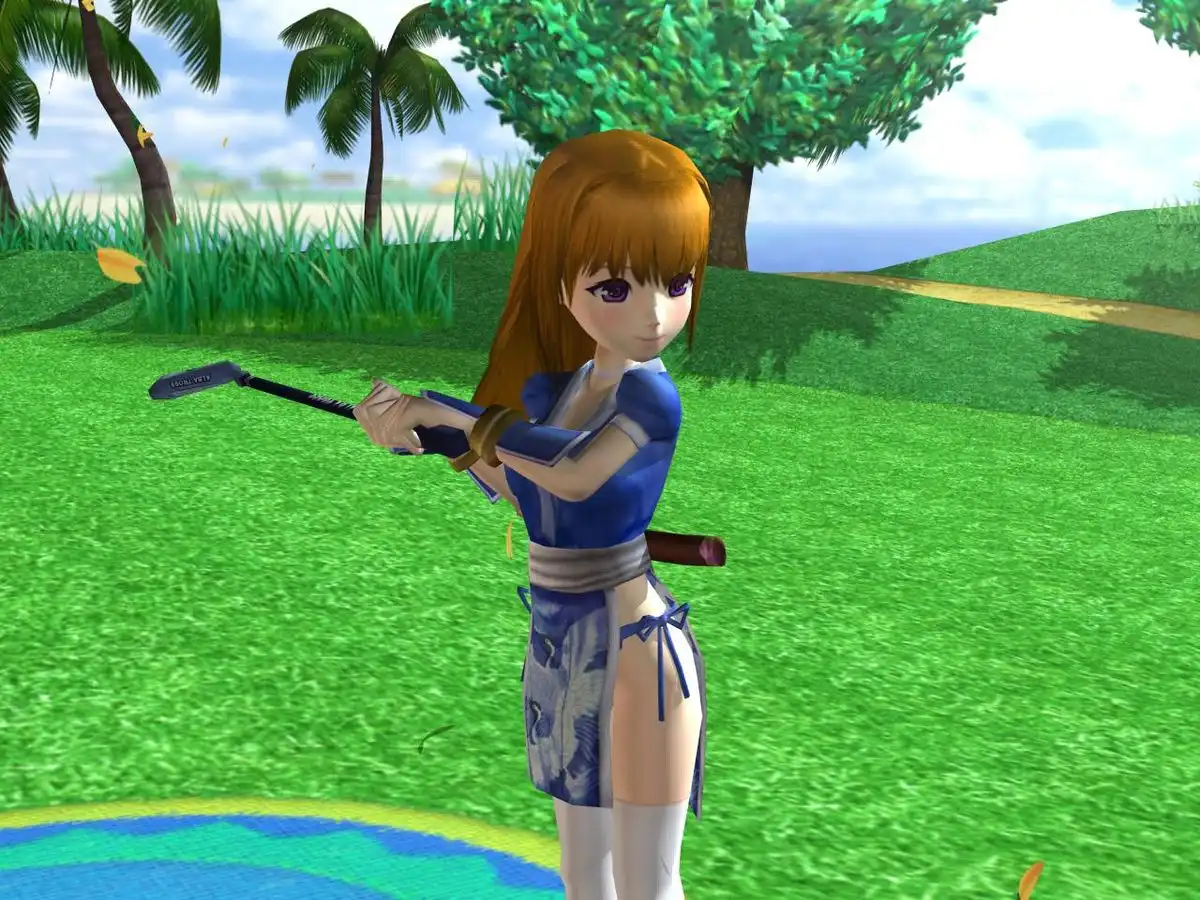
Arin's "Kasumi Outfit" in Super Swing Golf
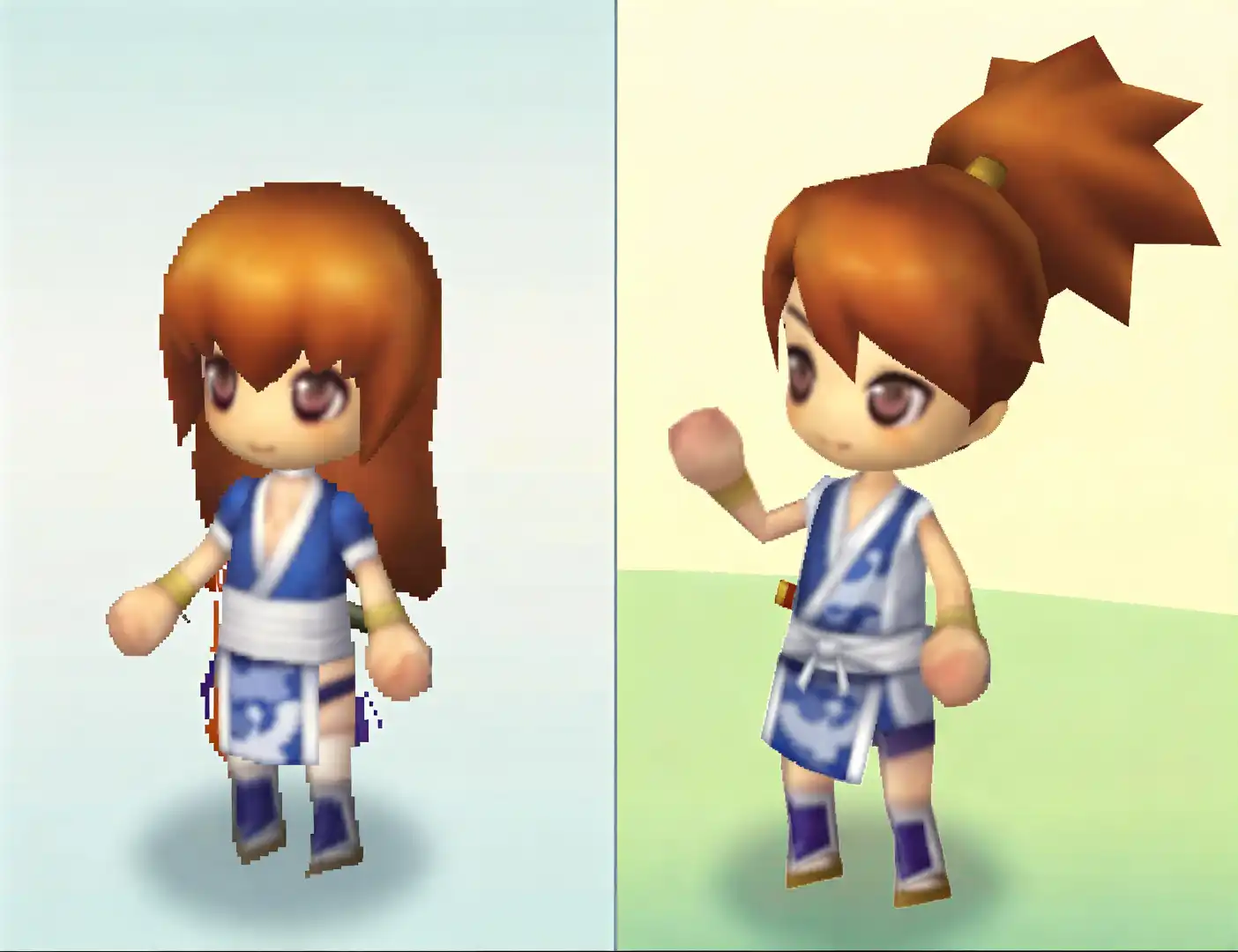
Kasumi costume for both female & male avatars in My GAMECITY
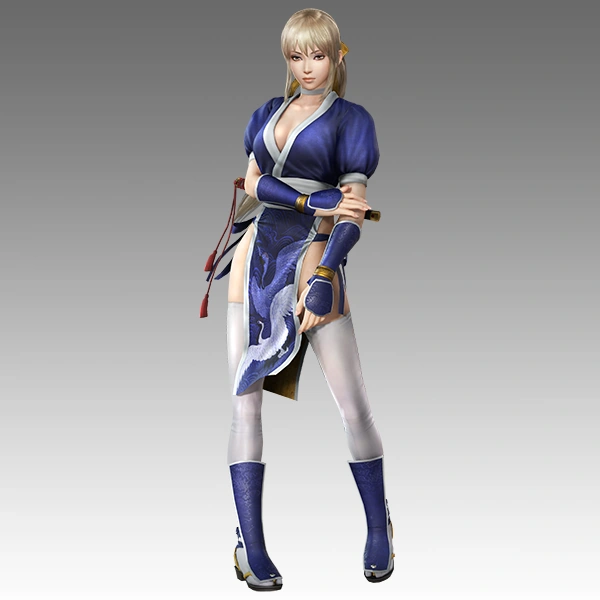
Wang Yuanji's DLC costume in Musou ☆ Stars
Cultural Reception, Accountability, and Historical Context
Industry Exploitation and Critical Response
Kasumi's design and marketing have been consistently criticized for sexual objectification, particularly given her age in early franchise entries. When confronted about these concerns, the developement lead at the time dismissed international criticism as "cultural misunderstanding," stating the studio would continue designing female characters according to "Japanese sensibilities" regardless of ethical concerns.[49]
Critical analysis of Kasumi's treatment includes:
- The Daily Mirror noting the absurdity of marketing an 18-year-old girl whose favorite food is strawberry yogurt as sexual fantasy material[50]
- GameFront's examination of exploitative breast physics implementation using DOAX2 as a primary example[51]
- GamesRadar identifying her as representing "festering adolescent wank-fantasies" rather than genuine character development[52]
- Wirtualna Polska ranking her design second only to Bayonetta among the most unrealistic and sexist depictions of women in gaming[53]
- Kotaku's analysis of objectified female characters in video games[54]
Official Xbox Magazine's claim that "the sheer brilliance of DOA3's gameplay must have made all gamers, feminists included, realise that Tina, Kasumi et al are actually rather fit" exemplifies gaming media's complicity in dismissing legitimate criticism through appeal to gameplay quality.[55]
Legal and Distribution Concerns
Nintendo chose not to release Dead or Alive: Dimensions in Sweden, with reports citing the country's child protection laws and the game's Figure Mode feature allowing intimate photography of underage characters.[56] Australia's Classification Board initially approved the game with a PG rating before revoking classification pending review after concerns were raised about potential child exploitation content.[57] After re-examination, the game was re-released with a stronger M rating.[58]
The North American cover art was altered to reduce Kasumi's exposure.[59] When questioned, a Tecmo Koei spokesperson downplayed the change as precautionary rather than mandated, claiming concerns were "blown out of proportion."[60]
Early Gaming Press (1997-2010)
Gaming publications in the late 1990s and 2000s consistently focused on Kasumi's appearance over her martial arts abilities or narrative role. Sega Saturn Magazine described her as having "the biggest, bountiful breasts we've ever gawped at," framing her through a lens that would later be recognized as reductive objectification.[61] Computer and Video Games declared readers would "fall in love with Kasumi" based primarily on her visual design rather than character depth.[62]
This pattern continued throughout the 2000s, with publications like Official Xbox Magazine claiming "the sheer brilliance of DOA3's gameplay must have made all gamers, feminists included, realise that Tina, Kasumi et al are actually rather fit"[63] - a statement that reveals how gaming media dismissed feminist criticism by suggesting gameplay quality justified objectification.
"Hottest Babe" Rankings (2004-2015)
Between 2004 and 2015, Kasumi appeared in numerous gaming media "hottest character" lists, reflecting an era when reducing female characters to sexual rankings was normalized industry practice:
- TeamXbox "Top Ten Xbox Babes" #3 (2004)[64]
- G4's Video Game Vixens "Dressed to Kill" winner (2005)[65]
- Official Xbox Magazine "Hottest Female Character on Xbox" (52% of votes, 2005)[66]
- G-Phoria "Best Hottest Babe" (55% of votes, 2007)[67]
- VG Chartz "Hottest Videogame Babes" #1 (2009)[68]
- UGO Networks "Top 50 Videogame Hotties" #3 (2010)[69]
These rankings typically evaluated female characters based on breast size, body proportions, and costume design rather than narrative significance or combat abilities. GameDaily explicitly stated their love of "female ninjas, especially ones with gigantic breasts,"[70] while UGO described her as "freakin' hot" and "the most attractive ninja you'll ever see."[71]
Gaming publications created dedicated features ranking female characters by specific body parts, including GamePro's "Top Asses in Gaming,"[72] GameFront's "Greatest Boobs in Video Game History,"[73] and similar lists focused on "chests" and physical attributes.[74] These represent a period in gaming journalism now widely recognized as complicit in systemic objectification.
International Market Positioning
Kotaku reported in 2006 that Kasumi had become "nothing short of an icon" in Japan,[75] with the lead developer at the time claiming "maybe 10% of [Japanese magazines] have Kasumi on their cover."[76] In Koei Tecmo's 2014 official poll, she received over 19% of votes as the series' most popular character.[77]
International polls consistently ranked her highly in "sexy character" categories across multiple countries including Poland, Brazil, Korea, Vietnam, and China,[78][79][80] reflecting how her marketing as a sexual object transcended cultural boundaries.
Cosplay Community and Creative Expression
Kasumi became one of the most frequently cosplayed fighting game characters, particularly in Japan where her costumes were popular at events since the 1990s.[81] Brian Ashcraft of Kotaku noted in 2012 that "her ninja outfit in its various colors is instantly recognizable. She isn't merely in Dead or Alive; she is Dead or Alive."[82]
Professional gamers Marjorie "Kasumi Chan" Bartell[83] and Marie-Laure "Kayane" Norindr[84] incorporated Kasumi's name into their professional aliases, and comic book writer Gail Simone identified her as a favorite DOA character.[85]
Critical Recognition Beyond Objectification
Some publications acknowledged Kasumi's martial arts abilities and narrative role. WomanGamers.com rated her 8.14/10 for being "willing to risk everything in order to search for her missing brother," noting positively "the popularity of the DOA characters with Japanese females, coupled with the fact that these ladies are not portrayed as damsels in distress but instead are shown to be dangerous opponents with their own agendas."[86]
The Age ranked her 36th on its 2008 list of top 50 Xbox characters,[87] and PC Games Hardware listed her among important female characters in gaming history.[88] Retro Gamer chose her as one of the "coolest fighters from the last 30 years" in 2013.[89]
Historical Context
The gaming industry's treatment of Kasumi between 1996 and 2015 reflects broader cultural attitudes toward female representation in media that have since been critically re-examined. What was once presented as celebratory "appreciation" is now more accurately understood as systematic reduction of complex characters to sexual objects for presumed male audiences.
Contemporary gaming criticism recognizes this era as emblematic of industry-wide problems with representation, objectification, and the marginalization of women both as characters and as audience members. The extensive documentation of Kasumi's physical attributes over her narrative agency or martial arts skill represents a failure of gaming media to engage with female characters as complete people.
While the Dead or Alive franchise has seen declining sales and reduced support - with DOA6's post-launch content ending prematurely in 2019 and the mobile game Dead or Alive Xtreme Venus Vacation Prism underperforming significantly upon its 2025 launch - the commercial success of games like NieR: Automata (2017) and Stellar Blade (2024) demonstrates that sexualized character design remains commercially viable when paired with innovative gameplay and narrative depth. Critics argue this highlights DOA's failure to evolve its core mechanics, competitive scene, or storytelling beyond its initial formula, resulting in market stagnation despite the franchise's pioneering role in establishing certain visual and technical standards for 3D fighting games.
Videos
Dead Or Alive - Kasumi Ending
Raw
Dead or Alive - Kasumi Ending (Translated)
Translation
Dead Or Alive ++ - Kasumi Ending "-1 Awaken"
Raw
Dead Or Alive 2 Hardcore Ending"
DOA2H
Kasumi's Dead or Alive 3 Ending
DOA3 "In The Ray of Sundown"
Dead Or Alive 4 KASUMI "The Eternal Heroine"
DOA4 "The Eternal Heroine"
Dead Or Alive Dimension Kasumi Origin
DOAD "Kasumi Origin Story"
Dead Or Alive 2 Intro and Victory Poses (JP)
DOA2 "Intro and Victory Poses"
Dead Or Alive 5 Intro and Victory Poses
DOA5 "Intro and Victory Poses"
Music Themes
The following are the music themes used for Kasumi throughout the series.
Note that both the Dead or Alive++ and Dimensions themes have no official names.
| Theme Name | Audio | Game Appearances |
|---|---|---|
| "Ketsui no Toki" | Dead or Alive (arcade, 1996); Dead or Alive (Sega Saturn, 1997; Arcade Mode); Dead or Alive 1 Ultimate (Arcade Mode); Dead or Alive 5 Last Round (optional theme); Dead or Alive 6 (optional theme) | |
| "Kasumi Remix" | Dead or Alive 2 Ultimate | |
| "Hitohira ~Reminiscent of Ketsui no Toki~" | Dead or Alive 2; DOA2: Hardcore; Dead or Alive 2 Ultimate; Dead or Alive Online; Dead or Alive 5 Ultimate (optional); Dead or Alive 5 Last Round (optional) | |
| "Eternity" | Dead or Alive 3; Dead or Alive 5 Ultimate (optional); Dead or Alive 5 Last Round (optional); Dead or Alive 6 (optional) | |
| "Hitohira Remix" | Dead or Alive 4 (Crash Club; as "Hitohira Remix"); Dead or Alive 6 (optional) | |
| "Purity" | Dead or Alive 4; Dead or Alive 5+; Dead or Alive 5 Ultimate (default); Dead or Alive 5 Ultimate Arcade; Dead or Alive 5 Last Round (default); Dead or Alive 6 (optional) | |
| "Hitohira -DW SW MIX-" | Dead or Alive 5 Last Round (optional) | |
| "Playa Del Soul" | Dead or Alive Xtreme Venus Vacation |
Gallery
Official artwork, character renders, and promotional images from across the Dead or Alive series.
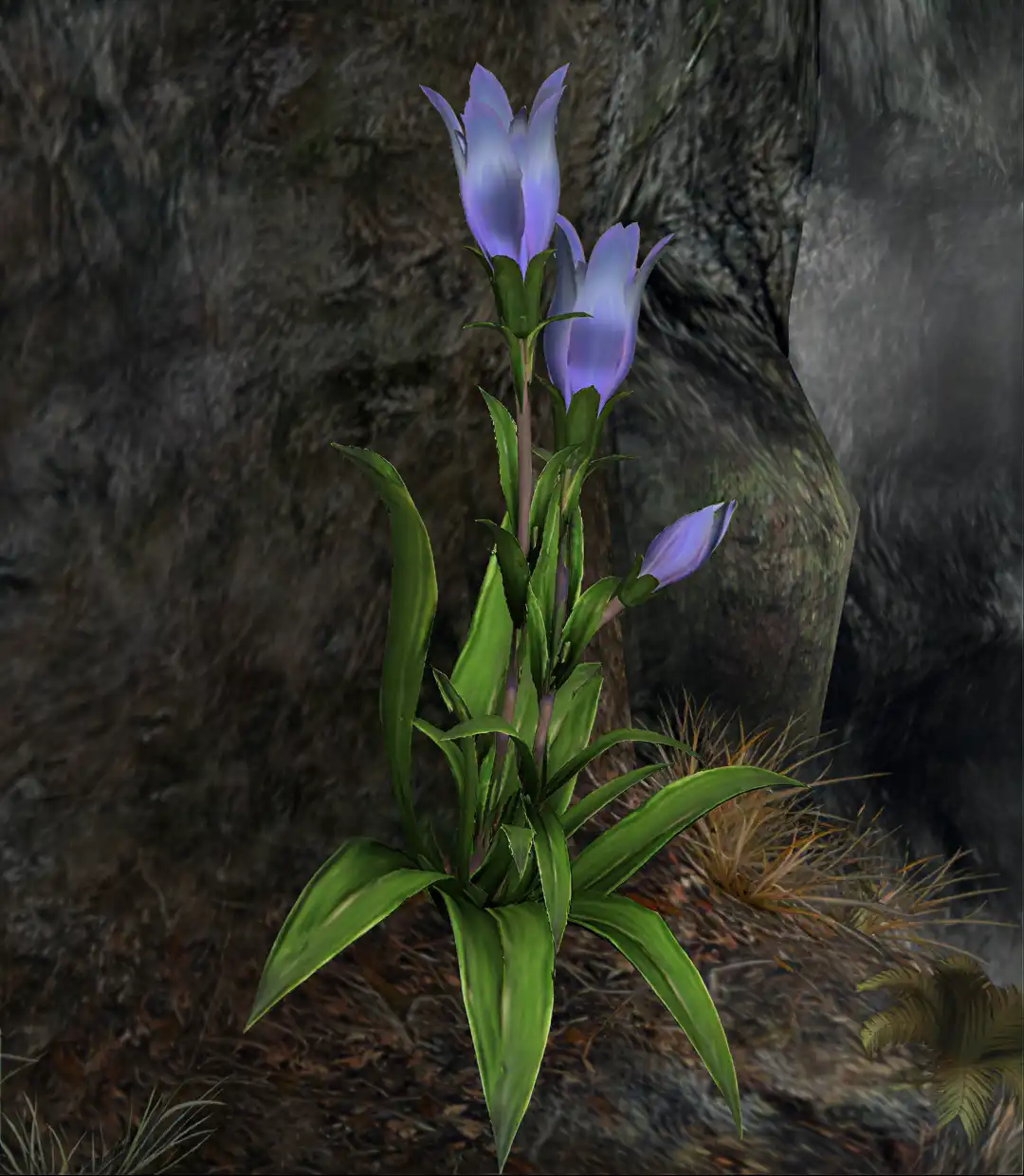
The Gentian flowers — Kasumi's symbolic flower, representing her longing and her exile.

天神流第十八代目 (Tenjin-ryū Dai-jūhachi-daime) — "Heavenly God Style, 18th Generation Successor." Kasumi's stylized name kanji (霞) and lineage emblem, appearing across her outfits throughout the series.
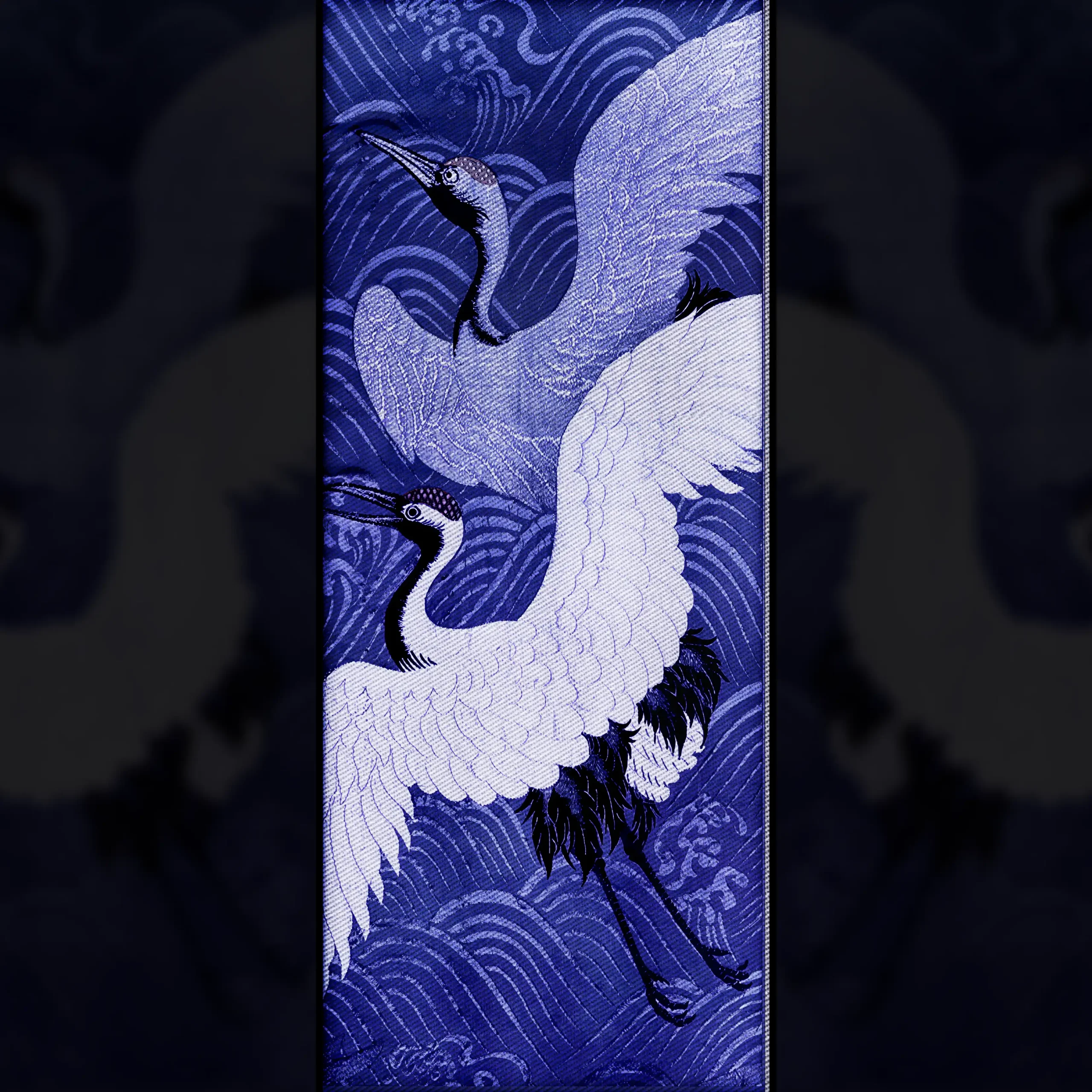
Traditional seigaiha wave pattern with tsuru cranes — motifs woven throughout Kasumi's costume designs, symbolizing resilience, longevity, and fidelity.

Kasumi on the cover of Dreamcast Magazine Vol. 32 (October 13, 2000), promoting DOA2 on Dreamcast — shown in civilian clothes, outside her ninja role.
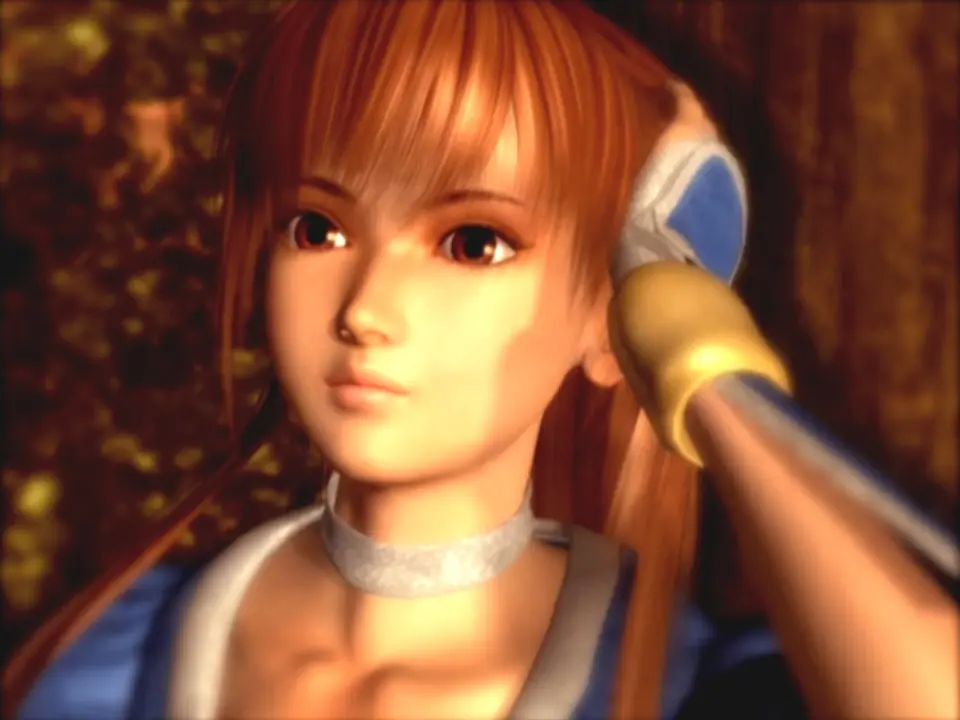
Kasumi as she appears in the DOA3 ending sequence.
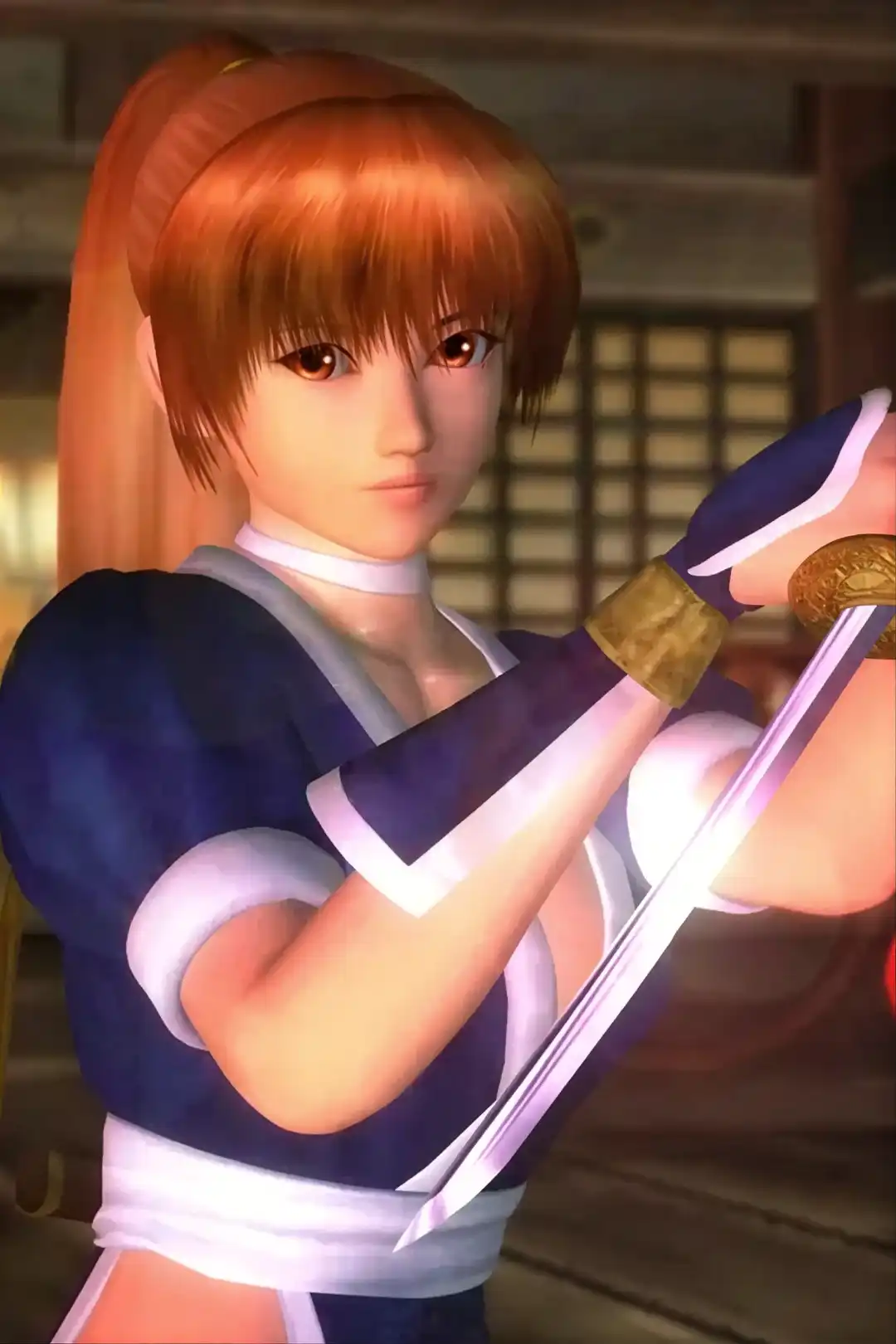
Kasumi promotional render.
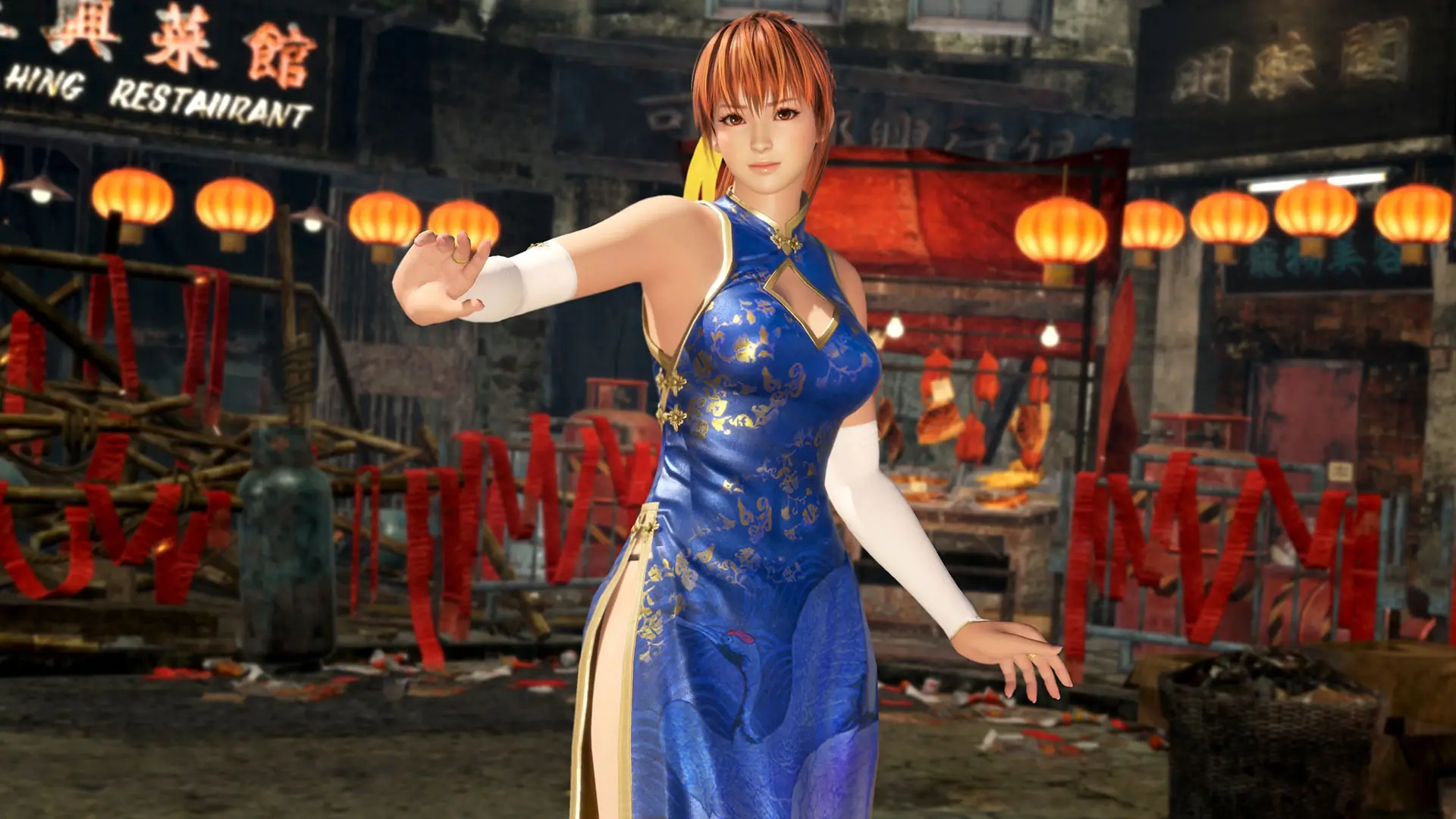
Kasumi character render.
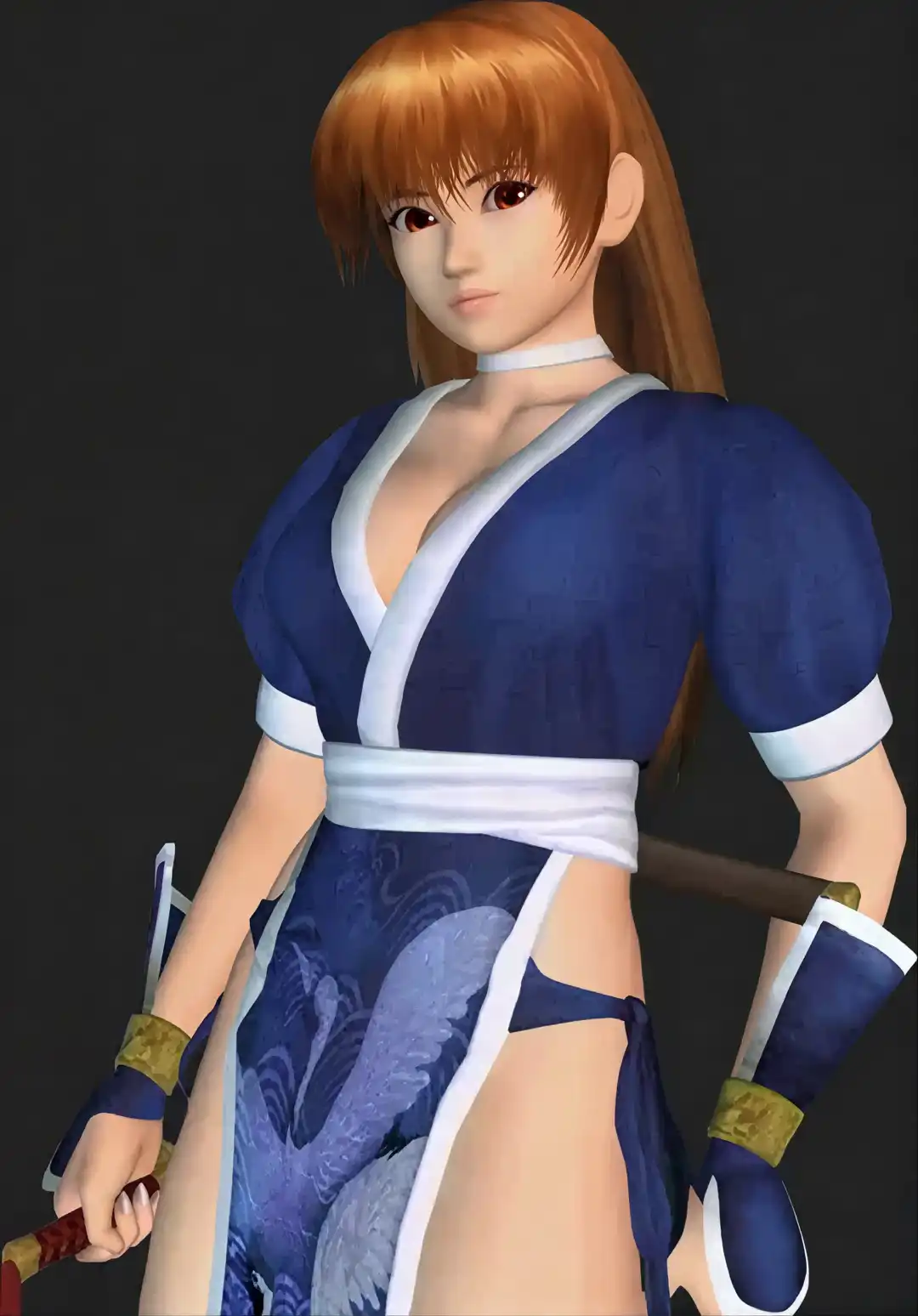
Kasumi promotional artwork.

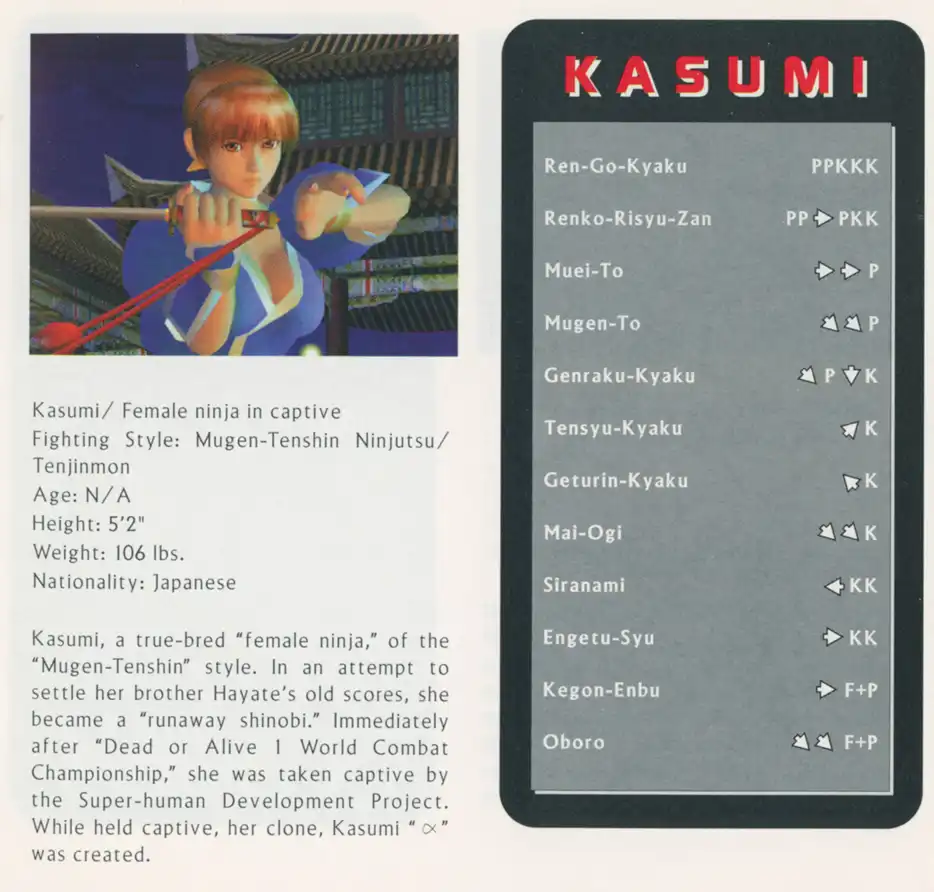
Kasumi in the Dead or Alive (PS1) manual.
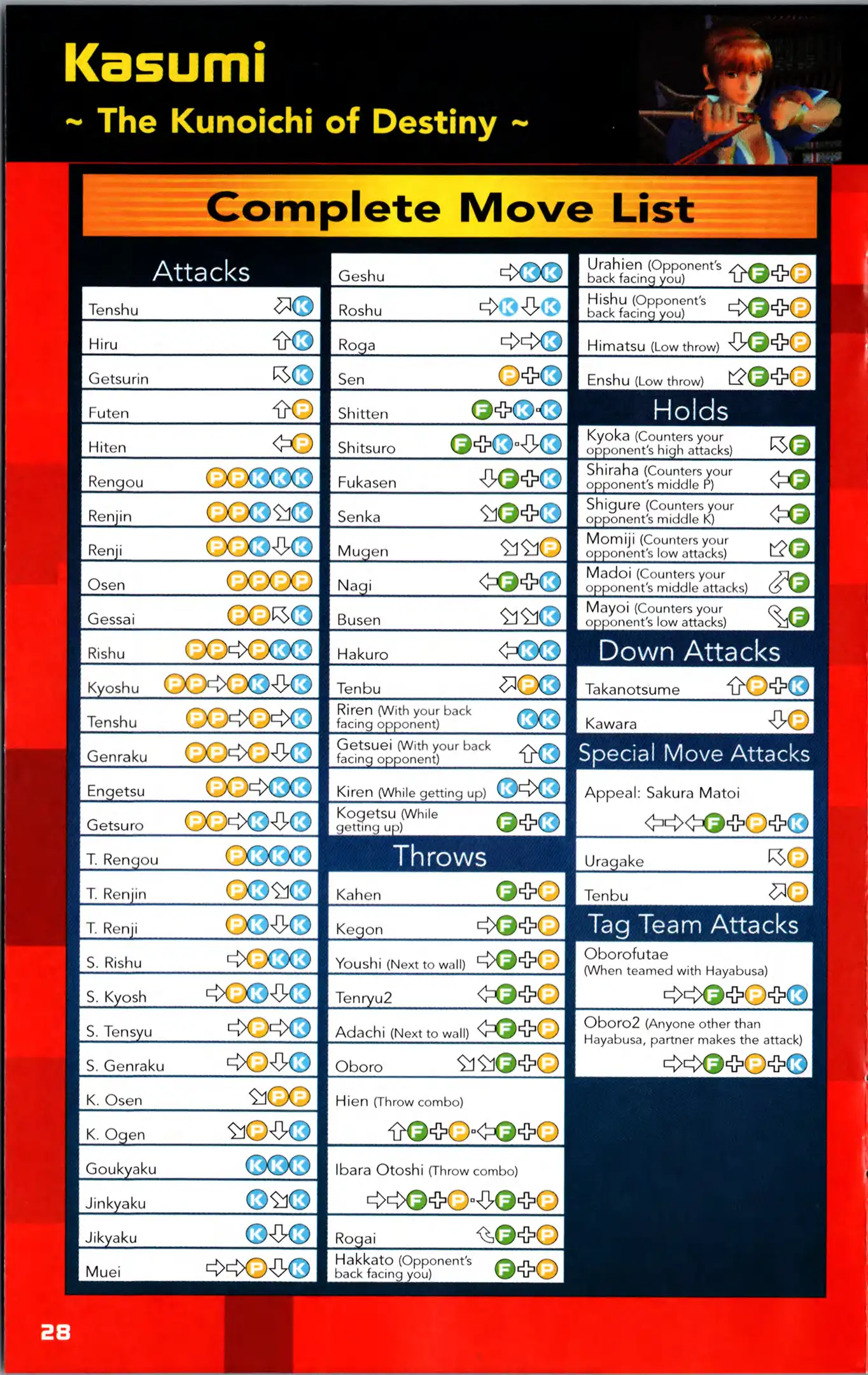
Kasumi in the Dead or Alive 2 manual.
Kasumi in the Dead or Alive 2 Hardcore (PS2) manual.
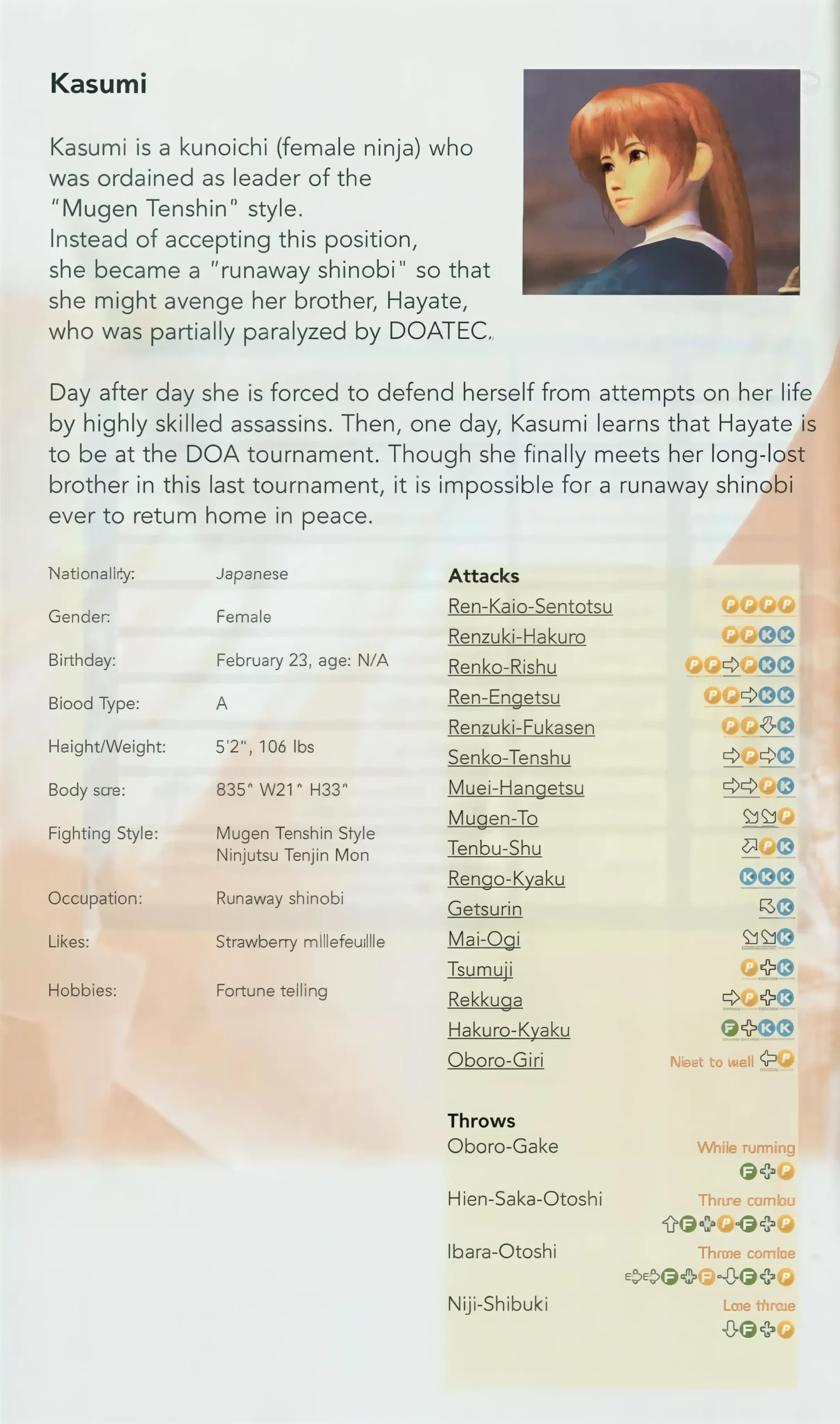
Kasumi in the Dead or Alive 3 manual.
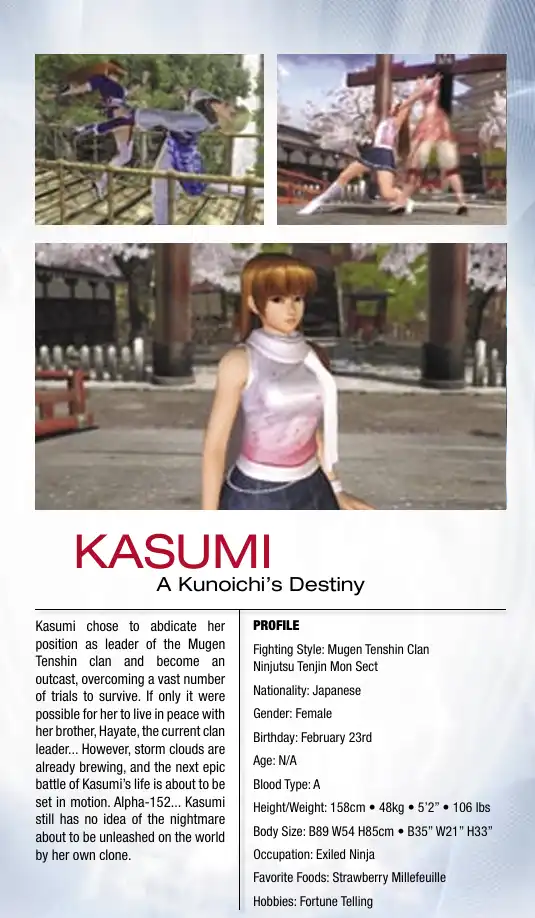
Kasumi in the Dead or Alive 4 manual.
Kasumi artwork — Dead or Alive (1996).
Kasumi artwork — Dead or Alive (1996).
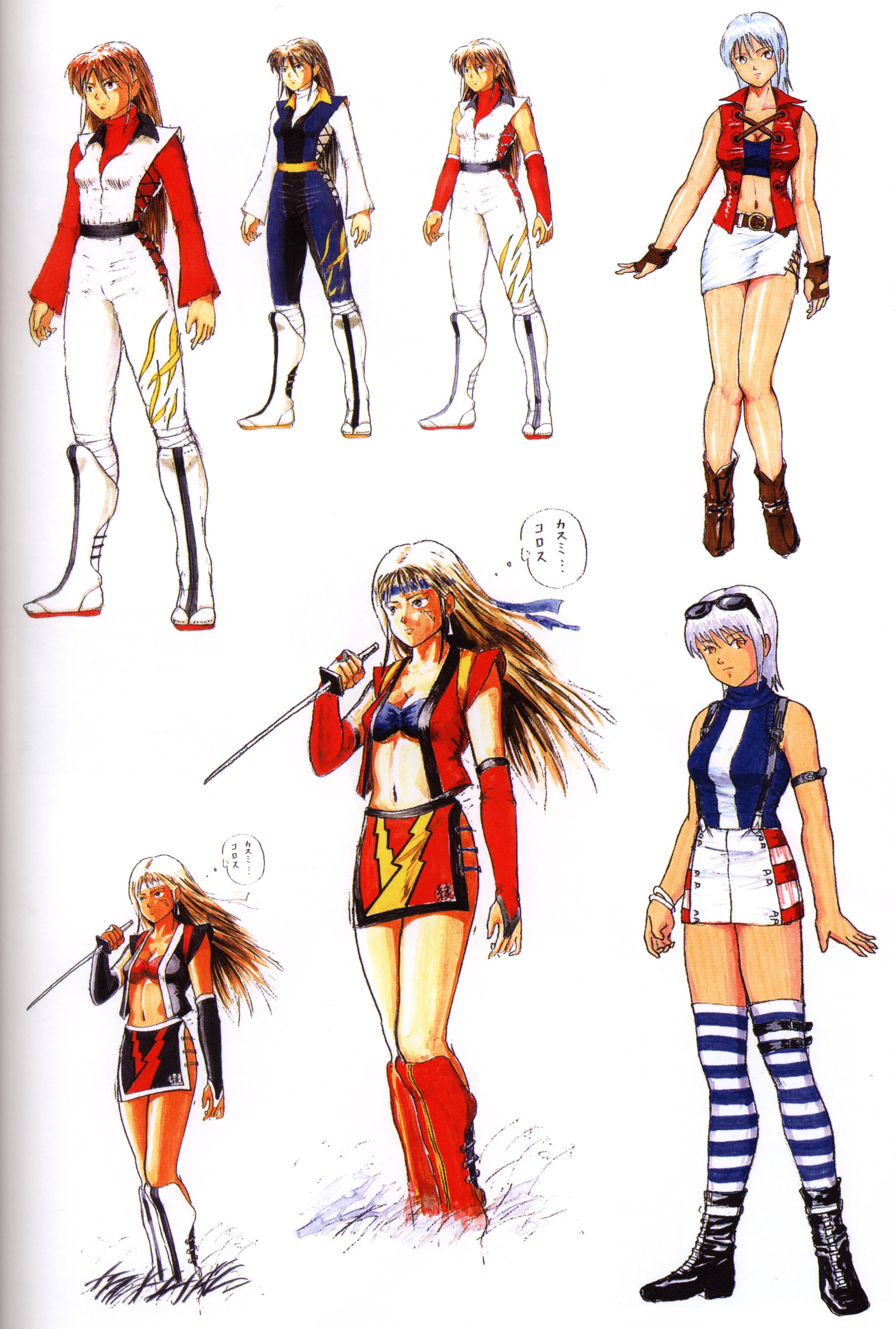
DOA1 concept art showing early costume designs for Kasumi and Ayame — before their final in-game appearance.

Kasumi's character select portrait from the DOA1 arcade version.
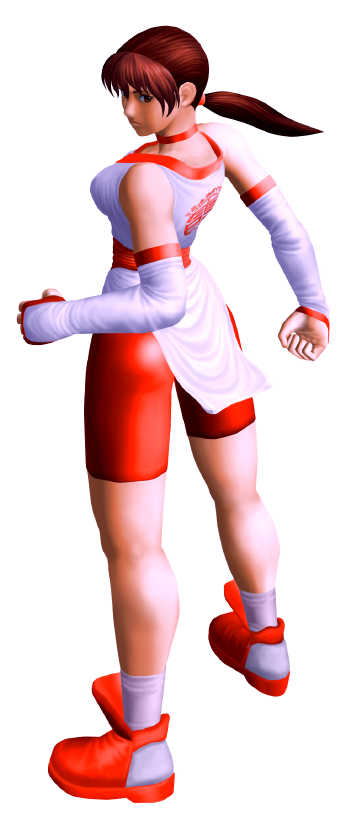
Classic Kasumi artwork from the early DOA era.

Kasumi in traditional kimono.

Kasumi in traditional kimono — alternate art.

Kasumi in traditional kimono — alternate art.
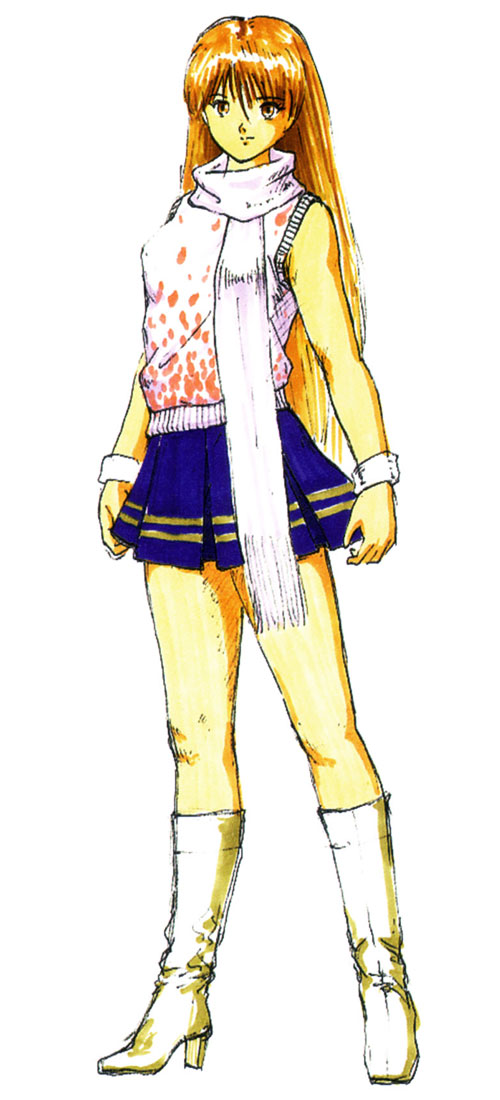
Kasumi character render — Dead or Alive 3.

Kasumi artwork — Dead or Alive 3.

Kasumi artwork — Dead or Alive 3.
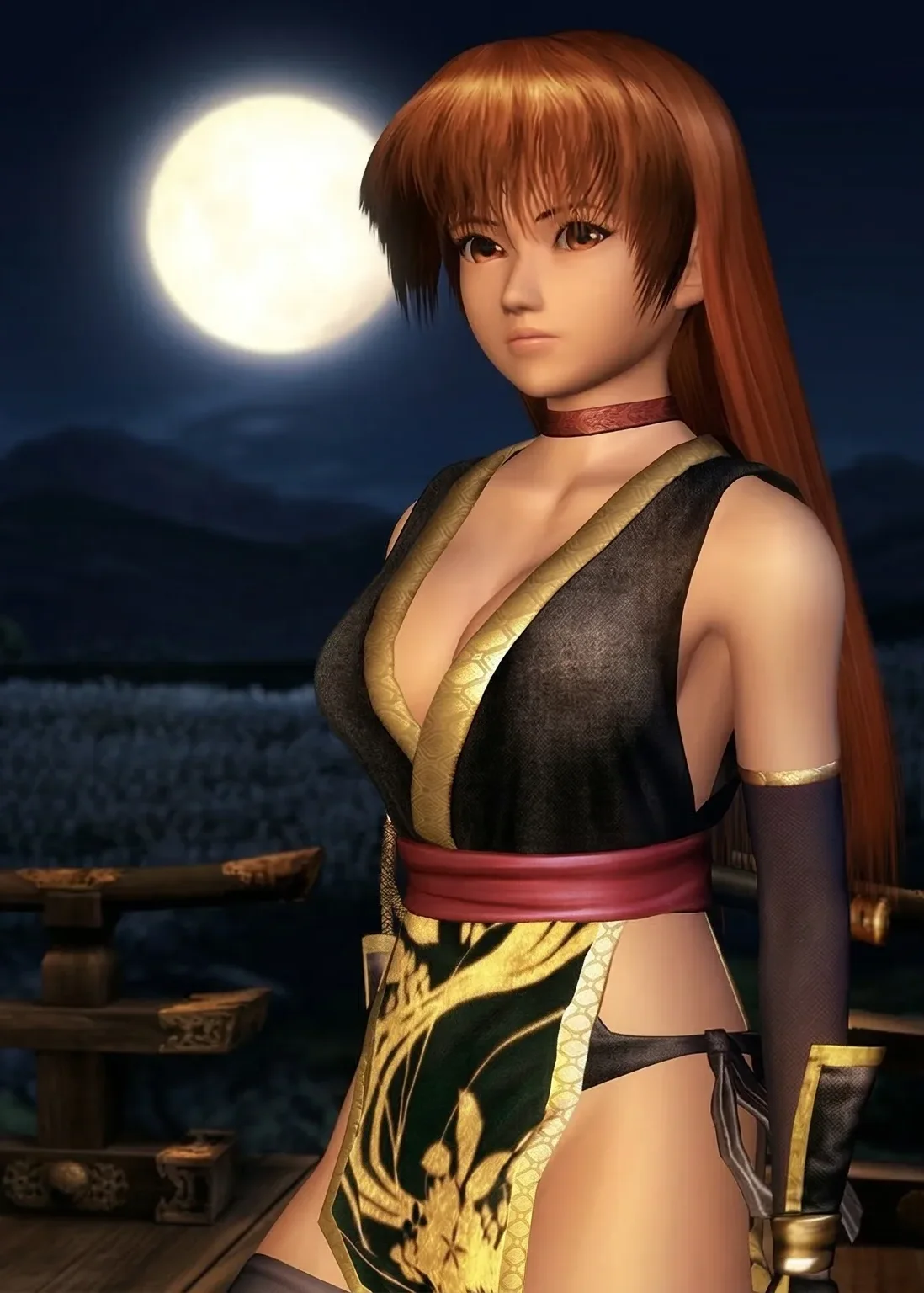
Kasumi artwork — Dead or Alive 4.

Dead or Alive 4 soundtrack cover art featuring Kasumi.
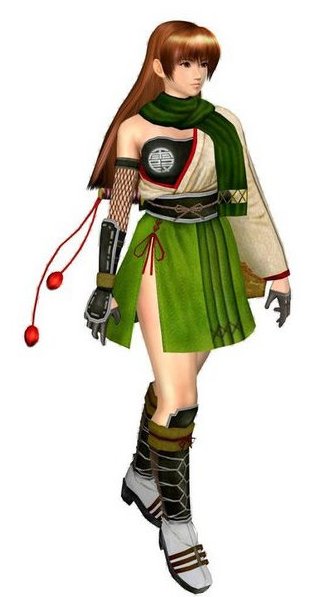
Kasumi artwork — Dead or Alive Dimensions (3DS).
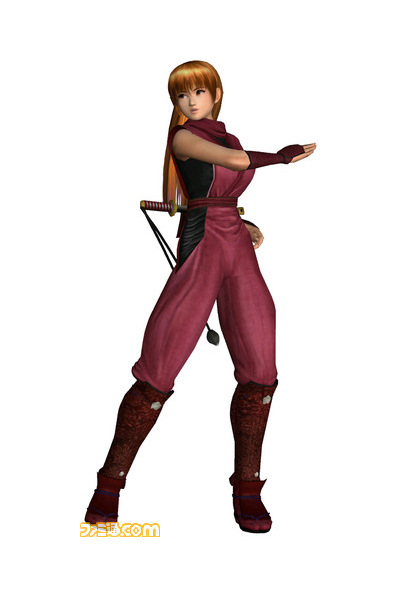
Kasumi render — Dead or Alive Dimensions.
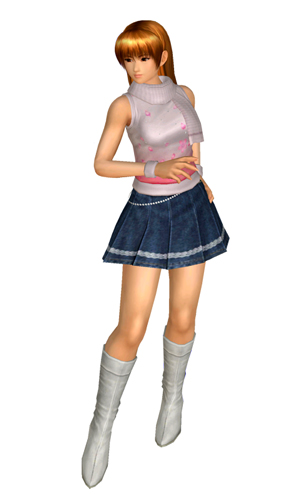
Kasumi artwork — Dead or Alive Dimensions.

Kasumi alternate artwork — Dead or Alive Dimensions.
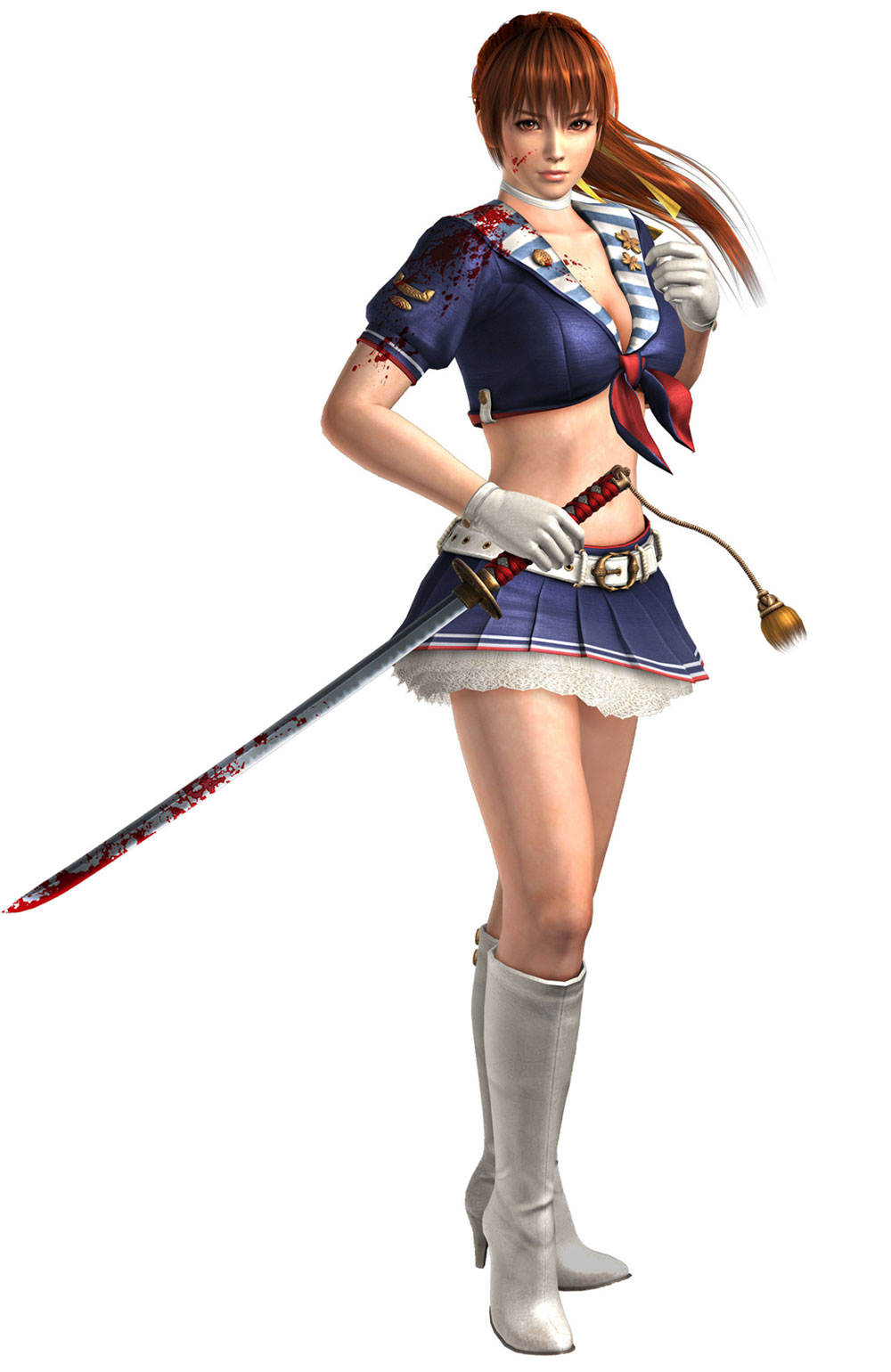
Kasumi in Ninja Gaiden 3: Razor's Edge — her crossover appearance as a playable character.
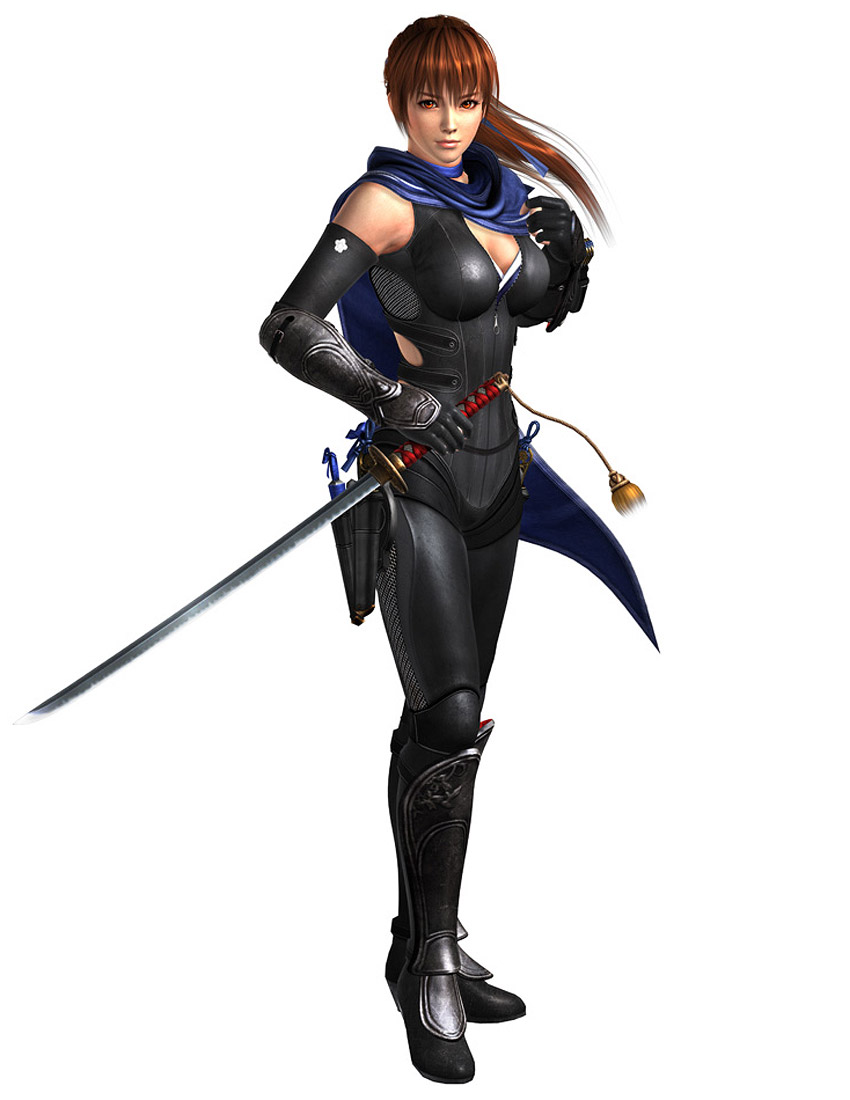
Kasumi in Ninja Gaiden 3: Razor's Edge.
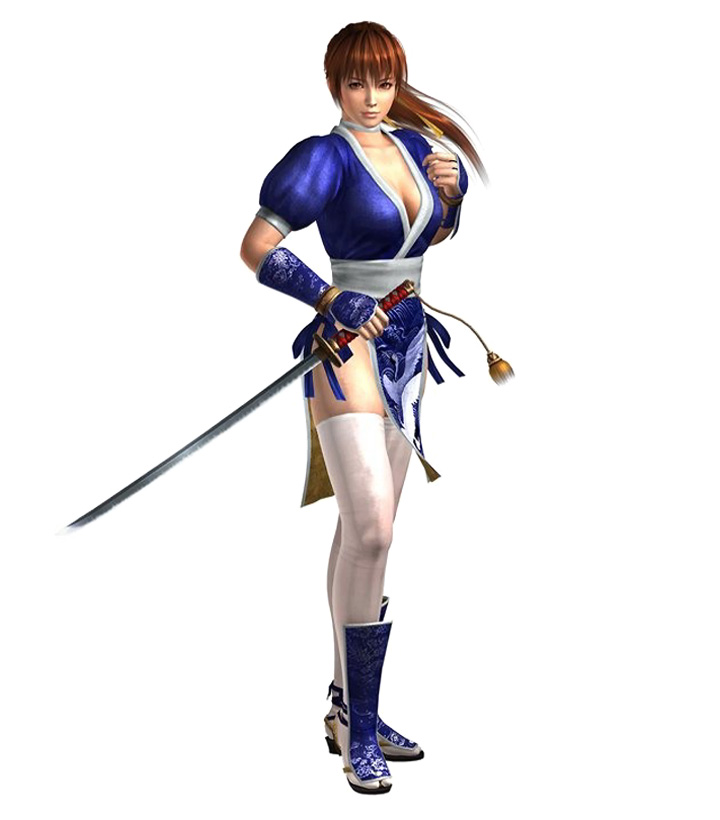
Kasumi in Ninja Gaiden 3: Razor's Edge.
Kasumi in Ninja Gaiden 3: Razor's Edge.
Kasumi in Ninja Gaiden 3: Razor's Edge.
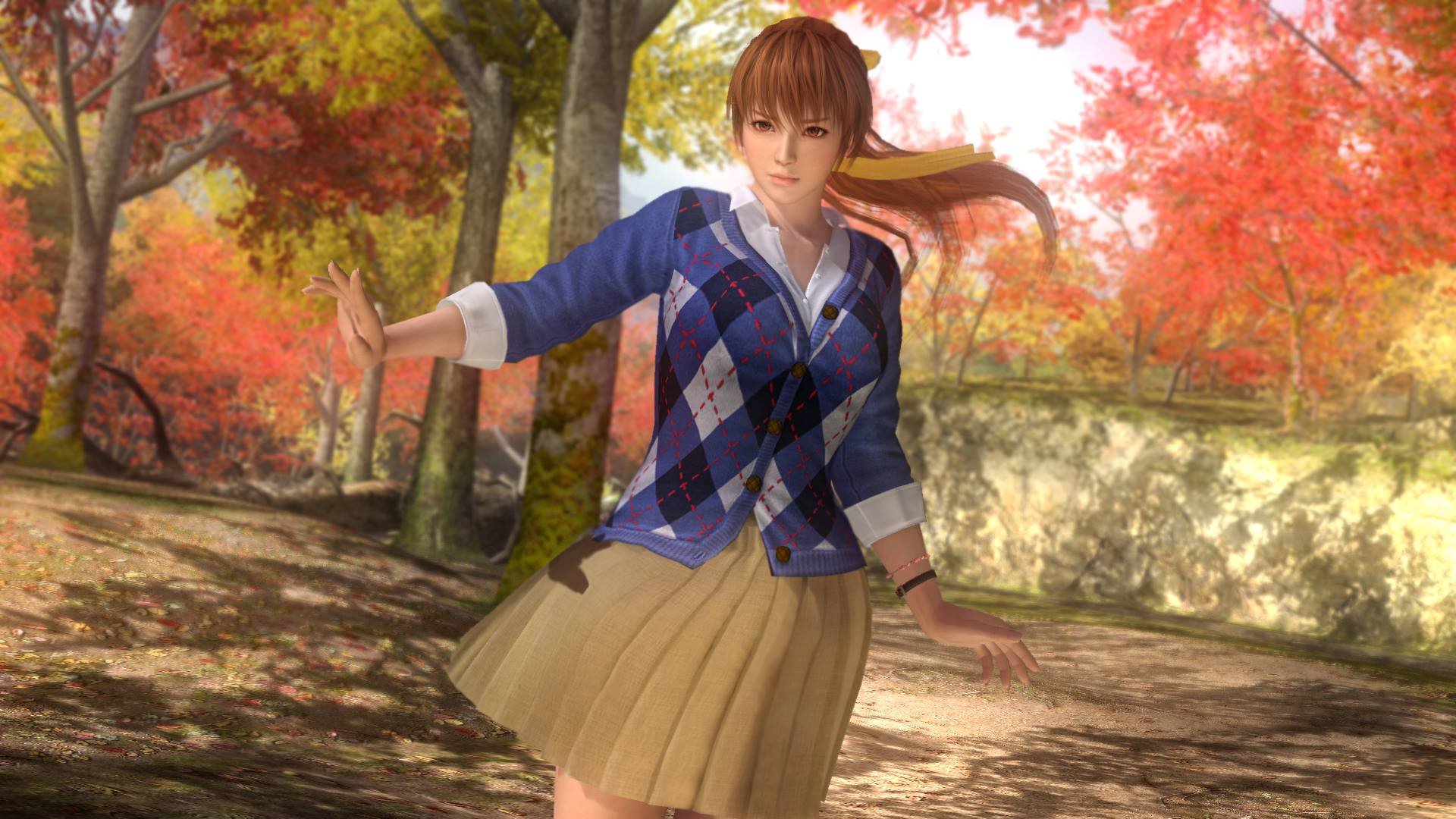
Kasumi in Dead or Alive 5 Ultimate.
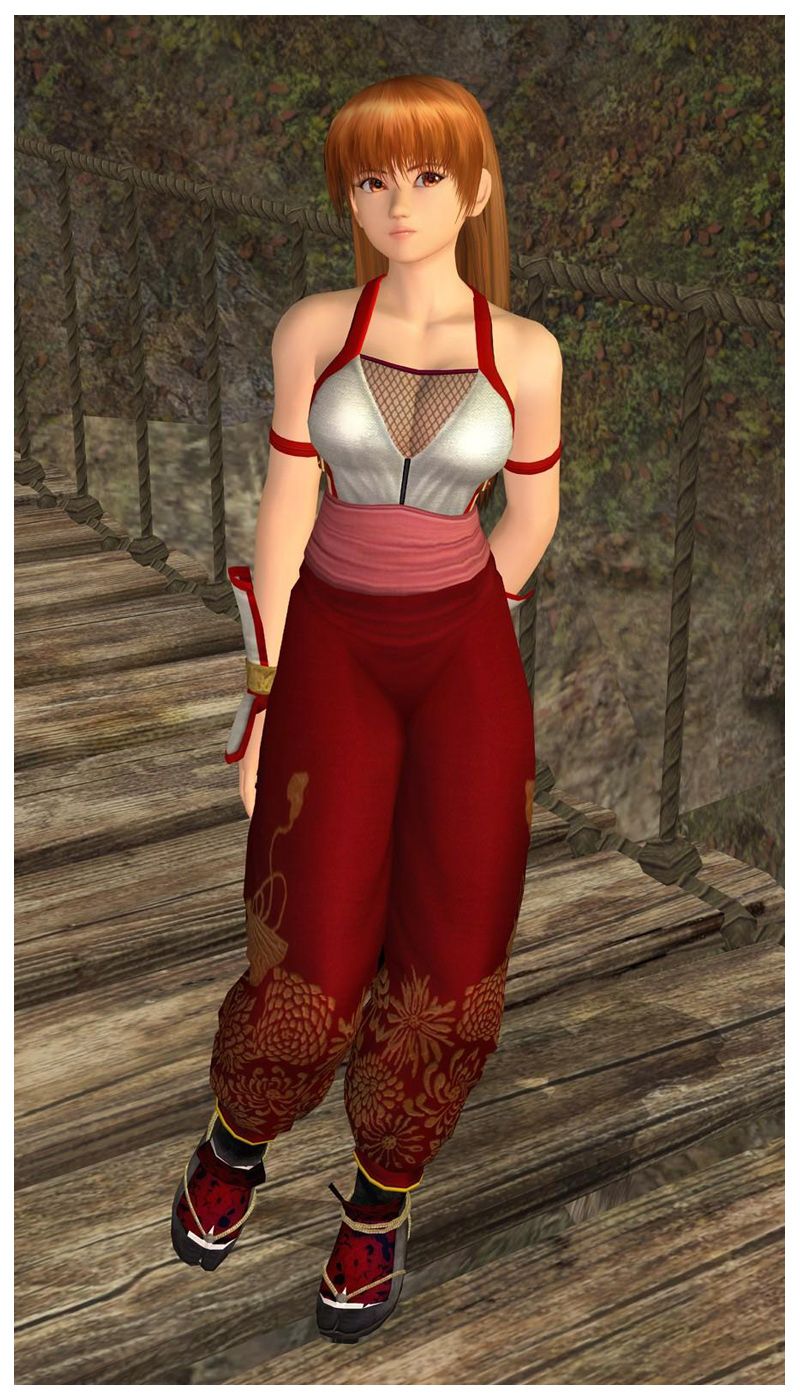
Kasumi promotional artwork — DOA4.
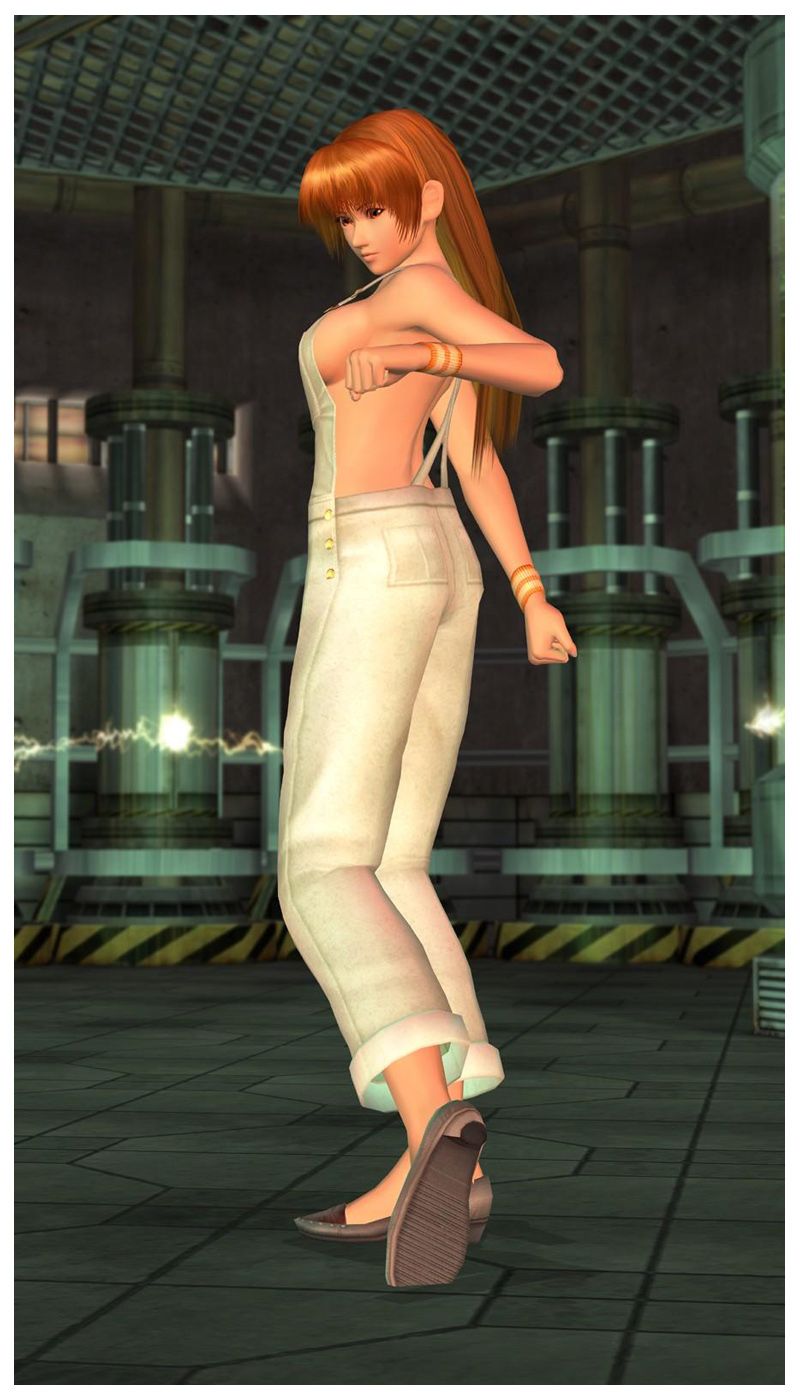
Kasumi promotional artwork — DOA4.
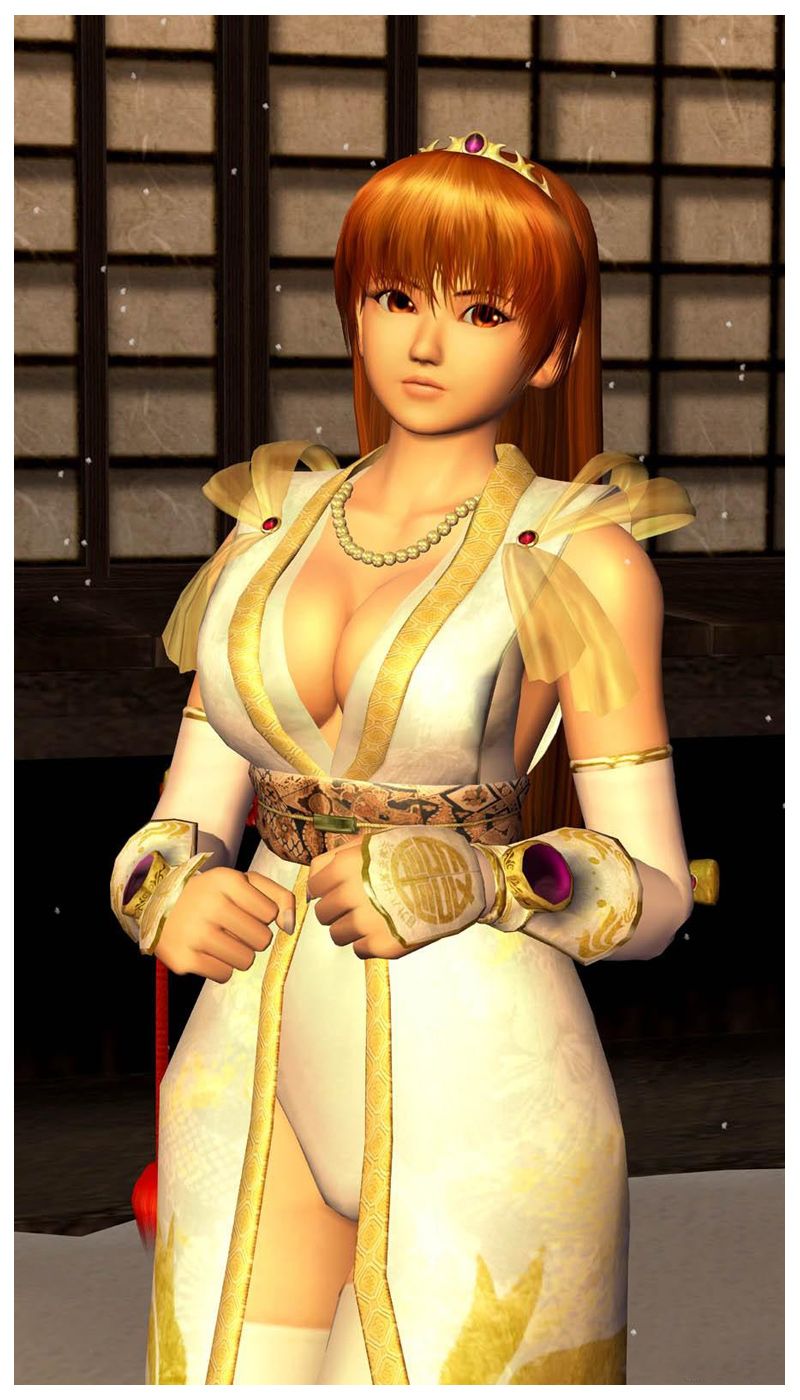
Kasumi promotional artwork — DOA4.
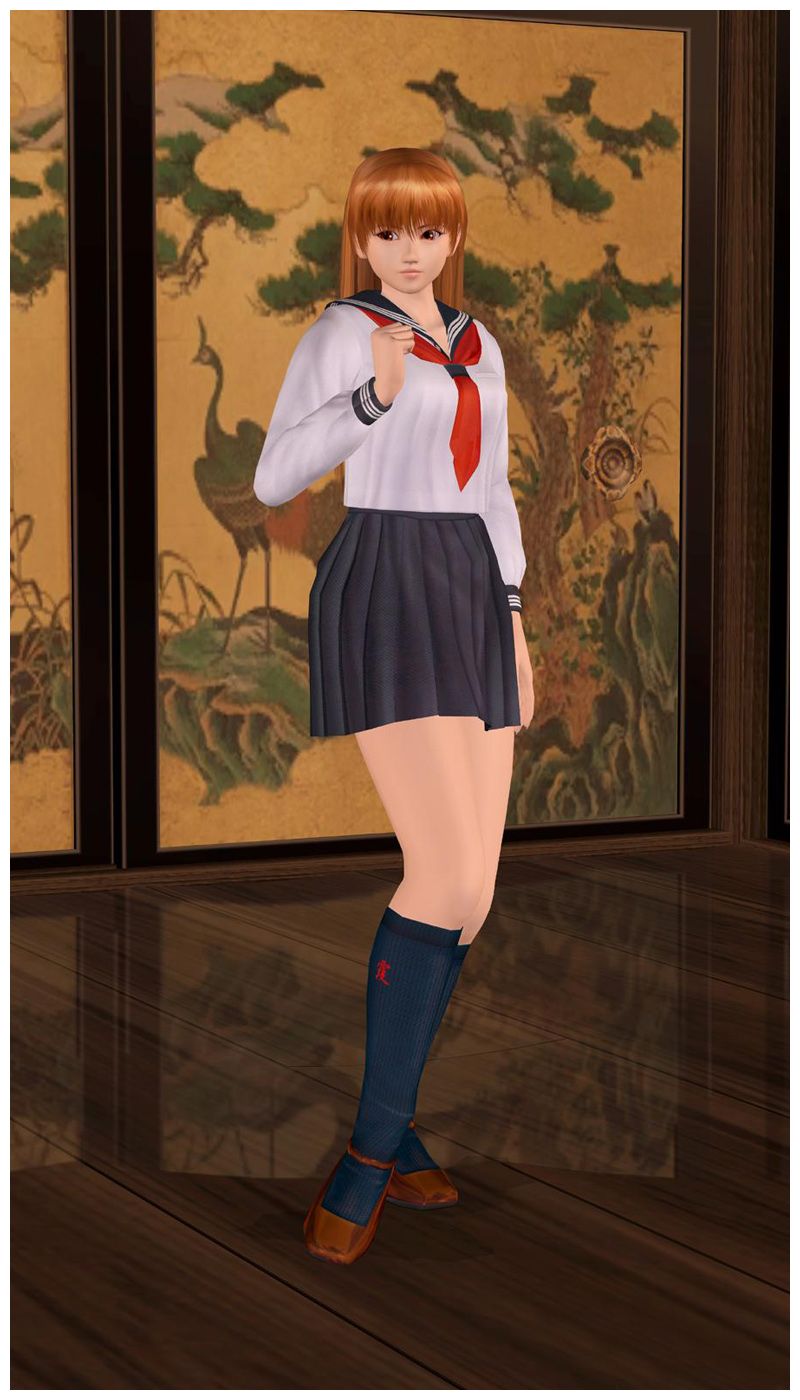
Kasumi promotional artwork — DOA4.
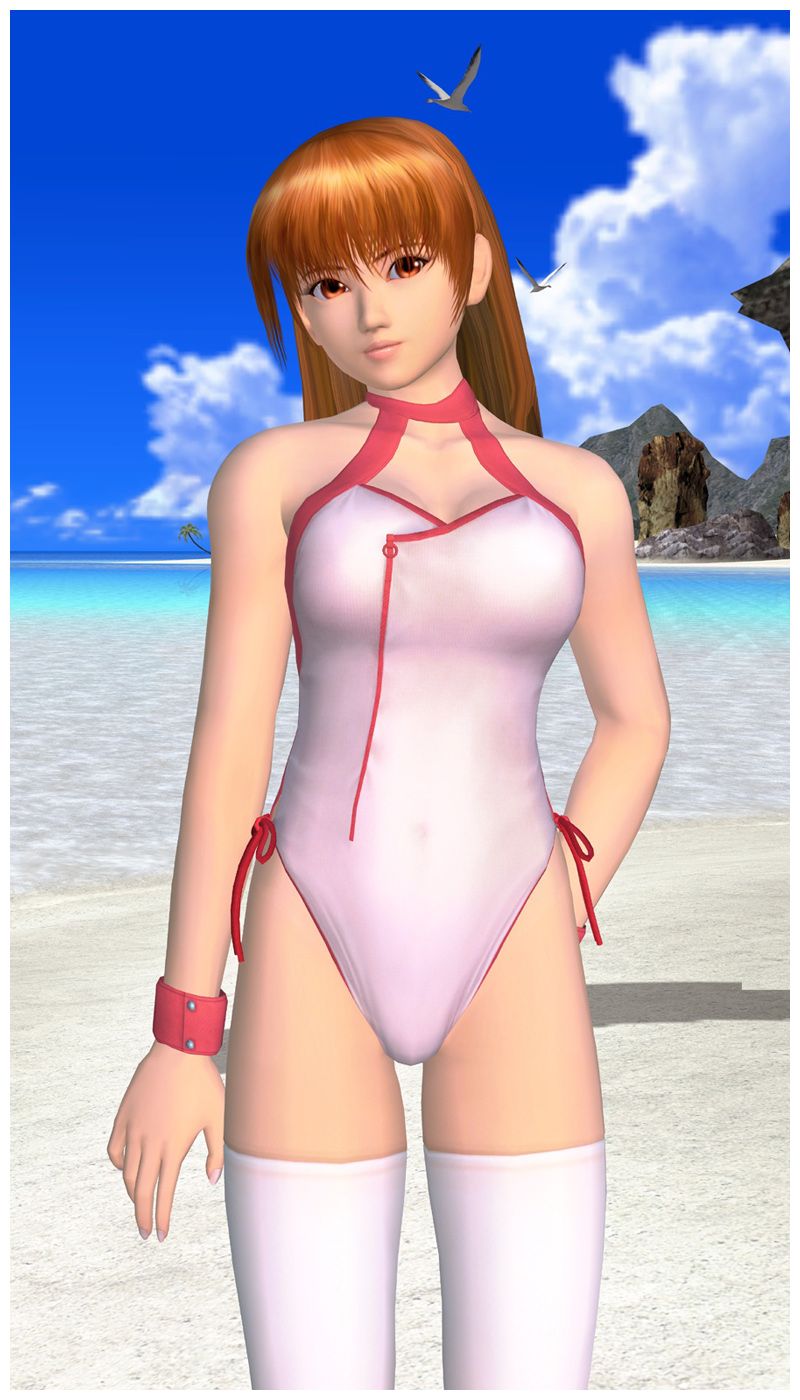
Kasumi promotional artwork — DOA4.
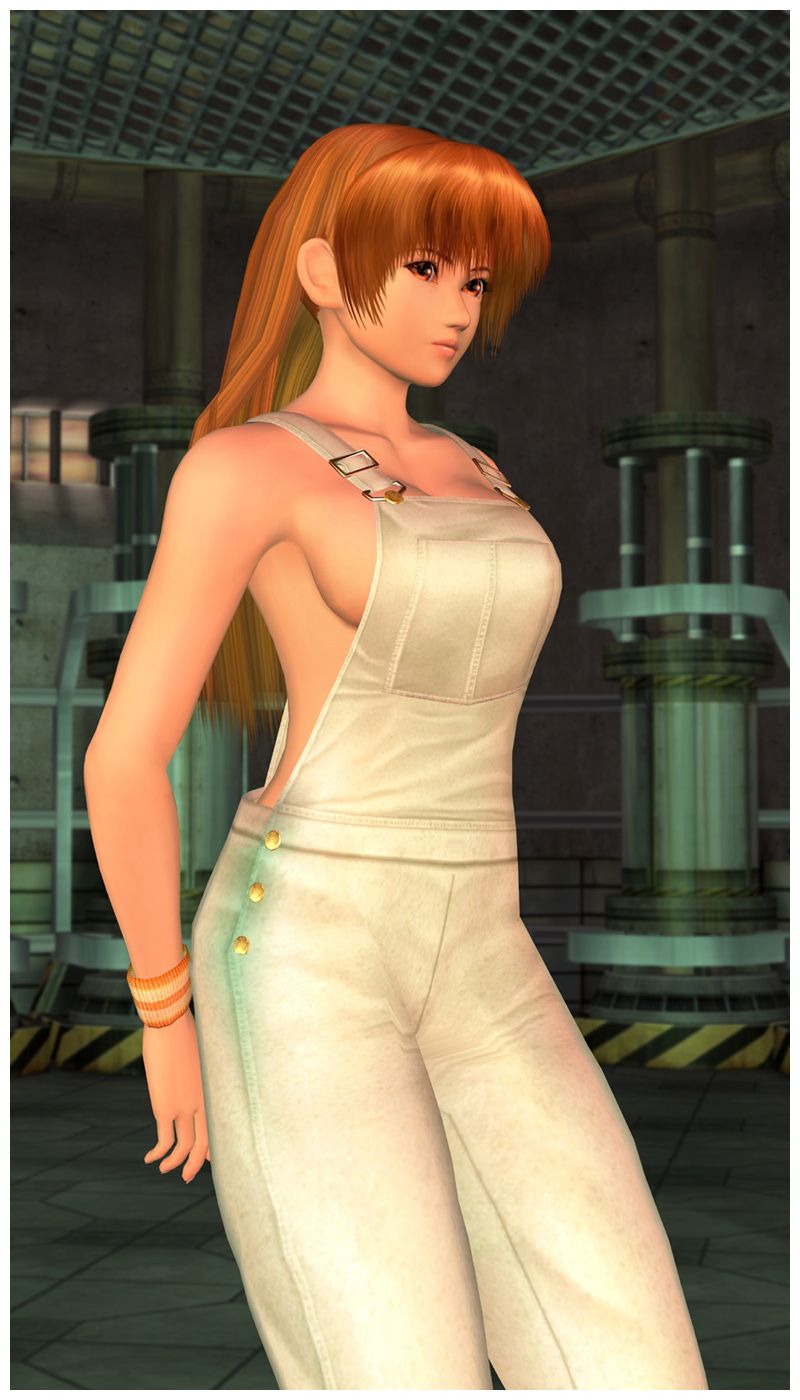
Kasumi promotional artwork — DOA4.
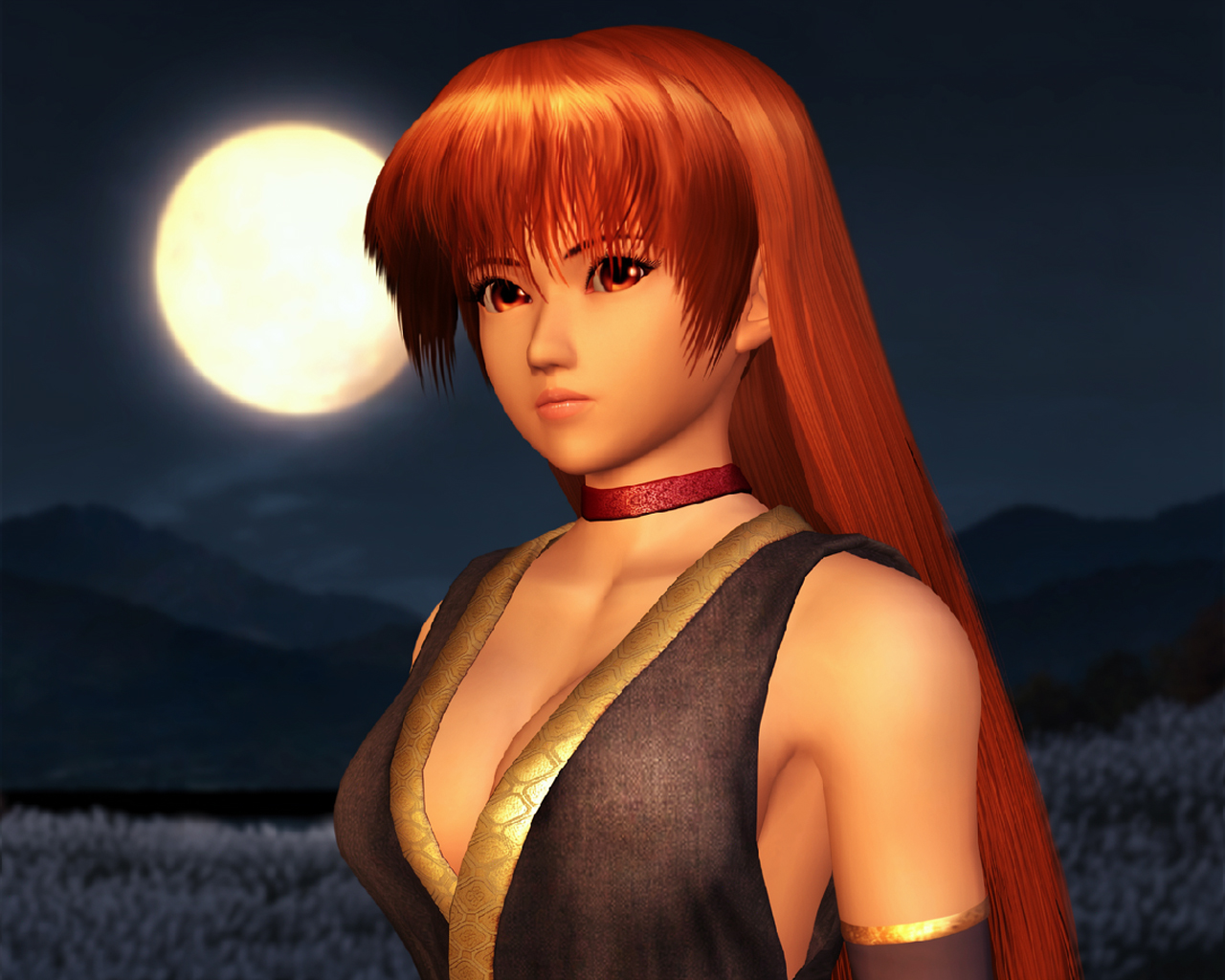
Kasumi in official Team Ninja artwork.
Kasumi official character render.

Kasumi promotional artwork.

Kasumi artwork.

Kasumi in Dead or Alive Xtreme.

Kasumi beach volleyball artwork.

Kasumi beach volleyball artwork.

Kasumi beach volleyball artwork.
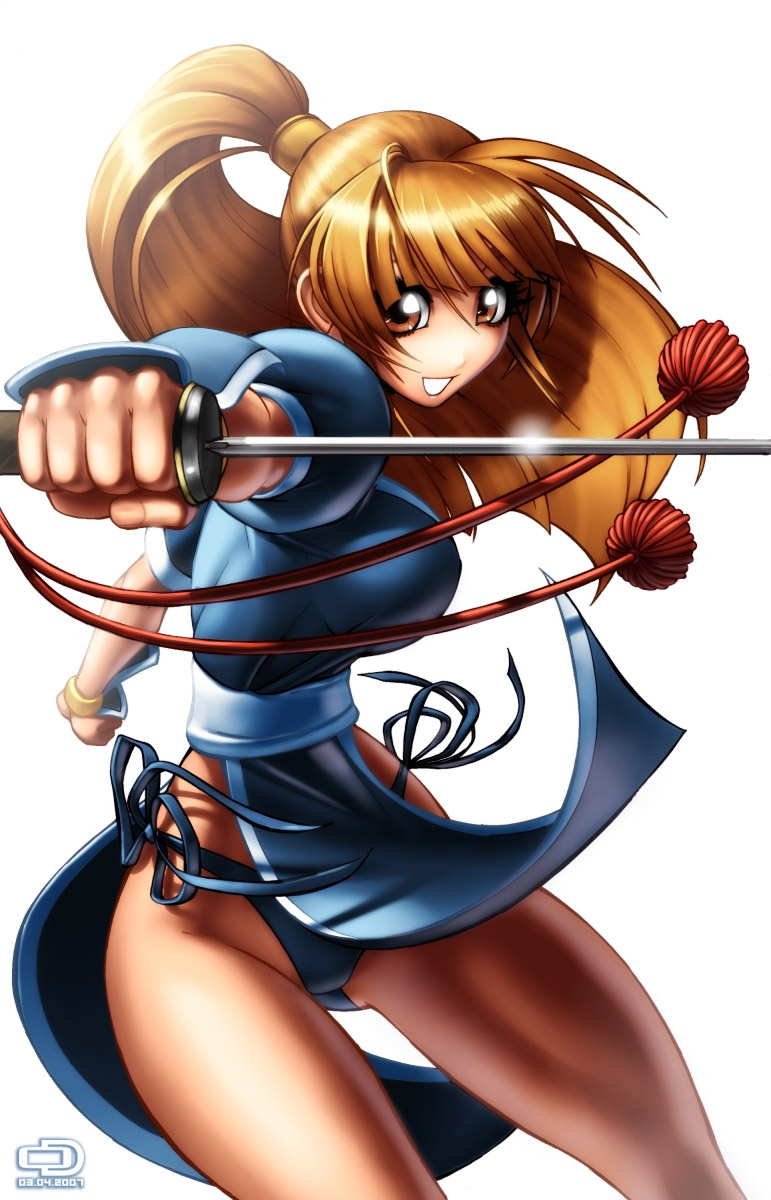
Kasumi as depicted in the UDON Dead or Alive comic series.

Kasumi icon art from the Dead or Alive series.

Kasumi icon art — Dead or Alive.

Kasumi pixel art face icon from the DOA series.
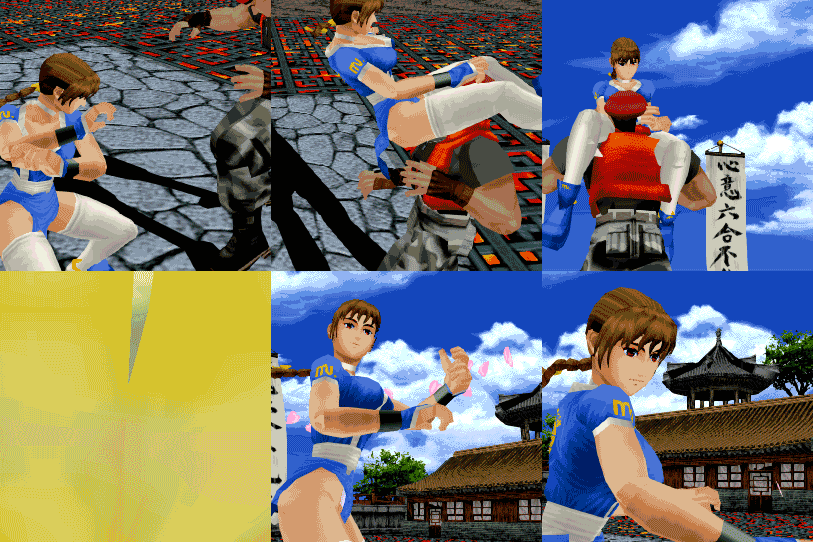
Kasumi vs. Bayman pre-fight intro — DOA1 Arcade.
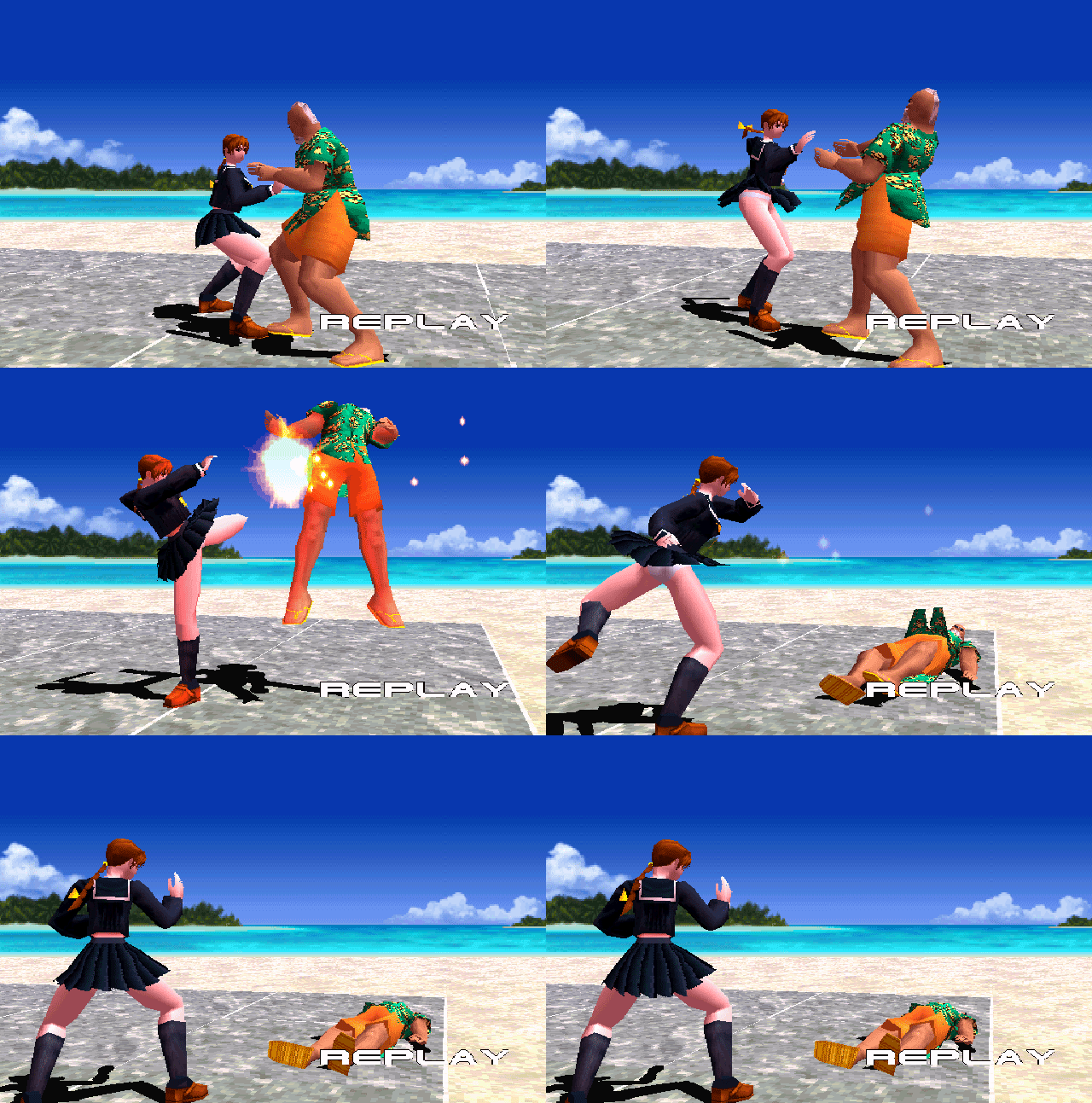
Kasumi combo on Gen Fu — DOA1 PS1.
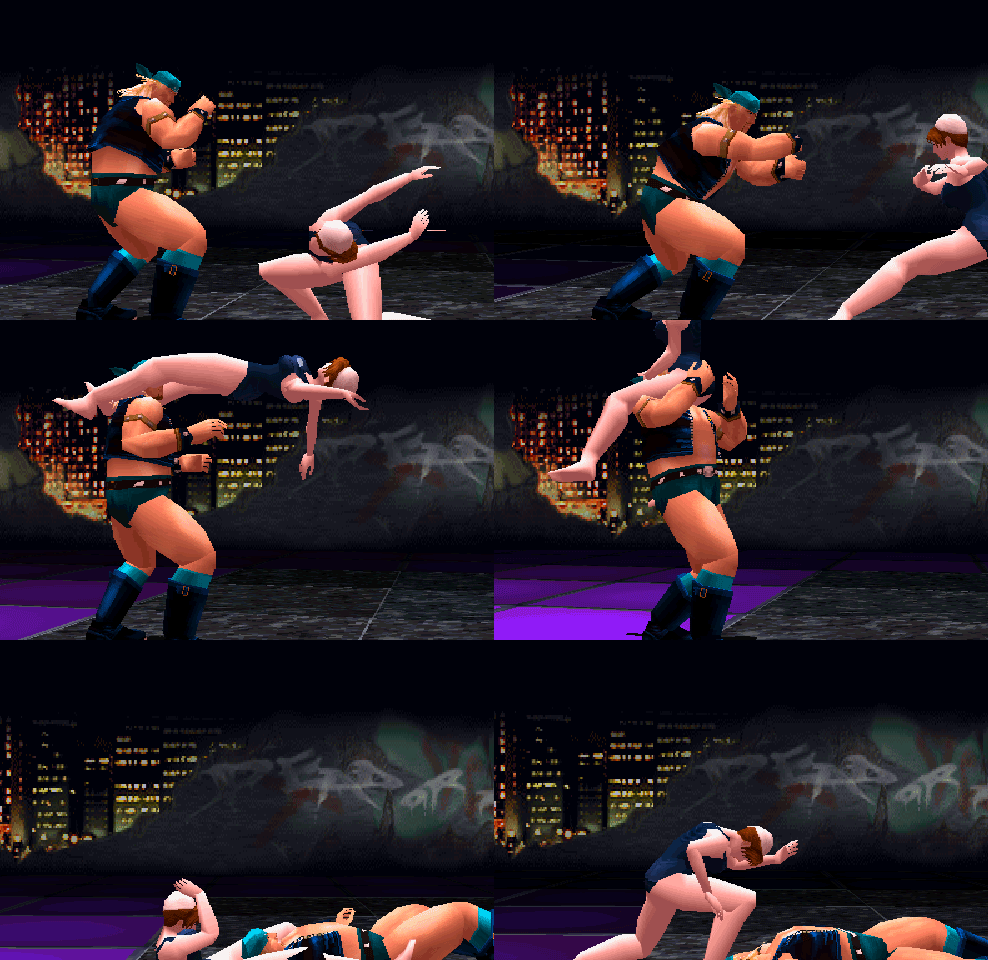
Kasumi throw on Bass — DOA1 PS1.
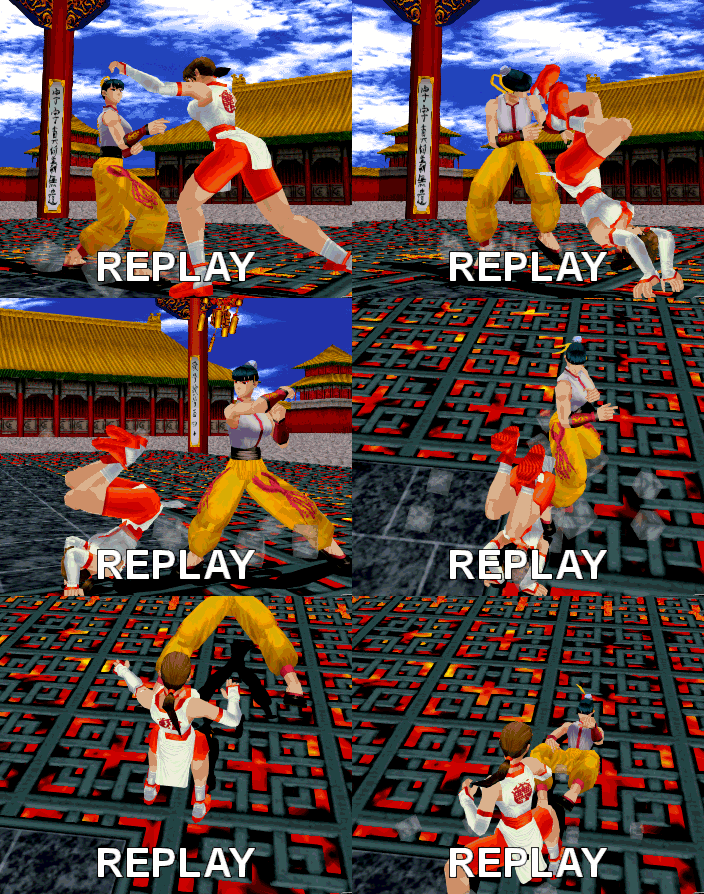
Spring kick KO replay — DOA1.
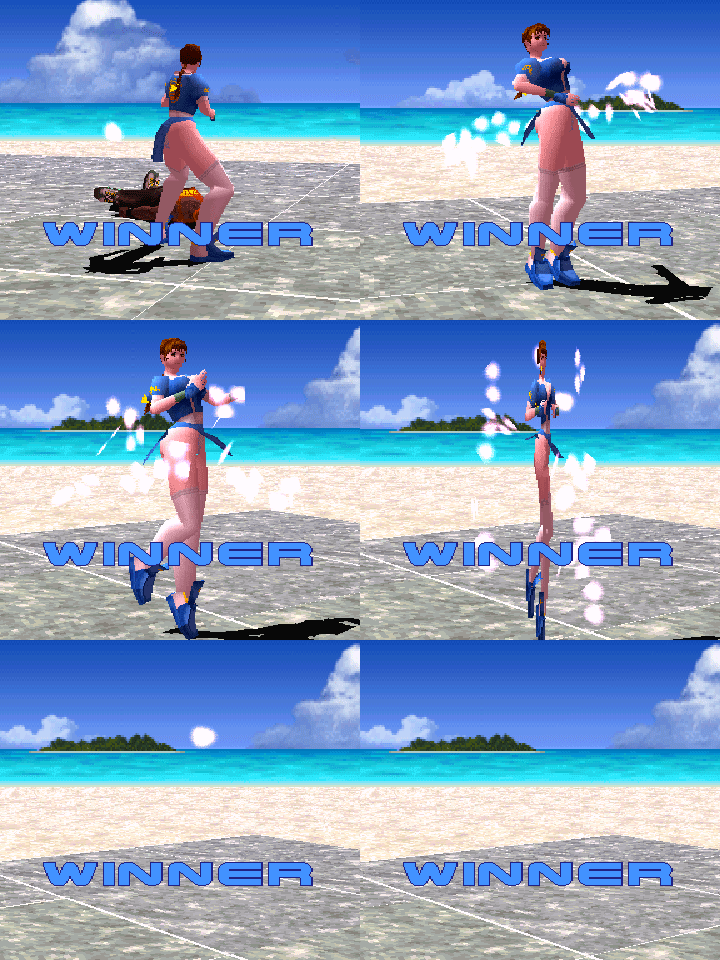
Kasumi victory screen — DOA1 PS1.
Victory animation — DOA1.
Win animation — DOA1.
DOA1's early physics engine demonstration — the system that would later be marketed as "DEAD or ALIVE" bounce technology.
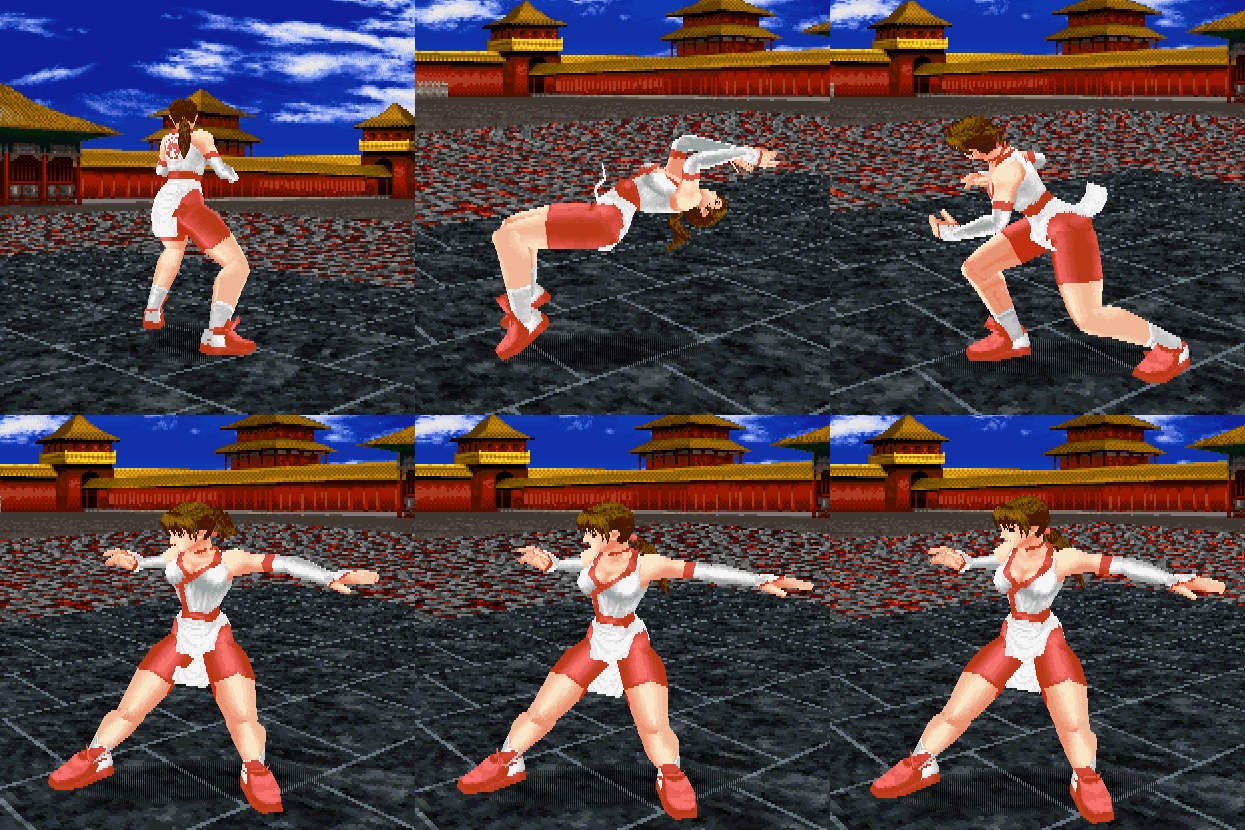
DOA1 victory animation featuring the series' early physics system — documented here as part of the game's technical history.
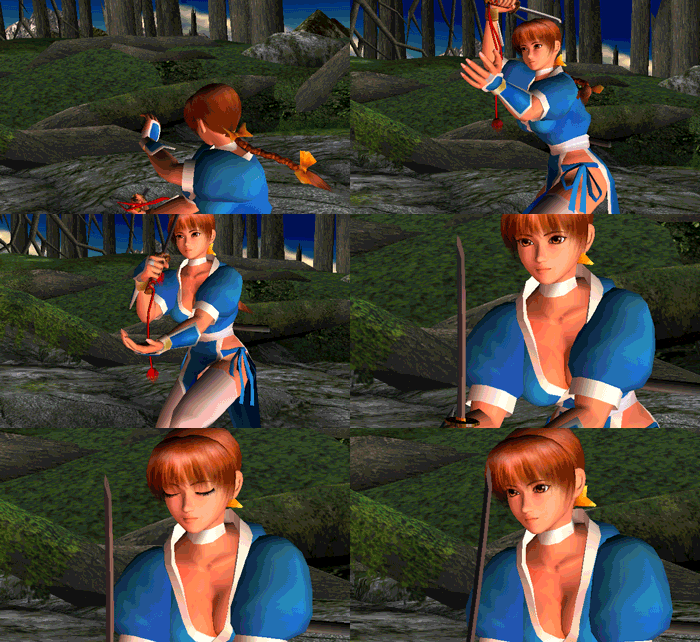
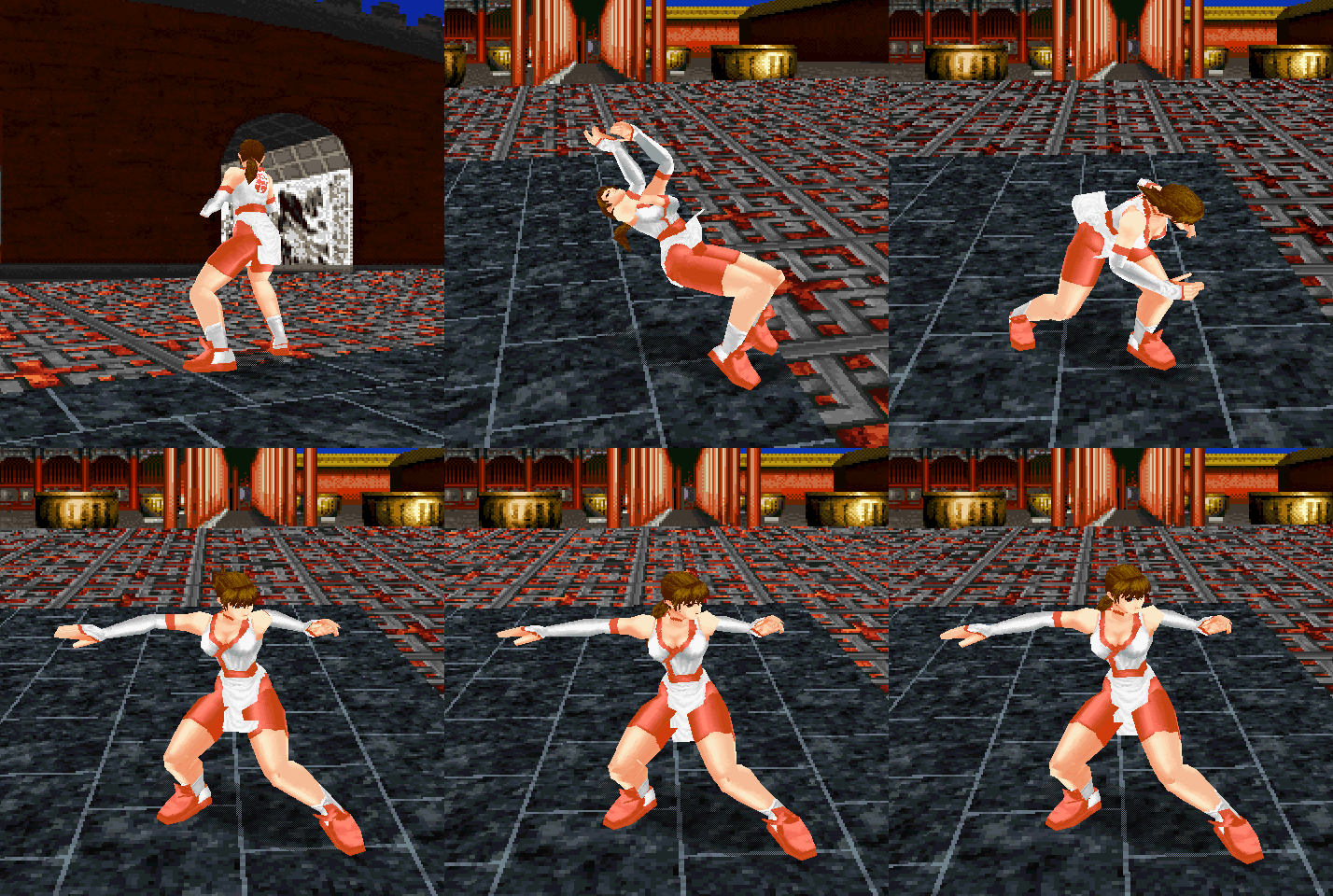
Kasumi intro animation — Dead or Alive 2.
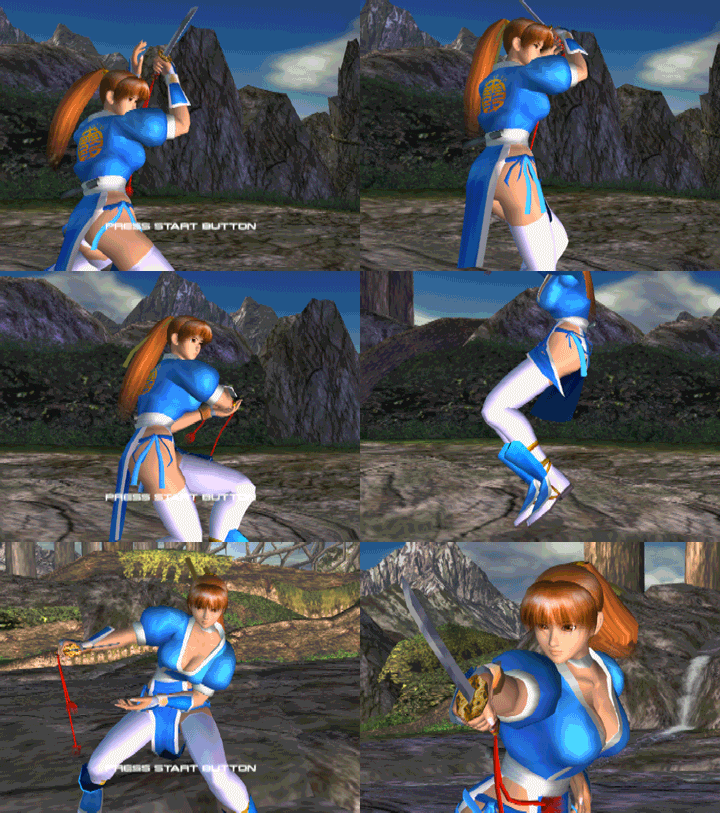
Kasumi intro kata — DOA2 Hardcore (PS2).

Kasumi combat stance — DOA2 .
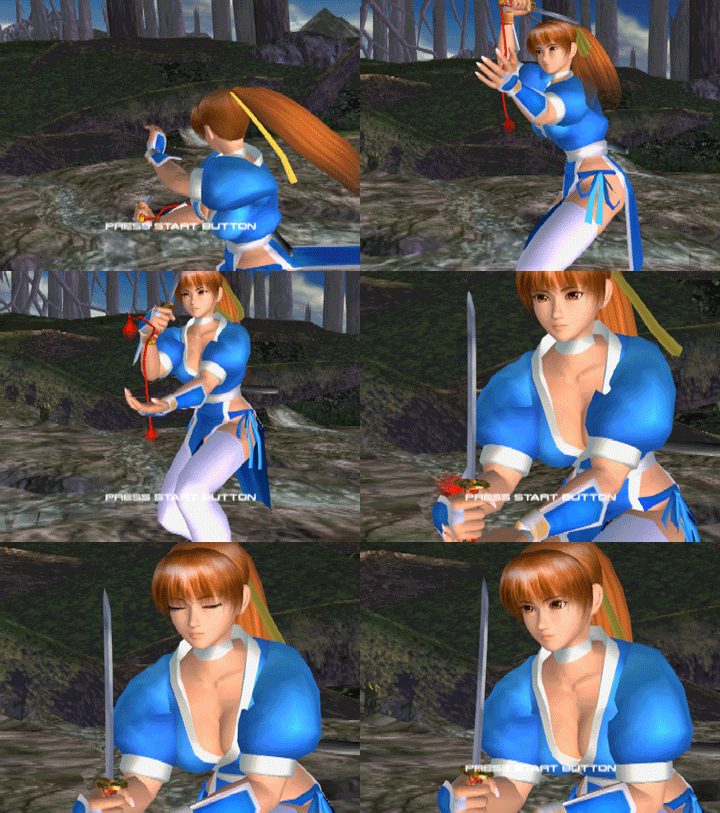
Kasumi intro animation — DOA2 Hardcore (PS2).
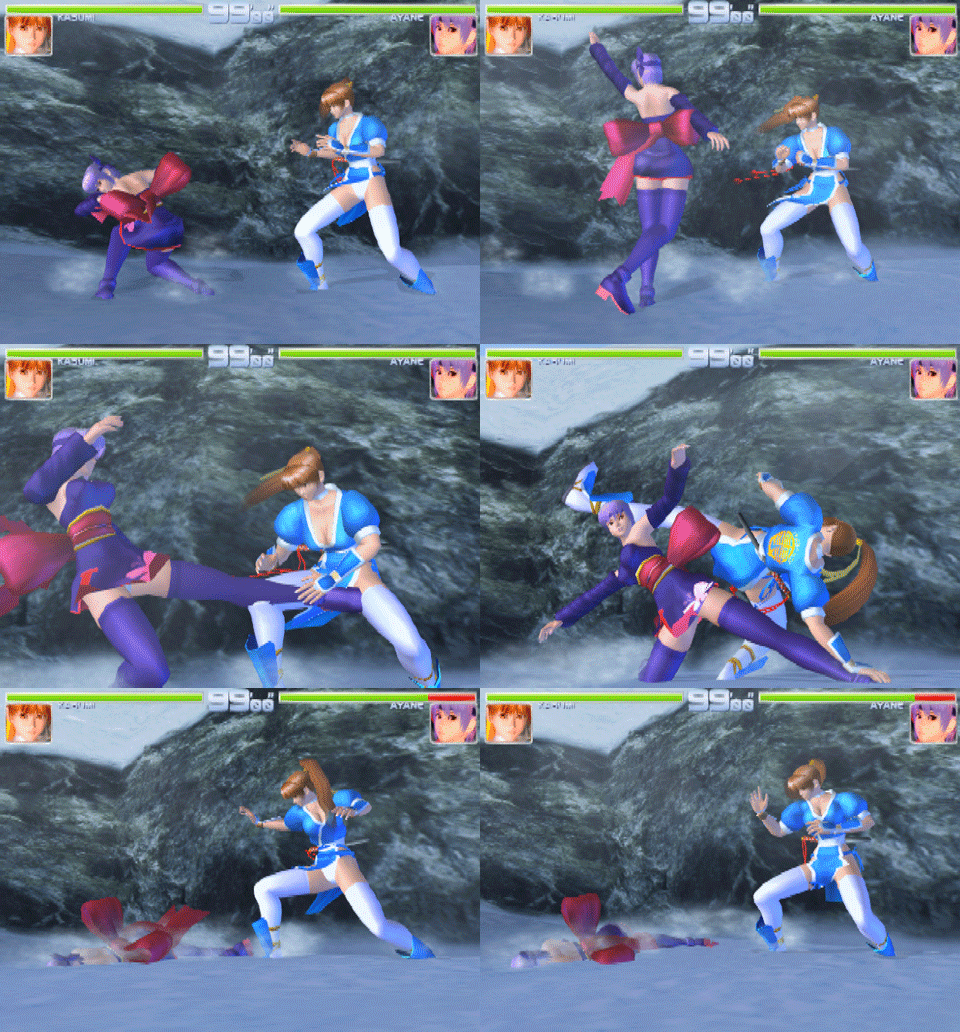
Kasumi counter animation — DOA2 Hardcore (PS2).
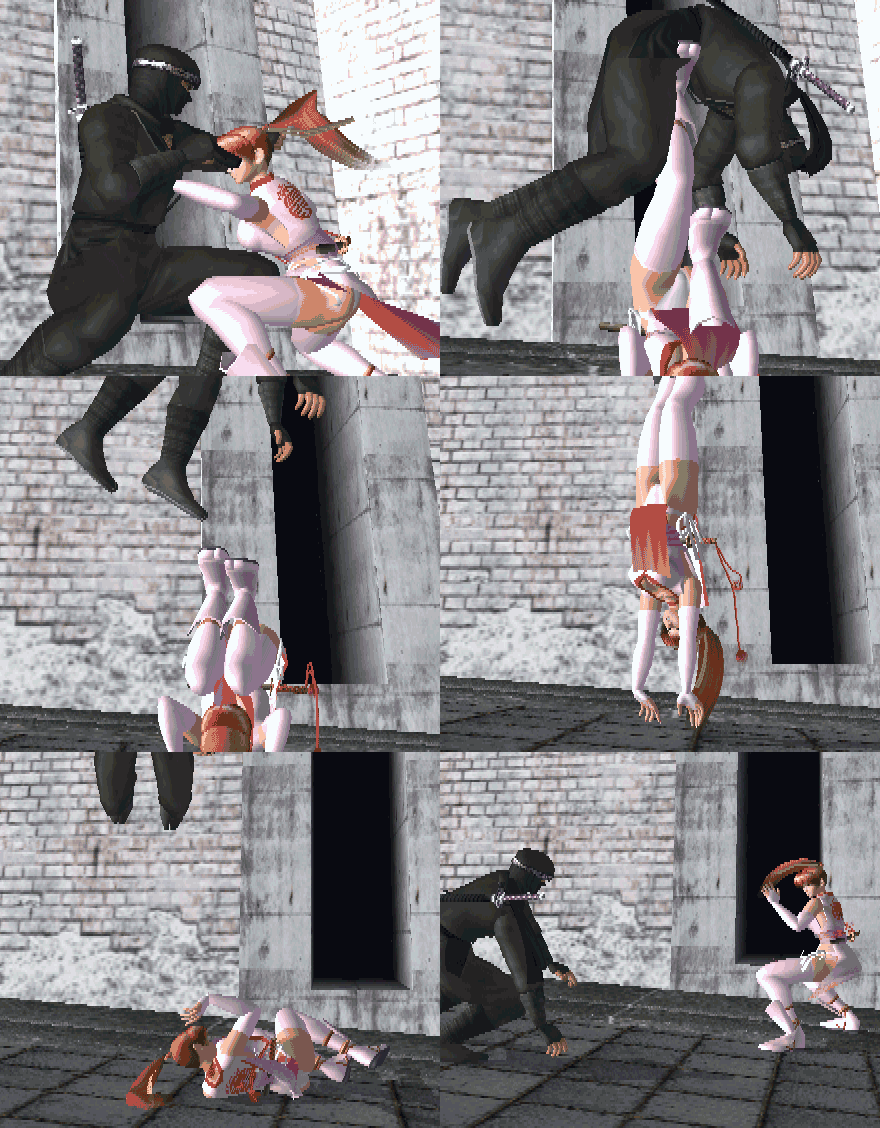
Kasumi kick-up throw — DOA2 Hardcore (PS2).
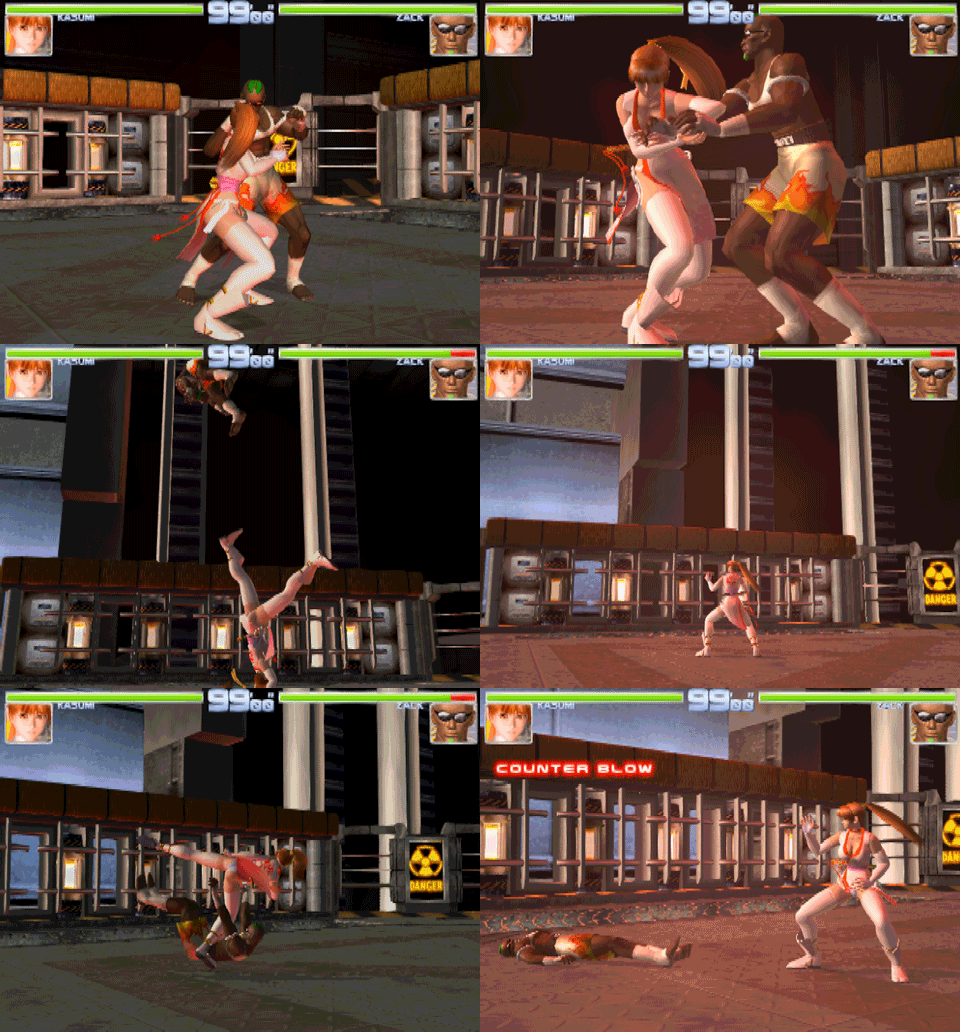
Kasumi throw on Zack — DOA2 Hardcore (PS2).
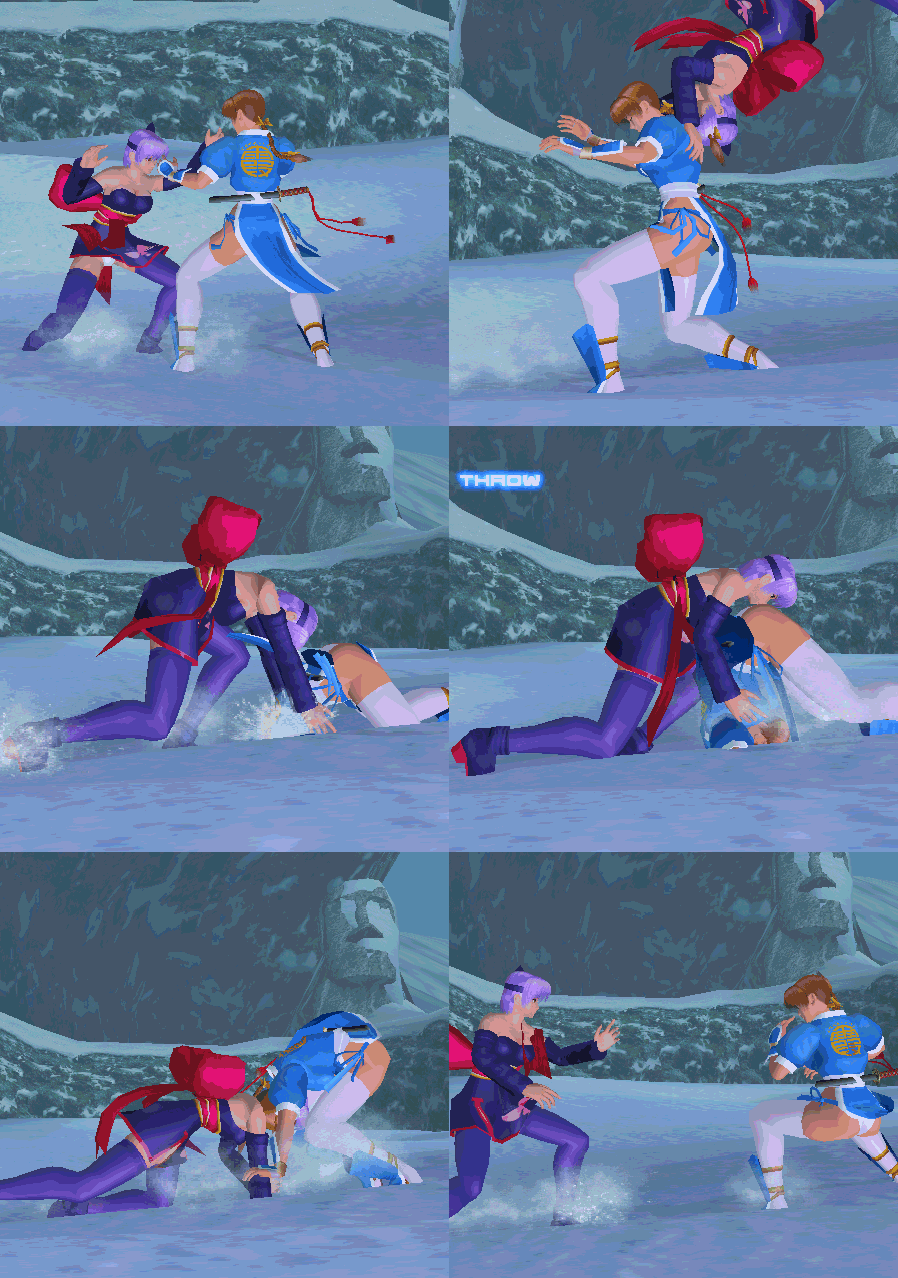
Ayane throw attempt / Kasumi escape — DOA2 Dreamcast. The tension between Ayane and Kasumi captured in gameplay.
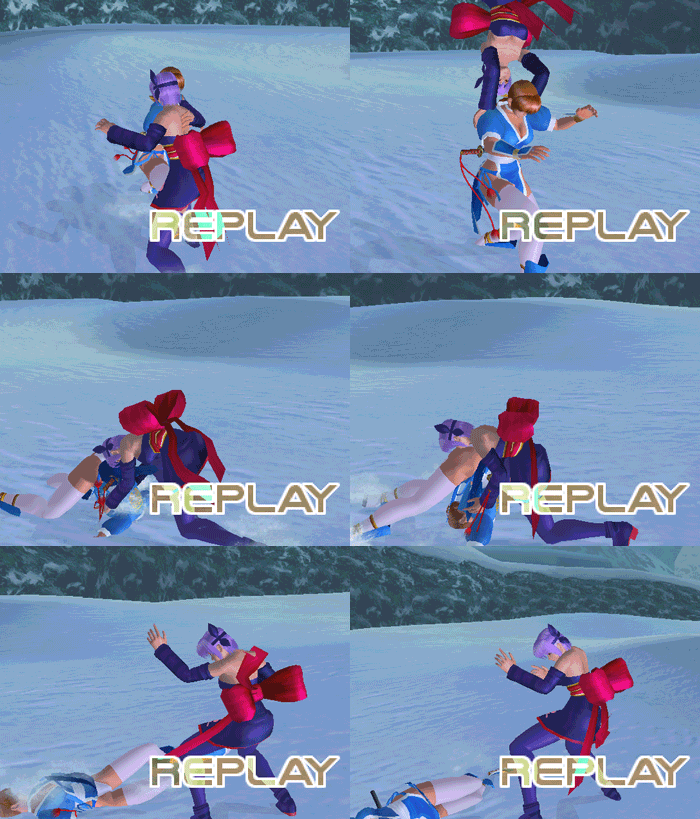
Ayane throws Kasumi — DOA2. The half-sisters' rivalry encoded in mechanics.
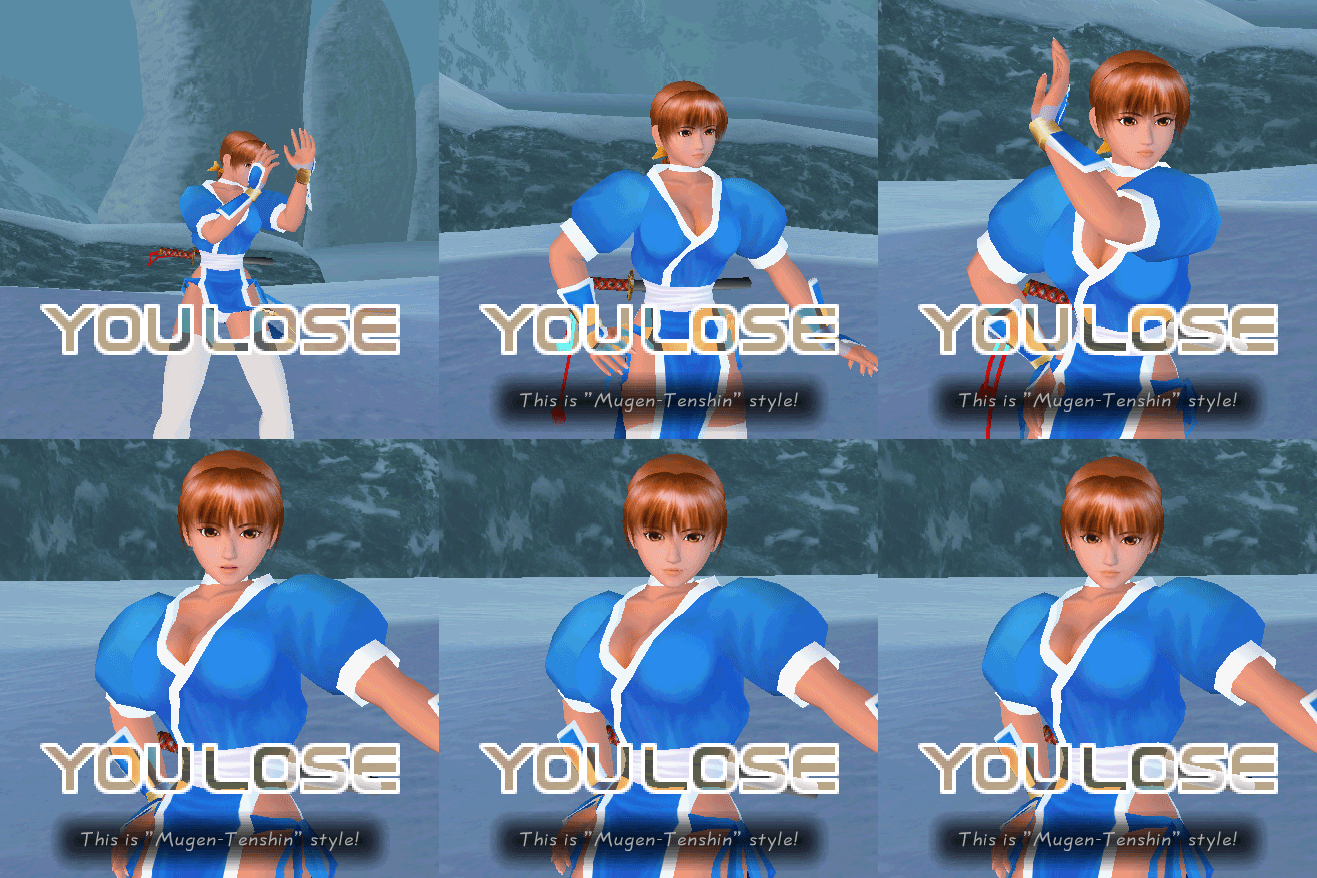
"You Lose" screen — DOA2 Dreamcast.

"You Lose" screen (alternate) — DOA2 Dreamcast.
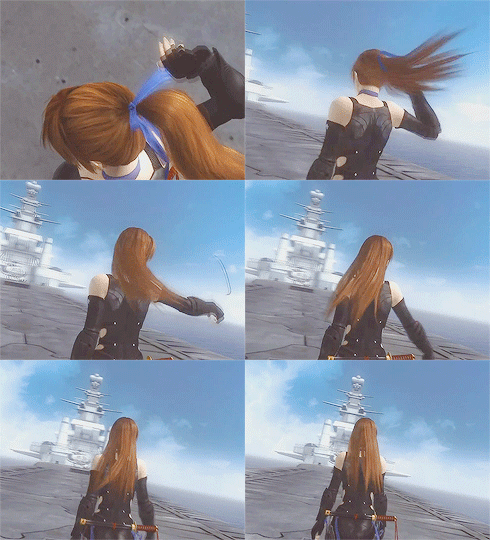
Kasumi on the ship stage — Dead or Alive.
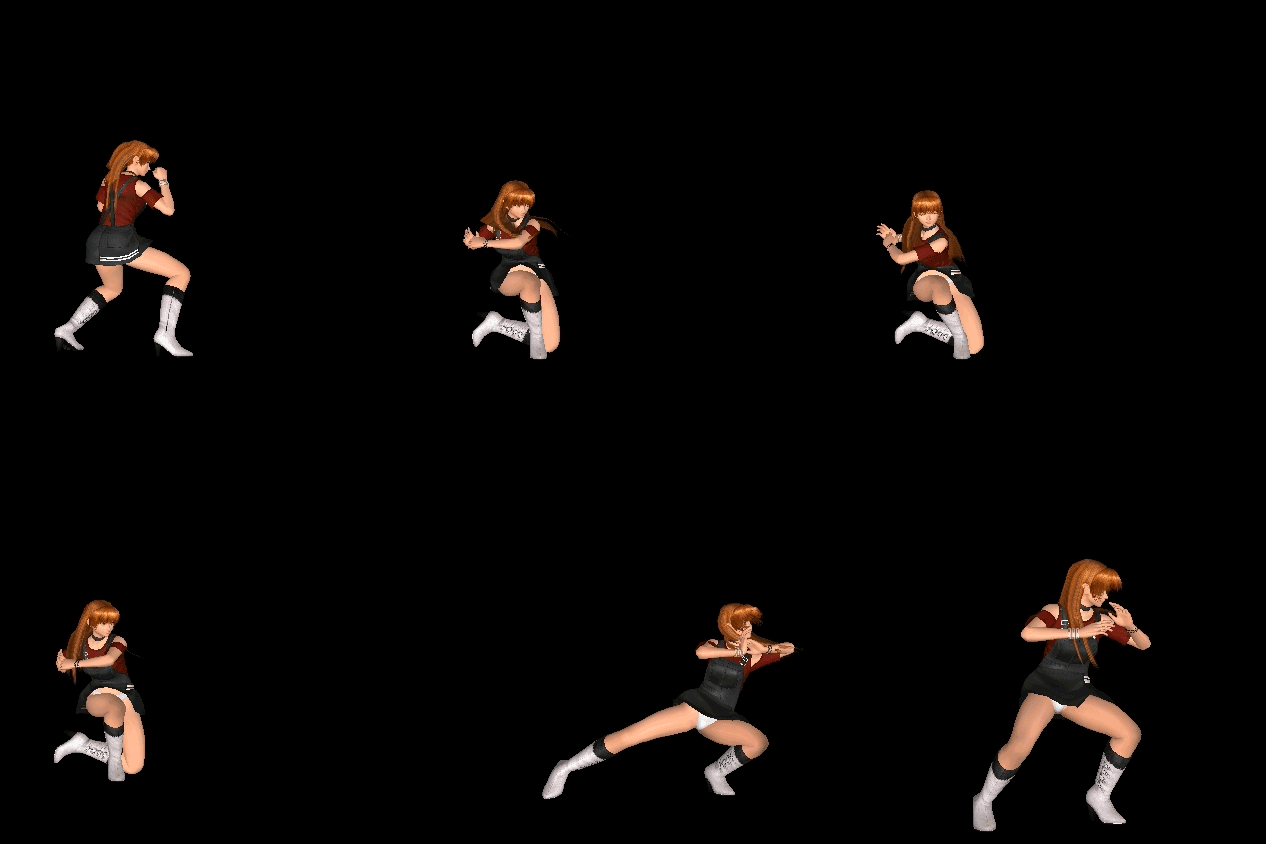
Early DOA elbow animation — a quirky artifact of the series' first engine.

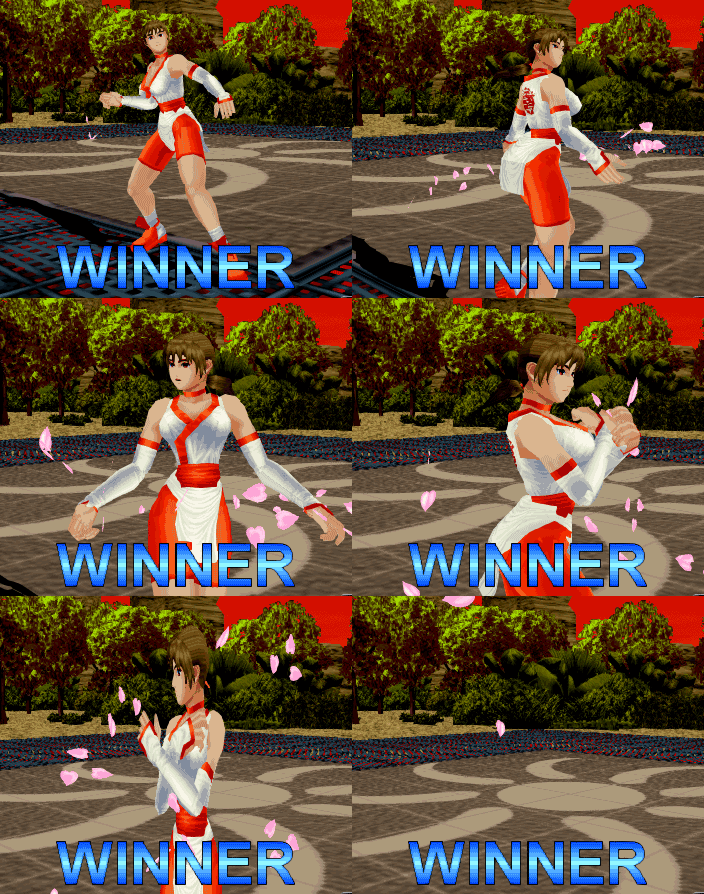
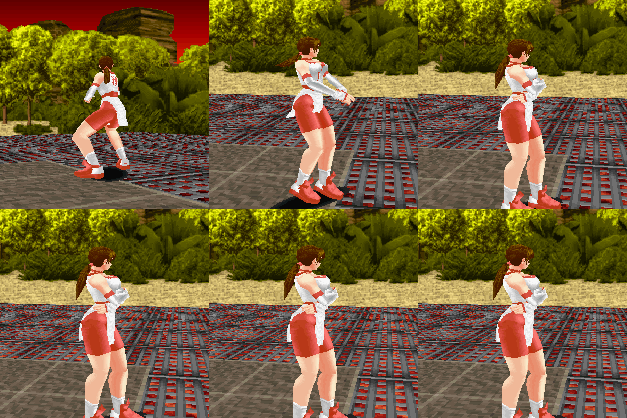
Kasumi intro animation — Dead or Alive 5.

Kasumi alternate animation — Dead or Alive 5.
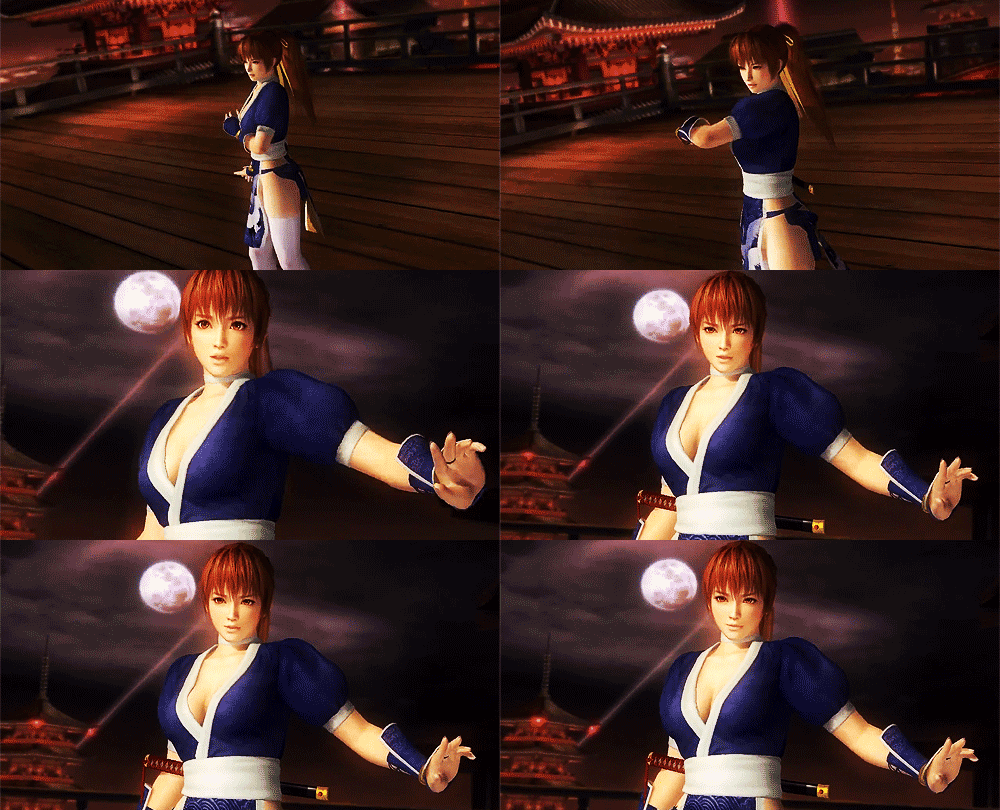
Kasumi victory animation — Dead or Alive 5 Last Round.

Kasumi animated sequence — Dead or Alive series.
Trivia
- Kasumi's creation is commonly attributed to the series' founding director, who even publicly described her as his "daughter." Some fans have questioned this, noting that his design sensibilities elsewhere — particularly Ein's styling in DOA2 and his later independent work Devil's Third — read as strongly personal in ways that Kasumi's character simply doesn't. Her quiet grace, her gentian flowers, her tragic exile bear none of his apparent aesthetic fingerprints. Whether the credit is deserved is debated; her legacy, regardless, belongs to those who document her as a complete person rather than a marketing asset.
- Dead or Alive 4 (2005), developed as a flagship Xbox 360 launch title, was an notoriously expensive production. The same director later sued Tecmo in June 2008, claiming he was owed approximately ¥148 million (~$1.4M USD) in promised bonuses tied to the game's commercial performance — bonuses Tecmo allegedly never paid. Tecmo countered by terminating his employment and filing a lawsuit of their own. He departed Team Ninja that year. The game sold respectably but the development costs and the legal fallout made it his final project at the studio he helped define.
- The blue-purple flowers frequently appearing in Kasumi's story scenes are visually consistent with gentians rather than her official birth flower freesia, reflecting the developers inconsistent symbolism. Gentians' associations with victory and determination better represent her character journey than the corporate-assigned alternative.
- Kasumi's defining visual elements include sakura petals that accompany her movements, her wakizashi sword, and her blue ninja outfit. These elements represent her connection to her homeland and combat heritage.
- In Japanese versions of the Dead or Alive Xtreme games, Kasumi's favorite color is listed as cherry blossom pink (桜色 sakura iro). English localizations translated this as either milky pink (Xtreme Beach Volleyball and Xtreme 2) or cherry pink (Xtreme 3), losing the cultural specificity of the original term.
-
Kasumi was ranked in numerous "hottest game babes" lists throughout the 2000s, reflecting the gaming
industry's reduction of female characters to sexual objects during that era:
- Ranked #3 on TeamXbox's "Top Ten Xbox Babes" (2004)
- Won "Dressed to Kill" category on Video Game Vixens (2005)
- Featured in IGN's "Videogame Babe of the Day" series (2006)
- Ranked #38 on The Age's "Top 50 Xbox Characters of All Time" (2008)
- Ranked #8 on GameDaily's "Top 50 Hottest Game Babes" (2008)
- Ranked #1 on VG Chartz's "Hottest Videogame Babes" (2009)
- Ranked #3 on UGO Networks's "Top 50 Videogame Hotties" (2010)
- Kasumi appears in the 2002 film Run Ronnie Run. The character Jerry Trellis (E.J. De la Pena) plays Dead or Alive 2 as Kasumi in two scenes, and later uses some of her moves in an actual fight near the film's conclusion.
-
Kasumi's age was deliberately obscured in western releases from Dead or Alive through Dead or
Alive 4 because Tecmo sexualized minors in the original Japanese versions and anticipated
international backlash. This choice reveals the company's awareness that their character design and
marketing crossed ethical boundaries.
- During the "My True Self" event in DOAX, Kasumi hesitates to accept a drink from Shandy, who reassures her it's non-alcoholic. This scene references Japan's legal drinking age of 20, acknowledging Kasumi is a minor while placing her in a resort environment designed for sexual objectification.
- Kasumi is the only character to retain her original default costumes throughout the series. Her blue and white ninja outfits have appeared in every mainline Dead or Alive game, providing visual continuity across the franchise.
- In Dead or Alive 5, Kasumi's hair is rendered with realistic length variations: shorter when worn loose to match realistic proportions, and slightly shorter in her braid as a callback to her original Dead or Alive appearance. Her side ponytail was also shortened, likely to prevent clipping issues during gameplay.
-
Kasumi's Dead or Alive 4 ending (depicting her dream of being a mermaid) confused audiences until a
designer explained it was an abstract allegory for her freedom from the Mugen Tenshin execution order. Since
DOA4 was intended as the series finale under his direction, he wanted to symbolically free her after
regretting how he "permanently doomed her" in Dead or Alive 3's ending.[46]
- Dead or Alive Xtreme Venus Vacation later incorporated this into canon during Kasumi's year 2 birthday episode "Keep Watching Over Me," where she explains she always dreamed of being a mermaid and longed for freedom. However, this recontextualization occurred in a gacha game designed to monetize her image, undermining the original ending's intended liberation.
- The original Dead or Alive 5 story treatment featured Kasumi reuniting with Ayane in a snowy field after the fourth tournament. Ayane collapsed into Kasumi's arms after warning her that DOATEC still existed and their village had been destroyed by DOATEC-Asia. This emotionally resonant scene was rejected when the game changed creative hands.[47]
- In Dead or Alive 2, Kasumi is the only character whose ending cutscene plays after the credits, emphasizing her narrative significance to the overall story.
- The lead developer at the time originally conceived Kasumi as a male character before changing her sex during early development. As her design became increasingly kawaii, he decided to make her the franchise protagonist—a choice that initially faced skepticism from the development team before gaining acceptance.
- The lead developer repeatedly referred to Kasumi using possessive familial language, calling her his "daughter" and stating she was "like a Venus to me." He claimed to feel "very close to her" and "responsible for her."
- When questioned about designing a sexualized 17-year-old character, the lead developer responded: "In Japan, that's okay. Maybe it's 20 in America," adding, "I was 27 when I created Kasumi. I'm older now, but 17-year-old girls are still gorgeous."
- The lead developer explained that Kasumi remained exclusive to Dead or Alive rather than appearing in Ninja Gaiden because her "very soft" design contradicted that game's "hard-edged" tone. He stated that including her would have transformed Ninja Gaiden into "Kasumi-den" (Kasumi's story) rather than Ryu Hayabusa's narrative, making it a "DOA action game" instead.
-
The Dead or Alive 5 redesign that matured Kasumi's appearance sparked considerable internal conflict
among developers. The game's art director stated the redesign required "a lot of courage" given Kasumi's
iconic status as "the face of DOA and the eternal heroine," and that the process sparked "the most disputes
in the development team."
- After leaving the development team in 2008, the same director publicly condemned the redesign in 2014, stating: "Straightly speakin', my daughter was totally ruined, spoiled. I can't/shouldn't avert my eyes from that fact. Many DOA fans here are crying, I will do something for DOA after I finished Devil's Third." This promise was never fulfilled.
- The critique of the series' direction is not entirely without basis. Post-DOA4, the franchise's storytelling leaned heavily on repetition — resurrecting Raidou as a recurring villain, cycling through multiple Kasumi clone arcs (Alpha-152, Kasumi α), and never meaningfully departing from the tournament framework. Early interviews suggest the series had ambitions for a darker, more narrative-driven direction that never materialized. Kasumi's character, however, has remained largely consistent throughout — her motivations, her tragedy, her compassion intact regardless of how thin the plots surrounding her became.
-
In 2002, Tecmo sued Japanese publisher West Side for creating and distributing an unauthorized add-on disc
for Dead or Alive 2 on PlayStation 2 that removed Kasumi's clothing. The lead developer claimed this
modification "was an attack on her." Tecmo won the case and was awarded over 2 million yen (approximately
US$20,000).[90]
- In 2005, Tecmo similarly sued the fan website NinjaHacker.net after they distributed patches for DOA3 and Dead or Alive Xtreme Beach Volleyball that enabled nude character models. This case settled out of court with undisclosed terms.
- The lawsuits exposed a significant contradiction: the modifications did not create nudity from scratch, but merely removed texture layers from anatomically detailed base models that the developers themselves had built into the game files. The "hacks" revealed what was already present—nude character meshes with detailed body shapes lacking only genitalia. The developers had constructed these models as the foundation layer, then applied clothing textures over them.
- Critics noted this represented corporate face-saving rather than genuine intellectual property protection, particularly given the timing in early-2000s Japan when gaming companies were sensitive about their public image. Despite the legal actions, nude models remained accessible through GameShark cheat devices in the Dreamcast version of DOA2 and later through fan-made modifications in DOA5.
- One contemporary observer noted that mainstream media exposure of nude patches could damage the company's brand value and character reputation, while others pointed out that similar modifications to characters like Lara Croft in Tomb Raider produced no comparable backlash against those publishers.
- Despite being the face of the main Dead or Alive fighting series, Kasumi has been notably de-emphasized in the Xtreme spinoffs. She has never appeared front and center on Xtreme box art except for a special edition of Dead or Alive Paradise, suggesting deliberate marketing decisions to prioritize other characters in the franchise's most explicitly objectifying entries.
- Kasumi's fortune telling hobby is explored in Xtreme Venus Vacation, where she demonstrates knowledge of tropical zodiac signs. She explains the origin of her sign Pisces to the Owner, discusses Scorpio with Nyotengu, and apparently explained Gemini to Hitomi during their respective birthdays.
- The North American PlayStation box art of the original Dead or Alive inexplicably depicts Kasumi with white hair. The reason for this alteration remains unknown.
- For years, North American releases systematically removed Kasumi from box art focus when she was featured prominently in Japanese versions. The original Dead or Alive shifted focus to Leifang, the Dreamcast version of DOA2 to Ein, and PS2/Ultimate versions used generic logo-focused covers. Dead or Alive Dimensions was the first North American release that retained her prominent placement.
- Kasumi was one of the first female characters to be the face of a long-running fighting game series featuring both male and female characters. While Morrigan Aensland from Darkstalkers preceded her, Morrigan shares mascot status with Demitri Maximoff, whereas Kasumi has been Dead or Alive's singular representative throughout its history.
- Kasumi is the only character to appear in every entry across both mainline and Xtreme series until Venus Vacation Prism, where she is notably absent. Of the original nine playable characters, she was the only one present in every prior game, including the spin-off Girls of DOA BlackJack. By comparison, Leifang was absent in Xtreme 3 Venus, Tina was absent in standard Xtreme 3 versions, and Zack is absent in the original Venus Vacation (excluding statues). Her exclusion from Prism marks the first time the franchise's face has been omitted from a release.
- Tecmo's English website for the original game listed Kasumi's hobbies as including "playing Angel Eyes," referencing the arcade game Tōkidenshō Angel Eyes that Tecmo released around the same time. This reference did not appear on the Japanese page, and is notable because Angel Eyes never released outside Japan.[48]
References
- ↑ Dead or Alive 5: Last Round - Official Japanese Website | DOA5 LR — Kasumi Archive
- ↑ Dead or Alive 5: Last Round - Official UK Website
- ↑ Dead or Alive 2 - Complete Scans Archive | DOA2 Movelist — Kasumi Archive
- ↑ Dead or Alive 4 - Game Manual | DOA4 Character Profile — Kasumi Archive
- ↑ Dead or Alive Paradise - Game Documentation
- ↑ Dead or Alive 1 - Game Manual (1998) | DOA 1997 Official Site — Kasumi Archive
- ↑ Dead or Alive Paradise - Game Guide
- ↑ Dead or Alive Xtreme 3 - Official Character Profile ;)
- ↑ Dead or Alive 2 - Kasumi Render
- ↑ Dead or Alive Ultimate - Intro Cutscene
- ↑ Dead or Alive: Dimensions - Story Mode | DOAD Character Profile — Kasumi Archive
- ↑ Dead or Alive: Dimensions - Chapter 1: Resolve
- ↑ Dead or Alive: Dimensions - Chapter 1: Resolve (Ayane/Kasumi Interaction)
- ↑ Dead or Alive: Dimensions - Chapter 1: Resolve (Ayane vs Raidou)
- ↑ Dead or Alive 1 - Kasumi's Original Ending
- ↑ Dead or Alive: Dimensions - Raidou's Re-awakening
- ↑ Dead or Alive: Dimensions - Hayabusa's Involvement with Raidou
- ↑ Dead or Alive 2 - Kasumi's Character Profile
- ↑ Dead or Alive: Dimensions - Hayabusa Rescues Kasumi
- ↑ Dead or Alive: Dimensions - Hayabusa & Kasumi Interaction
- ↑ Dead or Alive 2 - Kasumi & Hayate Meeting
- ↑ Dead or Alive: Dimensions - Hayabusa's Role in Kasumi/Hayate Reunion
- ↑ Dead or Alive 2 Hardcore ending
- ↑ Dead or Alive: Dimensions - Kokoro Encounters Kasumi & Ayane
- ↑ Dead or Alive 3 - Kasumi & Ayane Meeting (Dead or Alive: Dimensions) | DOA3 Character Profile — Kasumi Archive
- ↑ Dead or Alive: Dimensions - Ayane & Ayame Meeting
- ↑ Dead or Alive 3 - Kasumi & Hayate Meeting (Dead or Alive: Dimensions)
- ↑ Dead or Alive 4 - Kasumi & Hayate Meeting (Dead or Alive: Dimensions)
- ↑ Dead or Alive 4 - Kasumi & Helena Meeting (Dead or Alive: Dimensions)
- ↑ Dead or Alive 4 - Helena's Ending
- ↑ Dead or Alive 5 - Hidden Village
- ↑ Dead or Alive 5 - Prologue: Premonition
- ↑ Dead or Alive 5 - Prologue: Siblings
- ↑ Dead or Alive 5 - Kasumi's Chapter: Waiting
- ↑ Dead or Alive 5 - Kasumi Part 2: Lies
- ↑ Dead or Alive 5 - Kasumi Part 2: Talk
- ↑ Dead or Alive 5 - Kasumi Part 2: Instinct
- ↑ Dead or Alive 5 - Kasumi Part 2: Showdown
- ↑ Dead or Alive 5 - Kasumi Part 2: The Code
- ↑ Dead or Alive 5 - Hayate: Epsilon's Curse
- ↑ Dualshockers - Dead or Alive 5: Last Round & King of Fighters XIV Wallpapers
- ↑ Twitter - GamerNeJp
- ↑ Twitter - DOAX VV Staff
- ↑ Twitter - DOAX VV Staff
- ↑ Dead or Alive Xtreme 3 - Official Character Profile ;)
- ↑ GameFAQs - Dead or Alive 5: Last Round Discussion
- ↑ Facebook - Designer Notes on Game Industry
- ↑ Internet Archive - Tecmo Dead or Alive Homepage (1997) | Archived Version (Kasumi-Centric)
- ↑ Brian Ashcraft, Dead or Alive's Sexualized Females Aren't Going Anywhere, Kotaku, August 22, 2012.
- ↑ "Games: UPLIFTING FEELING" - The Mirror (London, England), July 14, 2000.
- ↑ Shawn Sines, Breast Physics: A Growing Social Problem?, GameFront, July 27, 2007.
- ↑ David Houghton, Are video games really sexist?, GamesRadar, January 19, 2010.
- ↑ "2. Kasumi (Dead or Alive 4, 2005): Najbardziej nierealistyczne i seksistowskie wizerunki kobiet w grach", Wirtualna Polska, 2010.
- ↑ Harris O'Malley, Nerds and Male Privilege Part 2: Deconstructing the Arguments, Kotaku, January 6, 2012.
- ↑ "Official Xbox Magazine - Issue 005 (2002-07)", Future Publishing (UK).
- ↑ Tyler Nagata, Dead or Alive Dimensions won't release in Sweden due to child pornography laws, GamesRadar, May 24, 2011.
- ↑ Asher Moses, Nintendo game banned after child porn concerns, smh.com.au, June 10, 2011.
- ↑ Alan Bell, Dead or Alive: Dimensions - Re-Rated in Australia, NZGamer.com, June 22, 2011.
- ↑ Luke Plunkett, American Censors Cover Up Dead Or Alive's Shameful Inner Thigh, Kotaku, March 23, 2011.
- ↑ Chris Pereira, Dead or Alive 3DS Box Change Not ESRB-Mandated, 1UP.com, March 24, 2011.
- ↑ "Official Sega Saturn Magazine Issue 26". December 1997.
- ↑ "Computer and Video Games - Issue 199 (1998-06)". June 1998.
- ↑ "Official Xbox Magazine - Issue 005 (2002-07)", Future Publishing (UK).
- ↑ TeamXbox Staff, Top Ten Xbox Babes, TeamXbox, June 30, 2004.
- ↑ "Dressed To Kill, Sexiest Finish, Viewers' Choice Best Booty", G4, 2005.
- ↑ Official Xbox Magazine 40, page 36.
- ↑ Luke Plunkett, Kasumi Emerges Victorious From G-Phoria Awards, Kotaku, August 10, 2007.
- ↑ VG Chartz, "Hottest Videogame Babes", 2009.
- ↑ UGO Networks, Top 50 Videogame Hotties, 2010.
- ↑ Chris Buffa, Top 25 Hottest Game Babes, GameDaily, March 21, 2008.
- ↑ "Top 11 Video Game Heroine Hotties", UGO, 2007.
- ↑ Tenacious Moses, The Top Asses in Gaming, GamePro, January 5, 2007.
- ↑ Ross Lincoln, The Greatest Boobs In Video Game History, GameFront, May 5, 2011.
- ↑ Rich Shivener, 10 Incredible Chests in Video Games, Joystick Division, August 1, 2011.
- ↑ Brian Ashcraft, This Kasumi Is Totally Bogus, Kotaku, July 16, 2006.
- ↑ Adam Doree, Developer Interview, Video Games Daily, May 27, 2004.
- ↑ "DEAD OR ALIVE 5 Last Round Character Poll", Gamecity.ne.jp, 2014.
- ↑ Roger Żochowski, Miss Gier Wideo, PPE.PL, September 9, 2012.
- ↑ "White Day 2009 Poll", News.17173.com, 2009.
- ↑ "25 Female Characters", Thanh Niên Game, 2015.
- ↑ Arcadia issue 2 page 189.
- ↑ Brian Ashcraft, Just Like That, Dead or Alive's Kasumi Comes Alive, Kotaku, August 22, 2012.
- ↑ Championship Gaming Invitational Interview: Marjorie "Kasumi Chan" Bartell, IGN, August 15, 2006.
- ↑ Kayane Interviews DOA5 Team, Put That Back, August 17, 2012.
- ↑ "GAIL SIMONE on Twitter", June 6, 2011.
- ↑ "Kasumi of Dead or Alive", WomenGamers.Com.
- ↑ Gameplayer Staff, The Top 50 Xbox Characters of All Time, The Age, September 30, 2008.
- ↑ Thilo Bayer, PCGH history: The most important female characters in games, PC Games Hardware, January 1, 2008.
- ↑ "Coolest fighters from the last 30 years", Retro Gamer, 2013.
- ↑ "テクモ、「デッドオアアライブ2」改造ディスクメーカーを提訴". Game Watch Impress, August 30, 2002.
- ↑ Community Documentation, "Dead or Alive Reddit Mods Ban Fans For Requesting Fanservice", Community Backlash Reports, 2024-2025.